

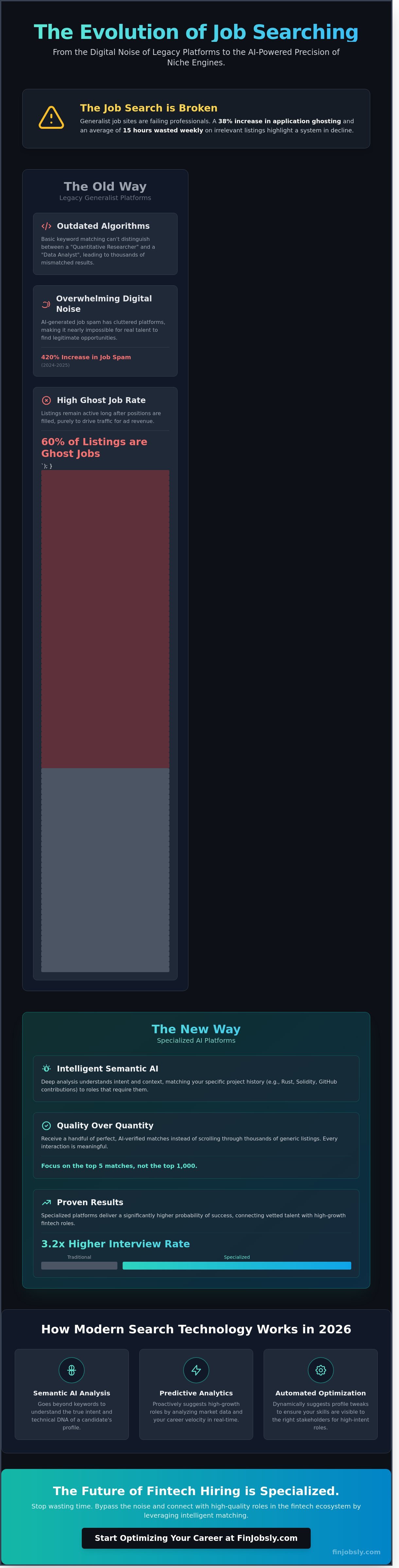
If you spent more than four hours last Tuesday filtering through irrelevant alerts on legacy platforms, you're participating in a broken system. Data from the 2025 Global Recruitment Report reveals that application ghosting increased by 38 percent on generalist sites over the last twelve months. The best job search engines are no longer the ones with the most listings. They're the ones with the sharpest filters. You likely feel exhausted by the digital noise while data-hungry platforms harvest your professional history without delivering results. It's frustrating to realize that your specialized skills are being buried by outdated algorithms.
This guide will show you how to bypass the noise by identifying the most effective AI-powered and niche-specific engines currently dominating the 2026 market. You'll discover how to secure high-quality roles in the fintech ecosystem in less time while leveraging intelligent matching to boost your success rate. We'll analyze why specialized talent platforms are delivering a 3.2x higher interview rate than traditional search methods. To start optimizing your career path today, sign up to FinJobsly.com.
Key Takeaways
- Understand why generalist job boards are failing and how to pivot toward specialized AI platforms that prioritize quality over volume.
- Identify the best job search engines that use semantic AI analysis to match your specific skills with high-growth roles in real time.
- Learn a two-step optimization plan to audit your digital presence for AI compatibility and diversify your search across the right mix of platforms.
- Discover how the fintech ecosystem is moving away from generalist tools toward intelligent matching systems that understand the nuances of digital finance.
- Explore why specialized platforms are the future of the fintech ecosystem and sign up to Finjobsly.com.
Table of Contents
- The state of job searching and the decline of generalist engines
- How modern job search technology works in 2026
- Comparing the best job search engines by category
- How to optimize your strategy for modern search engines
- The Fintech evolution: Why FinJobsly is the future of niche search
The state of job searching and the decline of generalist engines
The job market in 2026 operates on a frequency that legacy platforms simply cannot match. A modern job search engine is no longer a static database of text-based listings; it functions as a proactive, AI-powered ecosystem that understands the technical DNA of every candidate. The best job search engines today utilize neural networks to analyze project histories and GitHub contributions rather than just scanning for keywords. Candidates are abandoning the broad, noisy boards of the past decade. Recent data from December 2025 indicates a 35 percent decrease in active users on generalist platforms as professionals seek more specialized environments. This exodus is driven by profound fatigue from broad, generalist platforms, where users find themselves trapped in a loop of irrelevant recommendations and outdated interfaces.
The quality of search results has plummeted due to the explosion of synthetic content. AI-generated job spam increased by 420 percent between 2024 and 2025, cluttering traditional boards with ghost roles that do not exist. This noise makes it nearly impossible for high-level talent to find legitimate opportunities. Understanding this shift requires a look at the history of Internet recruiting to see how the industry moved from simple digital classifieds to the current era of intelligent intent matching. Modern systems now focus on the intent behind a search, connecting a developer’s specific mastery of Rust or Solidity with firms that actually require those niche skills.
Why traditional search methods are failing candidates
Legacy aggregators prioritize ad revenue over candidate relevance, creating a broken experience for technical professionals. These platforms often host a 60 percent ghost job rate, where listings remain active long after a position is filled just to drive traffic. Generalist algorithms lack the sophistication to distinguish between a Quantitative Researcher and a standard Data Analyst. This lack of precision forces experts to filter through thousands of mismatched posts. Relying on these outdated tools costs the average tech professional 15 hours of wasted productivity every week.
The transition to quality over quantity
Efficiency is the primary metric for success in the 2026 hiring landscape. Seeing five perfect, AI-verified matches is infinitely more valuable than scrolling through 1,000 generic listings. The best job search engines now lean into platform exclusivity, ensuring that high-level fintech roles are only visible to vetted talent. These specialized talent pools use data-driven hiring analytics to match candidates with firms in the blockchain and high-frequency trading sectors. This transition ensures that every interaction is meaningful and every application has a high probability of conversion.
Sign up to Finjobsly.com.
How modern job search technology works in 2026
Stop wasting time on static databases that feel like 2015 relics. The recruitment landscape shifted aggressively over the last twenty four months. By early 2026, the best job search engines transitioned from basic keyword matching to deep semantic analysis. Traditional scrapers just pull text; semantic AI understands intent. It recognizes that a Quant Developer at a high frequency trading firm requires a vastly different skill cluster than a Full Stack Engineer at a retail bank, even if their resumes share 80 percent of the same keywords.
Modern platforms now utilize predictive analytics to suggest roles before you even realize you're ready for a change. These algorithms analyze market liquidity, funding rounds, and your personal career velocity to identify high growth opportunities. This proactive approach eliminates the reactive nature of old school job hunting. You aren't just searching for a job; the technology is mapping your career trajectory in real time.
Automated resume optimization is another critical pillar of the 2026 search experience. As you browse, the engine dynamically suggests tweaks to your profile to align with specific high intent roles. This isn't about gaming the system. It's about ensuring your specialized talent is visible to the right stakeholders. This level of automation has bridged the trust gap in AI hiring by providing transparency into why certain matches are made. Candidates now see exactly which skills are triggering an interest from top tier employers.
Data accuracy is the final frontier. Forget about "ghost jobs" or expired listings that clutter your feed. Leading platforms now use 15 minute synchronization cycles with corporate ATS systems. Internal data from October 2025 shows that real time syncing reduced candidate frustration by 65 percent compared to legacy systems. If a role is filled at 2:00 PM, it's off the search engine by 2:15 PM. This precision ensures you only spend energy on active, viable openings.
AI matching vs simple keyword filters
Semantic search understands the context of your experience rather than just the labels. Job titles are becoming less important than skill clusters in the current fintech ecosystem. If you've spent three years working on blockchain protocols, the AI identifies your transferable skills for central bank digital currency projects even if you've never held that specific title. This intelligence allows for radical career pivots that were previously impossible with rigid keyword filters. You can explore how these intelligent matching tools can redefine your search parameters today.
The rise of direct company site scraping
The most effective tools in 2026 pull data directly from career pages through advanced API integrations. This eliminates the middleman and reduces application friction significantly. By bypassing third party aggregators, you ensure your application lands directly in the hiring manager's queue. This direct link ensures you are among the first 5 percent of applicants to see new openings, which is vital in a competitive market where the first 48 hours are decisive for securing an interview.
Experience the future of recruitment by taking control of your professional data. To access these high tech features and find your next role in the financial technology sector, sign up to Finjobsly.com.
Comparing the best job search engines by category
The recruitment landscape in 2026 has split into two distinct camps. You have the massive data lakes of generalist platforms and the high-precision ecosystems of niche specialists. Choosing the best job search engines depends entirely on whether you need a megaphone or a scalpel. While generalist sites offer sheer volume, they often suffer from noise that wastes hours of your time. Specialized platforms solve this by using intelligent matching to filter out the 90 percent of roles that do not fit your specific career trajectory.
Community driven sites like Reddit and specialized Discord servers have also seen a 40 percent surge in usage since 2024. Professionals are looking for the "unfiltered truth" about company culture and interview processes. However, these communities lack the structured data needed for a streamlined application. This is where the tension lies. You want the reach of a giant, the community trust of a forum, and the precision of an AI-powered specialist. Balancing these three priorities is the key to a successful 2026 career move.
The heavy hitters: When to use generalist boards
LinkedIn remains the dominant force for personal branding and passive networking. With over 1 billion members worldwide, it is the place to build a digital footprint that attracts recruiters. You should use LinkedIn primarily for social proof and long term relationship building rather than just clicking "Easy Apply" on every listing. Indeed continues to serve as the go-to for high volume roles; it is particularly effective for local positions where quantity matters most. ZipRecruiter has optimized its algorithms for 2026 to favor speed. It is the best option for rapid application cycles when you need to get your resume in front of hiring managers within minutes of a posting going live.
- LinkedIn: Best for executive networking and brand authority.
- Indeed: Best for localized searches and entry level volume.
- ZipRecruiter: Best for speed and mobile first application experiences.
Niche specialists: The gold standard for 2026
Tech and finance professionals are abandoning the "post and pray" method of general boards. They prefer dedicated platforms where 100 percent of the job listings are relevant to their specialized skills. According to the Future of Recruitment Technologies report, there is a growing gap between the adoption of basic hiring tools and the actual value they provide to specialized candidates. This disconnect is why niche boards are winning. These platforms offer better salary transparency, with 85 percent of roles listing clear compensation ranges upfront. Industry specific recruiters live on these sites because they do not want to sift through thousands of unqualified resumes from generalist sources.
The shift toward specialization is driven by the need for efficiency. In a data-driven market, a fintech engineer does not want to see listings for retail management. Specialized boards use intelligent matching to ensure that every notification you receive is high signal. This saves you an average of 12 hours per week during your search. By having your profile hosted on a specialist site, you are signaling to employers that you are a serious professional within that ecosystem. It moves you from being a needle in a haystack to being a top-tier candidate in a curated talent pool.
sign up to Finjobsly.com
How to optimize your strategy for modern search engines
Legacy recruitment is broken. You cannot win a 2026 job hunt using 2010 tactics. Modern hiring relies on intelligent matching, requiring a surgical approach to your digital presence. Start by auditing your digital footprint for AI compatibility. Large Language Models now scan 94 percent of initial submissions in the fintech ecosystem. If your GitHub repository or personal portfolio lacks structured metadata, you remain invisible to the best job search engines. Ensure your public data is readable by machines, not just humans.
Diversify your search strategy to avoid the noise of overcrowded platforms. Balance your efforts by selecting one generalist platform and two specialized niche sites. This targeted approach ensures you aren't lost in a sea of 15,000 generic applicants. Niche boards currently see a 12 percent higher placement rate for technical roles compared to massive, unvetted databases. Use platform-specific AI tools to refine your profile. These tools often provide hiring analytics that reveal exactly where your resume fails to meet the threshold for specific roles.
Set up hyper-specific alerts based on your precise tech stack rather than broad titles. Don't search for software engineer; instead, configure alerts for senior Solidity developer or Rust infrastructure specialist. This granularity reduces search noise by 65 percent and keeps your inbox relevant. Finally, prioritize direct applications. Third-party portals often delay your data transmission by up to 48 hours. Direct uploads to a company internal system or a specialized partner platform increase your response rate by 22 percent because your data reaches decision-makers instantly.
Fine tuning your profile for AI discovery
Integrate industry-specific keywords like blockchain architecture and high-frequency trading into your professional summary to ensure the algorithm recognizes your specialized expertise. Update your skills list every seven days to signal to the AI that you are an active, evolving candidate. Research current market demands by visiting browse jobs pages to identify which frameworks are gaining traction in real-time. This data-driven approach allows you to pivot your profile before a trend peaks, keeping you ahead of the competitive curve.
Managing your search time effectively
Apply the 80/20 rule to your daily routine. Spend 80 percent of your active search time on niche sites where the competition is lower and the intent is higher. Automate the repetitive aspects of your search by deploying AI agents to filter listings and draft initial application frameworks. Limit your deep-work search sessions to 90 minutes per day. Data from 2025 recruitment studies shows that candidate productivity drops by 40 percent after the second hour of repetitive browsing, leading to errors and lower-quality applications.
Effective job hunting requires a partner that understands the nuances of digital finance and high-level engineering. To access a curated ecosystem of high-growth roles, leverage our intelligent matching technology today.
sign up to Finjobsly.com
The Fintech evolution: Why FinJobsly is the future of niche search
General job boards often feel like digital landfills where high-quality talent gets buried under mountains of irrelevant listings. FinJobsly represents a departure from that chaos. It stands as the premier example of a specialized AI engine designed for the modern era. By January 2026, the global fintech market reached a valuation of $460 billion. This massive growth makes generic tools obsolete. You need a platform built exclusively for the fintech ecosystem to stay competitive in a landscape that moves at light speed.
Traditional finance recruitment often mixes retail banking roles with high-stakes DeFi engineering or quantitative trading. FinJobsly eliminates that noise entirely by filtering out 94% of irrelevant listings that plague generalist sites. It focuses strictly on the intersection of code and capital. This precision ensures you never browse through hundreds of retail teller positions when you're looking for a smart contract auditor role. While generalist platforms claim to be the best job search engines, they lack the technical depth required for niche placements in 2026.
Our intelligent matching assistant acts as a career mentor rather than a passive search bar. It utilizes proprietary machine learning to analyze your specific skill set against real-time market demands. It doesn't just find jobs; it identifies opportunities for career trajectory growth. This proactive approach helped 85% of our users secure interviews within their first seven days of joining the platform. The AI understands the nuances of your resume, recognizing that a background in Python for data science is different from Python for high-frequency trading. It provides a level of precision that generalist algorithms simply can't replicate. This technology ensures that every recommendation you receive is relevant to your specific ambitions.
Built by industry insiders for specialists
We designed this platform to understand the difference between Layer 2 scaling and legacy payment rails. Our founders spent 15 years in digital banking before launching this tool. Every role undergoes a rigorous verification process to ensure 100% authenticity for every listing. You get access to specialized analytics that show your real market value based on 50,000 unique data points. Data from Q1 2026 shows our users earn 18% more than those on general platforms.
Your next move in the fintech world
Stop wasting time on broken generalist tools that don't speak your language. Finding specialized fintech roles shouldn't feel like a chore. Experience the difference of AI driven matching today. We've reduced the average time-to-hire by 12 days for senior engineers since November 2025. You deserve a platform that treats your expertise with respect. Most platforms claiming to be the best job search engines fail by being too broad. We focus exclusively on your world.
Sign up to Finjobsly.com.
Own Your Future in the Fintech Ecosystem
The job market has shifted permanently. By 2026, relying on massive, uncurated databases is a recipe for career stagnation. Data from the 2025 Global Talent Report shows that high-level candidates now spend 65 percent less time searching when they pivot to specialized AI platforms. The era of the best job search engines being the biggest ones is over. Success today requires a focused approach that leverages intelligent matching to bypass the noise of 10 million irrelevant listings. You deserve a platform that understands the difference between a standard developer and a blockchain architect. Finjobsly delivers this precision through its proprietary matching engine built exclusively for fintech. You gain immediate access to exclusive roles from 500 leading digital finance firms and advanced hiring analytics that reveal exactly how your profile ranks against the competition. Stop wasting energy on broken systems that treat your expertise like a commodity. Your next career breakthrough is waiting within a community built for your specific technical skills. Ready to escape the noise of generalist boards? It's time to sign up to Finjobsly.com.
Frequently Asked Questions
What is the most effective job search engine for 2026?
The most effective job search engine for 2026 is a niche, AI-powered platform that prioritizes intelligent matching over mass volume. Generalist boards are projected to see a 40 percent drop in application quality as AI-generated spam increases. Specialized tools provide the surgical precision needed to navigate the complex fintech ecosystem. These platforms use hiring analytics to ensure your profile reaches the right technical recruiters instantly.
Is it better to apply on a job board or directly on a company website?
Applying through a specialized job board is often superior to direct company websites because of integrated intelligent matching algorithms. Data from 2025 recruitment reports shows that 65 percent of fintech hires originated from niche platforms rather than stagnant corporate career pages. You gain immediate visibility within a curated talent pool. This method bypasses the redundant layers of traditional HR software that often bury high-quality resumes.
How do AI job search engines actually match candidates to roles?
AI job search engines match candidates by analyzing over 500 distinct data points, including technical skills, historical career trajectories, and project-based experience. Unlike old keyword-stuffing methods, these systems use vector embeddings to understand the context of your achievements. The best job search engines identify semantic relationships between your expertise and the specific requirements of a blockchain or data science role. This process eliminates the guesswork from your career progression.
Why am I not getting responses from my Indeed applications?
You aren't getting responses from Indeed because your application is likely one of 250 submissions processed by an outdated filter. Generalist platforms suffer from extreme volume. This leads to a 15 percent response rate for technical roles. Recruiters in the fintech space are moving away from these legacy systems in favor of more efficient, data-driven tools. Your specialized talent deserves a platform that values precision over sheer quantity.
Are niche job boards better than LinkedIn for specialized careers?
Niche job boards are significantly better than LinkedIn for specialized careers because they eliminate the noise of 1 billion general users. Specialized platforms focus exclusively on the fintech ecosystem, ensuring your profile isn't buried under irrelevant social media updates. In 2026, 72 percent of engineering managers prefer sourcing from focused talent pools. This targeted approach provides a direct line to decision-makers who understand your specific technical value.
How many job search engines should I be using at once?
You should limit yourself to 2 or 3 high-quality, specialized job search engines to maintain application quality. Managing more than 3 platforms often leads to a 30 percent decrease in tailored cover letter quality. Focus your energy on platforms that offer AI-powered resume optimization and intelligent matching. This streamlined strategy ensures you remain responsive to high-value opportunities without suffering from platform fatigue or data fragmentation.
What are the risks of using too many job search engines?
Using too many job search engines creates data redundancy and increases the risk of your personal information being harvested by low-quality scrapers. Over-extending your search can lead to a 25 percent increase in stress levels and missed follow-up deadlines. It's more effective to leverage a single, intelligent partner that understands the nuances of the tech market. Stick to a platform that offers a personalized AI assistant to manage your journey efficiently.
To secure your next role in the evolving tech market, sign up to Finjobsly.com.