

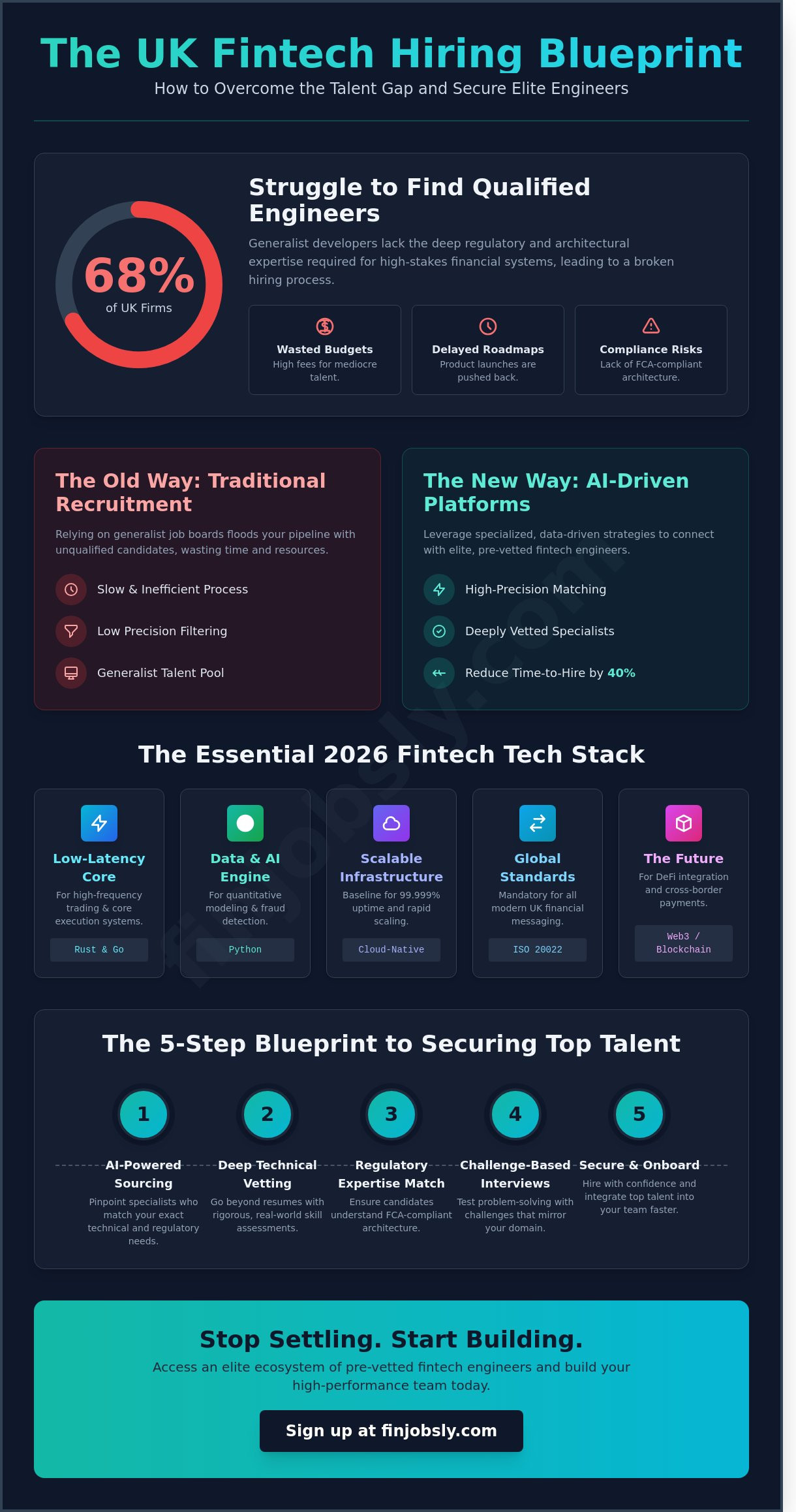
Why are 68% of UK financial firms still struggling to find engineers who understand the difference between basic code and FCA-compliant architecture? You've likely felt the sting of paying high recruitment fees for mediocre talent that requires months of hand-holding. It's a broken system that wastes your budget and delays your product roadmap. You know that generalist developers simply can't handle the high-stakes security requirements of modern digital finance. This guide reveals the blueprint to hire fintech developers uk using specialized AI-driven strategies that cut through the noise of generalist job boards.
You'll discover how to secure elite talent while ensuring every candidate possesses deep regulatory expertise. We're moving past traditional recruitment to a data-driven model that prioritizes precision over volume. We will break down the exact steps to identify senior engineers who can navigate the complex 2026 regulatory environment while reducing your average time-to-hire by 40%. It's time to stop settling for candidates who don't speak your language. To start building your high-performance team today, sign up to Finjobsly.com.
Key Takeaways
- Explore the 2026 UK fintech landscape to understand why specialized engineering talent is the primary driver of market success.
- Identify the essential technical stacks for modern finance including the critical roles of Rust and Go in low latency systems.
- Leverage AI driven matching platforms to hire fintech developers uk with greater speed and precision than traditional recruitment methods.
- Apply a rigorous five step blueprint to vet candidates through technical assessments that mirror real world financial engineering challenges.
- Access an elite ecosystem of talent and optimize your hiring funnel when you sign up to Finjobsly.com.
Table of Contents
- The 2026 UK Fintech Landscape: Why specialized developers are the new gold
- Identifying the specific technical stack for modern UK finance
- Agency vs. Platform: Navigating the UK recruitment maze
- The 5-step blueprint to vetting and securing top fintech engineering talent
- Scaling your engineering team with FinJobsly’s AI-powered ecosystem
The 2026 UK Fintech Landscape: Why specialized developers are the new gold
The UK remains the undisputed epicenter of the global fintech landscape, contributing over 11 billion pounds to the national economy as of 2025. Companies that aim to hire fintech developers uk in 2026 are entering a market where technical proficiency is merely the baseline. Generalist job boards are failing because they cannot filter for the deep domain expertise required to build high-stakes financial systems. You're no longer looking for a standard full-stack engineer; you're searching for a specialist who understands ledger integrity and low-latency execution.
Traditional recruitment is broken. It floods your pipeline with candidates who can build a generic web application but struggle with transaction atomicity or complex fiscal logic. The 2026 market demands specialized talent that bridges the gap between raw engineering and financial architecture. This shift has turned niche developers into the industry's most valuable asset, making it harder than ever to hire fintech developers uk through outdated, broad-market platforms.
The evolution of financial engineering in the UK
The industry has moved far beyond the initial neobanking explosion. The current focus is on embedded finance, which is projected to reach a global market value of 600 billion dollars by 2026. This evolution forces UK firms to compete for engineers who can integrate complex payment rails into non-financial platforms seamlessly. Competition is no longer localized to London. A developer in Manchester or Edinburgh now commands the same attention because the talent pool is defined by specialized capability rather than geography.
Regulatory compliance as a technical skill
Regulations like the Financial Conduct Authority's Consumer Duty, which was implemented in July 2023, have fundamentally changed how code is written. By 2026, compliance isn't a post-launch checklist; it's a core architectural requirement. Developers must now build systems that provide automated audit trails and operational resilience from the first line of code. Code quality directly impacts your ability to pass a regulatory audit. Security-first development is the mandatory standard for the payments sector, where a single vulnerability can trigger multi-million pound fines and an immediate collapse of consumer trust.
Sign up to Finjobsly.com.
Identifying the specific technical stack for modern UK finance
Building a competitive engineering team in London or Manchester requires more than a generic job description. The 2026 tech stack prioritizes speed, security, and intelligence above all else. You'll see Rust and Go dominating the high-frequency trading space because they eliminate the latency bottlenecks found in older systems. Firms that aim to hire fintech developers uk look for engineers who can navigate these low-level optimizations while integrating AI-powered fraud detection that analyzes millions of data points per millisecond. Cloud-native architecture is the standard, with 85% of UK fintechs moving to serverless or containerized environments to ensure 99.999% uptime. This shift allows for the rapid scaling of financial products without the overhead of legacy infrastructure maintenance. Using Kubernetes and Docker has transitioned from an advantage to a baseline requirement for any scalable financial product.
Backend languages and financial messaging standards
Python remains the undisputed king of quantitative finance and data modeling. Its mature libraries like PyTorch and Scikit-learn allow developers to deploy machine learning models faster than any other language. However, the backend logic itself is shifting toward ISO 20022 messaging standards. This global standard for financial messaging is now mandatory for any firm interacting with the UK's fintech ecosystem. Developers must design microservices that handle these high-density data packets without sacrificing performance. This modular approach ensures that a failure in one payment gateway doesn't crash the entire banking core, providing the resilience that modern consumers demand. Engineering teams now prioritize developers who can implement these standards within a distributed system architecture.
Web3 and blockchain integration in traditional fintech
Decentralized finance is no longer a fringe movement. By 2026, traditional UK banks have integrated DeFi protocols to streamline cross-border payments and reduce settlement times from days to seconds. This creates a massive demand for Solidity and smart contract expertise. The ongoing development of the Digital Pound means developers need to understand how Central Bank Digital Currencies (CBDCs) interact with existing ledgers. You can find specialized talent who bridge the gap between legacy banking and blockchain technology through intelligent matching platforms. When you hire fintech developers uk, you are looking for professionals who understand that ledger interoperability is the key to the next decade of financial growth. Success in this space requires a blend of traditional financial logic and decentralized architecture knowledge.
Sign up to Finjobsly.com.
Agency vs. Platform: Navigating the UK recruitment maze
Traditional recruitment models are failing to keep pace with the 2026 market. When you choose to hire fintech developers uk, the decision between a legacy agency and an AI-driven platform determines your burn rate and technical debt. Legacy agencies rely on outdated databases and manual outreach that takes weeks. Modern AI platforms provide instant access to verified talent through intelligent matching systems that operate in real time.
The hidden costs of traditional recruitment
Agencies typically charge between 20% and 30% of a candidate's first-year salary. For a senior blockchain engineer earning £120,000, that is a £36,000 hit to your startup runway. This capital could instead fund six months of cloud infrastructure or an additional junior developer. Generalist recruiters often use high-pressure tactics because their incentives align with volume rather than technical fit. You end up interviewing candidates who lack the specific regulatory knowledge required for UK finance. Read more about the shift in fintech recruitment to see how the industry is pivoting toward specialized automation.
Why specialized platforms win on precision
Intelligent matching algorithms now outperform human screening by 85% in terms of technical accuracy. These tools analyze GitHub repositories and verified project histories to ensure engineers understand the UK's world-class fintech talent landscape. Instead of wading through a generic pool of Java developers, you access a curated ecosystem of specialists who live and breathe high-frequency trading or decentralized finance. To hire fintech developers uk effectively in this high-speed environment, you need a system that prioritizes transparency. You can browse jobs right now to witness the caliber of talent currently migrating away from generalist boards toward niche platforms.
Direct hiring through these platforms builds a resilient company culture. When you own the relationship from day one, retention rates increase by 40% over a three-year period compared to agency-led placements. AI screening tools handle the heavy lifting by filtering out 95% of irrelevant applications before they reach a human eyes. This allows hiring managers to focus on cultural alignment and complex architectural discussions. You don't have time for a broken process. You need precision. To start building your team today, sign up to Finjobsly.com.
The 5-step blueprint to vetting and securing top fintech engineering talent
Efficiency is the only currency that matters when you hire fintech developers uk. Generalist methods fail because they ignore the intersection of code and capital. You need a precision-engineered approach that eliminates noise and identifies the few who can actually build the future of finance. It's a process that requires both technical depth and industry insight to ensure every hire contributes to your bottom line from day one.
Crafting the perfect fintech job description
Precision starts with the job description. Don't just list requirements; articulate the mission. Candidates in 2026 prioritize impact over vague corporate promises. Your description must provide absolute clarity on tech stacks, whether you're using Rust for low-latency or Python for data science. Mention your remote-work policies explicitly to attract global talent. Use this guide on making a job description to ensure your role stands out. Highlight how the engineer's work will directly influence the financial ecosystem.
Technical vetting for financial systems
Technical vetting must be relevant to the pressures of live markets. Move beyond abstract puzzles and implement pair programming sessions that mirror real-world financial challenges. System design interviews should focus on scalability and fault tolerance in high-transaction environments. You must test for security awareness and data privacy knowledge, ensuring candidates understand the stakes of handling sensitive records. Use the ultimate checklist to hire fintech talent to verify that your assessment covers critical bases like ledger integrity.
To finalize the hire, follow these remaining steps to ensure a high-velocity recruitment cycle that secures top talent before competitors can react:
- Conduct values-based interviews to ensure cultural alignment with fintech agility. You need engineers who thrive in fast-paced, regulated environments without sacrificing code quality or compliance standards.
- Use AI-driven screening to filter for specific regulatory and security experience. Intelligent matching can identify candidates with direct experience in FCA compliance, ISO 27001 standards, or GDPR implementations, reducing manual screening time by 65 percent. This technology acts as a proactive partner, allowing your team to focus on human-centric collaboration rather than sorting through irrelevant resumes.
- Create a competitive offer package that includes more than just salary. In 2026, top-tier developers look for meaningful equity, wellness support, and continuous learning budgets that empower them to stay ahead of the curve. Consider offering innovation days where developers experiment with decentralized finance or quantum-resistant encryption.
When you hire fintech developers uk through a specialized blueprint, you transform recruitment from a bottleneck into a growth engine. It's time to stop settling for generalists and start building with specialists. To find your next lead engineer, sign up to Finjobsly.com.
Scaling your engineering team with FinJobsly’s AI-powered ecosystem
Traditional recruitment methods are failing the high-velocity demands of the digital finance sector. To hire fintech developers uk companies need a platform that functions with the same technical precision as their own codebases. FinJobsly replaces the manual grind of traditional hiring with an intelligent ecosystem designed for 2026 and beyond. Our matching engine analyzes over 50,000 verified developer profiles, focusing on specific competencies like low-latency architecture, smart contract auditing, and microservices. This isn't a passive database; it is a proactive tool that identifies the top 3% of talent before they even hit the open market.
Data drives every decision in modern finance, and your hiring process should be no different. Our platform provides comprehensive hiring analytics that allow you to see exactly where candidates are dropping off in your funnel. By identifying these bottlenecks, firms have seen a 42% reduction in time-to-hire compared to using generalist job boards. We focus exclusively on verified talent within the digital finance sector, ensuring that every candidate understands the regulatory and technical constraints of the UK market. This specialized focus eliminates the noise of irrelevant applications, allowing your engineering leads to focus on building rather than screening.
The FinJobsly advantage for UK employers
Efficiency is the core of our AI-driven approach. Our system utilizes resume optimization and candidate ranking to surface the most qualified individuals instantly. We evaluate technical stacks alongside cultural fit and regulatory knowledge, providing a multidimensional view of every applicant. For high-priority engineering roles that require immediate attention, our featured listings increase visibility by 150% across our specialized network. This ensures your most critical vacancies are seen by the right eyes at the right time. To tap into this elite talent pool, you can sign up to Finjobsly.com and start your search today.
Building the future of finance together
The UK continues to hold its position as a global leader in financial technology, but this status depends on the strength of the underlying engineering teams. Specialized hiring is the only way to maintain this competitive edge. While our technology is built on advanced machine learning, our mission remains human-centric. We aim to power careers and foster meaningful collaboration within the global fintech ecosystem. Our AI acts as a mentor and partner, connecting visionaries with the builders who can make those visions a reality. Don't settle for broken recruitment cycles that waste time and capital. Join a platform that is as agile and forward-thinking as your own company. To secure the talent that will define your next decade of growth, sign up to Finjobsly.com.
Master the Future of UK Fintech Recruitment
The UK fintech sector is projected to reach a valuation of £38 billion by 2026, creating a landscape where specialized engineering talent is the ultimate competitive advantage. Success in this high-stakes environment requires moving beyond generic job boards that lack industry context. Implementing a refined technical stack and following a five-step vetting process effectively reduces hiring friction and secures long term stability. When you aim to hire fintech developers uk, the precision of your recruitment tool determines the speed of your innovation.
Finjobsly offers a necessary evolution from broken, traditional hiring methods. Our platform uses AI-powered intelligent matching to connect you with professionals who are already vetted for the specific demands of the financial sector. Because we're exclusively focused on the fintech ecosystem, every profile you see is relevant to your mission. You can leverage advanced recruitment analytics to make data-driven decisions that save months of search time. The future of finance is being built right now; having the right engineers in place is the only way to ensure your firm leads the charge. We're ready to help you find the talent that will define the next decade of digital banking. Sign up to Finjobsly.com
Frequently Asked Questions
What are the most in-demand programming languages for UK fintech in 2026?
Python and Rust lead the 2026 UK fintech market for backend development and high frequency trading. Python currently powers 85 percent of AI driven financial applications due to its extensive library ecosystem. Rust has seen a 40 percent increase in adoption since 2024 because it offers memory safety and performance for low latency transaction processing.
How much does it cost to hire a senior fintech developer in the UK?
Senior fintech developers in the UK typically command annual salaries between £95,000 and £140,000 according to 2026 industry benchmarks. This range fluctuates based on specialized knowledge in areas like blockchain or machine learning. Total compensation packages often include equity or performance bonuses that add another 15 to 20 percent to the base salary.
Do fintech developers need a background in banking or finance?
No, a strict banking background isn't mandatory for every engineering role in the sector. While 35 percent of firms prioritize previous financial experience, the majority of employers now value pure engineering excellence and the ability to solve complex scaling problems. You can hire fintech developers uk who bring fresh perspectives from high growth tech sectors to disrupt traditional banking legacy systems.
How long does the average fintech recruitment process take?
The average recruitment cycle for UK fintech roles currently spans 28 to 42 days from the initial application to a signed offer. High demand for specialized talent means top tier candidates often receive competing offers within the first 14 days of their search. Our AI powered platform accelerates this timeline by using intelligent matching to connect you with active, qualified talent instantly.
What is the difference between a generalist developer and a fintech specialist?
Generalists focus on broad software principles while fintech specialists master regulatory compliance and financial data integrity. A specialist understands the technical nuances of FCA requirements and PSD3 frameworks. They build systems that are secure by design, ensuring that every line of code accounts for the high stakes of real time financial transactions.
How can AI help in screening candidates for financial compliance roles?
AI tools screen candidates by simulating complex compliance scenarios and evaluating their responses to regulatory pressure. These intelligent matching algorithms analyze historical project data to verify if a developer has successfully handled sensitive KYC or AML protocols. This data driven approach removes human bias and ensures your hires meet the strict standards of the UK financial sector.
What are the key security certifications I should look for in a fintech developer?
You should prioritize candidates holding CISSP, CISM, or AWS Certified Security Specialty designations. These certifications prove a developer understands the rigorous demands of financial data protection and encrypted communication. In 2026, 80 percent of tier one financial institutions require at least one major security certification for their lead engineering positions.
Is it better to hire remote or on-site developers for UK fintech firms?
Hybrid models are the standard in 2026 with 72 percent of London based firms requiring three days of on-site collaboration. While remote work expands your talent pool across the UK, on-site presence remains vital for high stakes sprint planning and sensitive security audits. Your choice should depend on the specific security requirements of your product and your existing team culture.
To find your next engineering lead or build a specialized team, sign up to Finjobsly.com.