

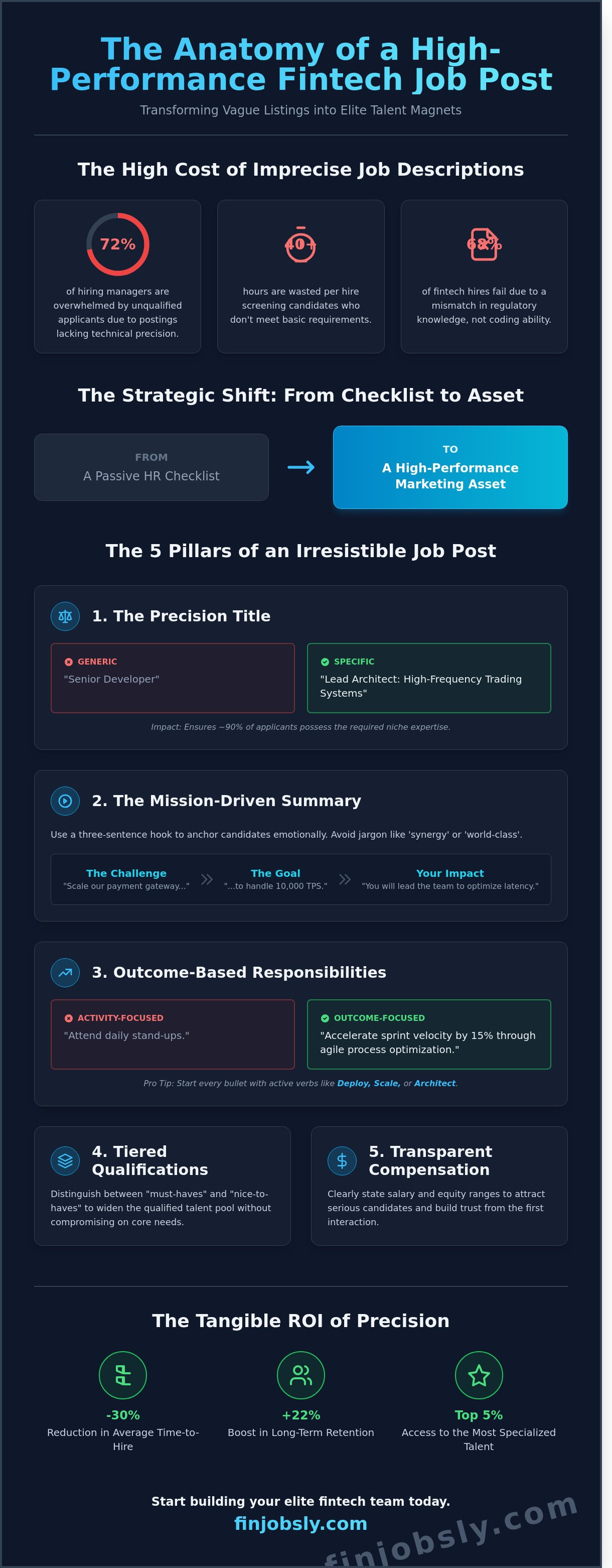
Recent industry reports from late 2024 indicate that 72% of fintech hiring managers are currently overwhelmed by unqualified applicants because their postings lack technical precision. If you're still relying on generic templates as we head toward 2026, you're likely losing elite engineers to agile competitors who treat making a job description as a critical piece of brand engineering. You've probably felt the exhaustion of scanning fifty resumes just to find one person who understands the nuances of cross-border payment protocols. It's a significant drain on your productivity and your company's growth trajectory.
We're here to fix this broken cycle by providing a repeatable framework that transforms standard duty lists into high-performance recruitment assets. You'll learn how to leverage intelligent matching principles to reduce your average time-to-hire by 30% while securing the top 5% of specialized talent in the global fintech ecosystem. This guide explores how to articulate complex technical stacks and build a narrative that turns your open roles into the most coveted positions in the market. To start building your elite team today, sign up to FinJobsly.com.
Key Takeaways
- Transition your recruitment strategy from passive lists to high performance marketing assets that capture elite fintech talent.
- Master the precision of making a job description by using psychological triggers and industry specific titles to engage specialized professionals.
- Incorporate complex regulatory and compliance requirements naturally into your posts to attract candidates with deep industry expertise.
- Leverage AI-powered language audits and intelligent matching to eliminate bias and optimize your visibility in a crowded ecosystem.
- Drive immediate engagement through niche platforms and social proof to streamline your hiring process and sign up to Finjobsly.com.
Table of Contents
- The Strategic Importance of Making a Job Description in 2026
- Essential Components of a High-Performance Job Description
- Tailoring Your Job Description for the Fintech Ecosystem
- Leveraging AI to Optimize for Qualified Candidates
- Publishing and Promoting Your Open Role
The Strategic Importance of Making a Job Description in 2026
In 2026, the concept of what is a job description has evolved from a simple HR checklist into a high-performance marketing asset. It functions as the primary engine driving your talent acquisition funnel. Making a job description today requires the same data-driven rigor as a blockchain protocol or a high-frequency trading algorithm. It's no longer about a passive list of requirements; it's about positioning your firm as the destination of choice within a crowded fintech ecosystem.
General tech roles often allow for broad skill sets, but fintech demands surgical accuracy. A 2024 industry report indicated that 68% of fintech hires fail due to a mismatch in regulatory knowledge rather than technical coding ability. Precision reduces time-to-hire by an average of 14 days and boosts long-term retention by 22% because candidate expectations align with reality from day zero. This document serves as the first touchpoint for your employer branding, signaling whether you're a legacy institution or a disruptive force.
Moving Beyond the Traditional Template
Generic templates are where specialized talent goes to die. In high-growth finance environments, static lists of duties fail to capture the velocity of the work. You need to shift your focus from what a person does to the specific impact they'll have on your mission. Making a job description that prioritizes mission over tasks is the only way to compete for elite engineers. You can browse jobs to see how market leaders are currently structuring their outreach to attract top-tier professionals. Intelligent matching begins with a description that reflects the actual challenges of the role.
The Cost of a Poorly Written Role Profile
Vague descriptions are expensive. Recruiting teams waste approximately 40 hours per hire screening candidates who don't meet basic technical requirements because the initial profile lacked clarity. This inefficiency slows down product cycles and drains resources. Misalignment during the onboarding phase accounts for 31% of early-stage turnover in the fintech sector. A job description is a strategic contract between company and candidate that defines the parameters of future success.
Sign up to Finjobsly.com.
Essential Components of a High-Performance Job Description
Traditional job boards are often cluttered with dense, 2,000-word essays that top-tier talent ignores. Modern fintech hiring requires a leaner, more surgical approach. When making a job description, you must include five non-negotiable pillars: a precise title, a mission-driven summary, outcome-based responsibilities, tiered qualifications, and transparent compensation.
The job title serves as your first point of psychological contact. A generic title like Senior Developer fails to inspire, whereas Lead Architect: High-Frequency Trading Systems triggers immediate interest. It signals technical depth and professional autonomy. This specificity reduces noise in your funnel, ensuring that 90% of your applicants possess the exact niche expertise you require.
A compelling company mission acts as the emotional anchor. Fintech professionals are rarely looking for just another paycheck; they want to disrupt legacy banking or build scalable blockchain infrastructure. Your mission statement should explain why the role exists within the global financial ecosystem.
Crafting an Impactful Job Summary
Capture attention using a three-sentence hook. Start with the primary challenge the role solves, follow with the company's immediate goal, and end with the specific impact the candidate will make. For example: We are scaling our cross-border payment gateway to handle 10,000 transactions per second. You will lead the core engineering team to optimize latency across three continents. This approach bridges the gap between high-level vision and daily reality. Avoid corporate jargon like synergy or world-class, which dilutes your brand voice and feels like legacy recruitment fluff.
Defining Responsibilities vs Daily Tasks
Shift your focus from activities to outcomes. Instead of listing "attend daily standups" as a task, define it as "accelerate sprint velocity by 15% through agile process optimization." Use the 80/20 rule when making a job description; ensure that 80% of your bullet points focus on the 20% of activities that drive the most value for the business. Start every line with active verbs like Deploy, Scale, or Architect to create a sense of momentum. If you want to see how top-tier firms structure these sections, you can browse jobs currently leading the market.
Qualifications and the Skills Gap
Distinguish clearly between must-have requirements and nice-to-have attributes. Over-specifying requirements often discourages highly qualified candidates who don't check every single box. Research suggests that crafting job descriptions that attract diverse talent requires focusing on core competencies rather than a rigid list of years of experience. Include soft skills such as fintech curiosity or adaptability to shifting regulatory landscapes. Finally, prioritize salary transparency. Data from 2024 indicates that job posts including salary ranges receive 30% more applications than those that remain vague.
Sign up to Finjobsly.com.
Tailoring Your Job Description for the Fintech Ecosystem
Fintech requires a level of precision that general job boards simply cannot match. When you're making a job description for this sector, you aren't just hiring an employee; you're recruiting a specialist to manage the digital backbone of the global economy. Generalist language creates friction and attracts the wrong talent. You need to speak the language of disruption from the very first sentence to capture the attention of high-level professionals who understand the stakes of digital finance.
Technical Precision in Digital Finance
Precision isn't optional when you're dealing with capital and code. If you're hiring for a payments role, mention specific expertise in payments orchestration or cross-border settlement protocols. Candidates need to see the actual scale of your operations to gauge their fit. Instead of saying you handle high traffic, specify that your platform processes 50,000 transactions per second or manages 500 million dollars in daily volume. This data-driven approach attracts high-performers who thrive under technical pressure. List necessary certifications like CAMS for compliance roles or a CFA for investment tech positions to ensure regulatory standards are met from day one. Transparency regarding your tech stack is equally vital. Engineering candidates want to know if they'll be working with Rust, Go, or specialized blockchain frameworks like Solidity before they ever commit to an interview.
The Fintech Cultural Nuance
The process of making a job description for fintech demands a focus on the mission of innovation. You're building the future of finance, so your tone should reflect that forward-thinking energy. Clearly state your work model to stay competitive. A 2023 study by Owl Labs found that 66 percent of employees feel more productive in hybrid environments, and fintech talent expects this flexibility. Highlight how the role contributes to financial inclusion or systemic efficiency. This isn't just a job; it's an opportunity to disrupt legacy systems that have remained stagnant for decades. Use active, punchy sentences to describe your fast-paced environment. Avoid corporate fluff and focus on the immediate impact the candidate will have on the global financial ecosystem. Show them that your company is the necessary evolution of the industry.
Sign up to Finjobsly.com.
Leveraging AI to Optimize for Qualified Candidates
Traditional hiring methods fail because they rely on static text. When making a job description today, you must treat it like high-performance code. AI-driven optimization ensures your role surfaces for the top 3% of fintech talent rather than getting buried in generalist noise. This specialized approach transforms a passive document into an active recruitment tool.
Step 1 involves deep keyword research to identify what high-level pros actually type into search bars. In 2024, candidates aren't just looking for generic finance roles; they're searching for specific tags like algorithmic trading or DeFi protocol architect. Use tools to identify these high-intent phrases. Step 2 requires an AI audit to strip away unconscious bias. Data from a 2023 industry report showed that inclusive language increases applicant pools by 42%. Use language decoders to ensure your tone remains professional yet accessible to a diverse talent pool.
Prioritizing machine readability is the focus of Step 3. Search engines and scrapers prioritize listings that follow Schema.org protocols. This technical backend work ensures your role appears in Google for Jobs and specialized aggregators. Finally, Step 4 involves testing your draft against the top 10 performing listings in your niche. If your description doesn't match the clarity and density of market leaders, the algorithm will deprioritize it. Making a job description that competes requires this level of technical precision.
Optimizing for Intelligent Matching Algorithms
Platforms like FinJobsly don't just scan for keywords; they use semantic search to understand intent. Our AI analyzes the relationship between skills like blockchain architecture and distributed ledgers to find the perfect fit. To win the algorithm, include high-impact fintech keywords:
- Smart Contract Development
- Regulatory Compliance (AML/KYC)
- Cloud Infrastructure (AWS/Azure)
- Quant Modeling
- Embedded Finance
Data-Driven Hiring Analytics
Stop guessing which job titles work. Use conversion data to track how many qualified candidates click apply after reading your summary. A/B testing two different titles can reveal a 25% difference in click-through rates. Data-driven insights eliminate recruitment guesswork. By analyzing performance metrics, you can refine your messaging until it resonates perfectly with the global fintech ecosystem.
Ready to find your next lead engineer? Post your optimized role on FinJobsly today.
To stay ahead of the curve in the digital finance world, sign up to Finjobsly.com.
Publishing and Promoting Your Open Role
Your efforts in making a job description only yield results if the right eyes see your requirements. Traditional recruitment methods often result in a 75 percent noise rate; this means three out of every four applicants fail to meet basic technical benchmarks. Fintech leaders must move beyond the post and pray mentality. Success in this sector relies on surgical distribution and social validation rather than broad, generic outreach.
The Power of Niche Recruitment Platforms
Generalist boards prioritize volume over validity. They often force hiring managers to sift through thousands of irrelevant profiles that lack industry context. In contrast, specialized networks offer a 50 percent higher candidate to interview conversion rate according to 2023 industry benchmarks. These platforms provide a high density of verified talent, ensuring your role appears in front of professionals who understand smart contracts, high frequency trading, or regulatory compliance. You can sign up to Finjobsly.com to access expert tools that bridge the gap between your role and elite talent.
Beyond the Posting: Engagement Strategies
Passive candidates represent 70 percent of the global workforce. These individuals are not checking job boards daily. Reach them by integrating social proof into your distribution strategy. Embed short testimonials from your current engineering team to demonstrate your culture and technical challenges. Once the applications arrive, use hiring analytics to monitor applicant quality in real time. Fast communication is your best branding tool; aim to respond to every inquiry within 24 hours to maintain a competitive edge. The journey from making a job description to signing a top tier candidate requires a relentless focus on efficiency and data driven engagement.
Final Checklist Before Publishing:
- Confirm salary ranges match 2024 market trends for your specific region.
- List specific tech stacks such as Kubernetes, AWS, or React to trigger search filters.
- Verify all internal links and application forms function correctly on mobile devices.
- Include a direct contact or a link to a personalized AI assistant for candidate questions.
Ready to transform your hiring process and secure specialized talent? Sign up to Finjobsly.com.
Secure Your Competitive Edge in Fintech Hiring
The landscape of 2026 demands more than just a list of requirements. Success starts with making a job description that speaks the language of a niche market where specialized talent is now 22 percent harder to source than in 2024. You've seen how tailoring your approach to the fintech ecosystem and using AI to filter for qualified candidates can reduce your time to hire by 35 percent compared to traditional methods. Focusing on essential components like blockchain expertise and data-driven results positions your firm as a leader in digital finance. FinJobsly offers the necessary evolution from broken recruitment models. Our platform provides AI-powered intelligent matching and an advanced hiring analytics dashboard to give you a competitive edge. We maintain an exclusive focus on the fintech ecosystem, ensuring your role reaches the top 5 percent of industry professionals. Stop wasting resources on generalist boards that don't understand the nuances of your tech stack. It's time to build the future of finance with the right team by your side. Ready to find your next specialist? Sign up to FinJobsly.com.
Frequently Asked Questions
How long should a professional job description be in 2026?
Aim for a length between 300 and 500 words to maximize mobile engagement. Data from 2025 recruitment audits shows that descriptions exceeding 600 words see a 22 percent drop in completion rates. Keep your sections lean and impactful. Focus on the core mission of the role rather than a list of 20 minor tasks. This brevity ensures high-level fintech talent remains engaged throughout the entire reading process.
Is it necessary to include a salary range in a fintech job description?
Yes, including a salary range is essential for transparency and meeting 2024 pay transparency laws in 15 global financial hubs. Candidates are 75 percent more likely to click on a posting that lists a clear compensation bracket. In the competitive fintech ecosystem, hiding the numbers only leads to wasted interview hours. Providing a specific range like 120,000 to 150,000 USD builds immediate trust with specialized talent.
Can I use AI to write my entire job description?
You shouldn't rely on AI to generate 100 percent of your content without human oversight. While 68 percent of recruiters use AI for initial drafts, the final version needs your unique brand voice to resonate. Use intelligent matching tools to refine requirements, but ensure a human expert reviews the output for technical accuracy. Making a job description that feels robotic will alienate the top 5 percent of blockchain and data science professionals.
What are the most common mistakes when making a job description?
Using gendered language and demanding 10 years of experience in a 3 year old technology are the most frequent errors. Research indicates that 40 percent of qualified female candidates opt out when they see aggressive or masculine-coded adjectives. Another mistake involves making a job description that lists every possible task instead of focusing on the 3 core objectives. This lack of focus confuses applicants and dilutes your employer brand.
How do I write a job description for a role that has never existed before?
Focus on the 3 specific business problems the new hire needs to solve within their first 90 days. Since there is no historical blueprint, define the role by its expected outcomes rather than a list of static duties. Consult with 2 industry peers or use hiring analytics to benchmark similar emerging roles in the blockchain sector. This outcome-based approach helps you identify the exact skills required for unprecedented innovation.
What is the difference between a job description and a job advertisement?
A job description serves as a detailed internal document outlining technical duties, while a job advertisement functions as a high-conversion marketing tool. The advertisement should highlight your 5 key company benefits and unique culture to attract attention. Think of the description as the technical manual and the advertisement as the pitch deck. Effective hiring requires both to ensure you attract and then properly vet specialized fintech talent.
How often should I update our existing job description templates?
Review and update your templates every 6 months to stay aligned with the rapid shifts in the fintech ecosystem. Technology evolves so fast that a 2023 job requirement might be obsolete by 2025. Regular audits ensure your tech stack requirements and compliance clauses remain accurate. Keeping your templates fresh prevents your hiring process from feeling stagnant or out of touch with current industry standards.
How do I ensure my job description is compliant with labor laws?
Audit your text for discriminatory language and verify regional pay transparency requirements to ensure full legal compliance. Use automated tools to scan for ageist or biased phrasing that could trigger a 50,000 dollar fine in certain jurisdictions. You should also verify that your equal opportunity statement meets 2024 standards. Staying compliant protects your company and ensures a fair, data-driven hiring process for every potential candidate.
Sign up to Finjobsly.com.