

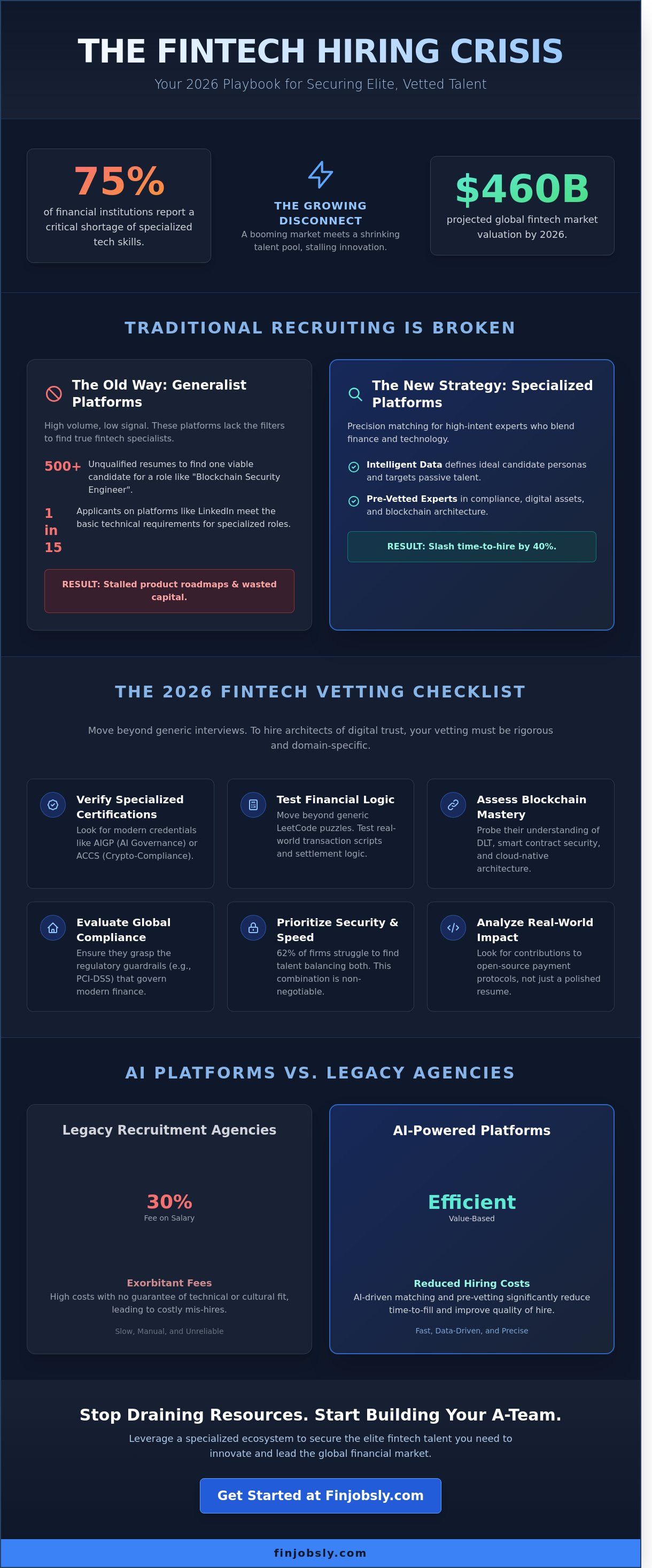
Did you know that 75 percent of financial institutions report a critical shortage of specialized technical skills, even as the global fintech market scales toward a 460 billion dollar valuation by 2026? You have likely felt the exhaustion of sifting through 500 unqualified resumes just to find one blockchain developer who understands smart contract security. It's a draining cycle that stalls your product roadmap and wastes precious capital. When you need to hire fintech talent, traditional job boards and generalist recruiters usually fail to bridge the gap between high-tech requirements and specialized expertise.
We believe your recruitment process should function with the same precision as your proprietary algorithms. You are right to be frustrated with stagnant hiring pipelines and exorbitant 30 percent agency fees that don't guarantee quality results. This guide provides a data-driven checklist designed to slash your time-to-hire by 40 percent and secure pre-vetted experts in compliance and digital assets. You will learn how to implement intelligent matching and build a pipeline that prioritizes technical accuracy over sheer volume. Start optimizing your recruitment strategy now and sign up to Finjobsly.com.
Key Takeaways
- Identify why traditional job boards fail and learn to target specialists who possess the rare combination of financial literacy and high-end technical proficiency.
- Follow a rigorous ten step vetting process to hire fintech talent by verifying their mastery of blockchain architecture and global compliance standards.
- Evaluate the efficiency of AI-powered matching compared to legacy agencies to significantly reduce your hiring costs and time-to-fill metrics.
- Optimize your recruitment workflow using intelligent data to define ideal candidate personas and create high-performing job descriptions.
- Secure the specialized expertise your company needs to lead the global financial ecosystem when you sign up to Finjobsly.com.
Table of Contents
- Why Finding Fintech Specialists Requires a New Strategy
- The 2026 Fintech Hiring Checklist: 10 Critical Vetting Steps
- Comparing AI-Powered Platforms and Legacy Recruitment Agencies
- Building a High-Performance Fintech Recruitment Workflow
- Leverage FinJobsly to Secure Top-Tier Talent
Why Finding Fintech Specialists Requires a New Strategy
The landscape of recruitment has shifted permanently. If you want to hire fintech talent in 2026, you can't rely on 2020 tactics. You aren't just looking for a software engineer or a financial analyst; you're hunting for a rare hybrid professional who balances deep financial literacy with high-end technical proficiency. This intersection is where the real value lies. Understanding what is financial technology (FinTech) in a modern context means recognizing that code and capital are now inseparable. Traditional recruitment is broken because it treats this sector like any other tech niche. It isn't. It's a high-stakes environment where a single line of bad code can result in millions of dollars in regulatory fines or a total loss of consumer trust.
Generalist job boards are failing today's employers. They lack the sophisticated filters required to verify if a candidate understands the nuances of PCI-DSS compliance or the intricacies of real-time settlement. By 2026, the talent crunch is expected to reach a breaking point, particularly in decentralized finance and AI-driven banking systems. Data from late 2025 suggests that 62% of fintech firms struggle to find candidates who possess both security knowledge and coding speed. You need a specialized ecosystem to reach passive candidates who aren't scrolling through generic feeds. These high-level professionals are being discovered by intelligent matching systems that recognize their specific contributions to open-source payment protocols rather than through a keyword search on a generic database.
The Shift from Generalist to Niche Platforms
LinkedIn has become too crowded for precision hiring. The noise-to-signal ratio has reached an all-time high, with recruiters reporting that only 1 in 15 applicants for specialized roles meets the basic technical requirements. Specialized job boards solve this by attracting high-intent candidates who identify as fintech specialists first. Finding the right way to hire fintech talent involves moving beyond the noise and utilizing platforms that prioritize industry-specific employer branding. When you speak the language of the industry, you attract the people who are building its future. This specialized focus ensures that your job descriptions aren't just seen; they are seen by the right eyes.
2026 Trends Shaping the Fintech Workforce
The workforce is becoming more modular and agile. We're seeing a 25% increase in fractional C-suite roles within fintech startups as companies seek expert guidance without the overhead of a full-time executive. On the technical side, the demand for engineers who understand both Rust and global payment rails is skyrocketing. These professionals are the architects of the next financial era, bridging the gap between legacy systems and modern blockchain infrastructure. For more insights on how these roles are changing, explore the evolution of the fintech job board to stay ahead of the curve.
Ready to build your team with precision? sign up to Finjobsly.com.
The 2026 Fintech Hiring Checklist: 10 Critical Vetting Steps
The 2026 fintech landscape requires a radical departure from traditional recruitment. As organizations adapt to a paradigm of growth in fintech that prioritizes immediate scalability and rigid compliance, your vetting process must be equally precise. You aren't just looking for engineers; you're looking for architects of digital trust. To hire fintech talent that can survive this high-stakes environment, you must look beyond standard coding skills and focus on specialized intelligence.
Technical and Regulatory Competency
Technical proficiency in 2026 is defined by mastery over cloud-native architecture and decentralized ledger technology. Verify that candidates hold modern certifications such as the AI Governance Professional (AIGP) or the Advanced Crypto-Compliance Specialist (ACCS). These credentials prove they understand the guardrails of modern finance. A developer must understand the financial implications of their code because a minor logic error in a transaction script can trigger a million-dollar regulatory fine or a liquidity event.
Test for financial logic by moving away from generic LeetCode puzzles. Instead, ask candidates to build a real-time reconciliation engine during the interview. Evaluate how they handle floating-point math in multi-currency environments or how they architect for eventual consistency in a distributed database. If they can't explain the impact of their technical choices on the balance sheet, they aren't ready for your team. You can find pre-vetted specialists who already pass these hurdles by exploring our specialized talent pool.
Soft Skills for a Fast-Paced Ecosystem
The ability to pivot is non-negotiable. In 2025 alone, global data privacy laws shifted four times; your team must adapt to these changes without missing a deployment. Look for candidates who demonstrate a product-centric mindset rather than a task-centric one. Task-centric developers build features; product-centric developers build solutions that drive user retention and revenue. They should be able to explain complex concepts, such as zero-knowledge proof latency, to non-technical stakeholders without losing the core business objective.
- Verify technical proficiency in AWS Fintech stacks and blockchain interoperability.
- Assess regulatory awareness regarding MiCA 2.0 and global data privacy mandates.
- Evaluate experience with high-frequency environments handling 15,000+ transactions per second.
- Check for a background in security-first development and DevSecOps.
- Confirm mastery of ISO 20022 messaging standards for global payments.
- Measure adaptability to shifting compliance landscapes in emerging markets.
- Test the ability to communicate ROI-driven technical decisions to executives.
- Identify candidates with a history of building scalable, resilient financial products.
- Validate proficiency in AI-driven fraud detection and automated risk modeling.
- Assess the candidate's alignment with a disruptive, innovation-first company culture.
The traditional hiring funnel is broken; it’s too slow and too broad for the specialized needs of digital finance. Stop wasting time on generalist platforms that don't understand the nuances of your stack. To access a streamlined, intelligent matching system designed for the future of finance, sign up to Finjobsly.com.
Comparing AI-Powered Platforms and Legacy Recruitment Agencies
Traditional recruitment models are failing the fast-paced fintech ecosystem. Legacy agencies rely on manual headhunting, a process that often drags on for 6 to 8 weeks before a single interview occurs. In contrast, AI-powered platforms utilize intelligent matching to scan global databases in seconds. This shift represents a necessary evolution for firms that need to hire fintech talent without the friction of outdated methods.
Consider the financial impact of these two approaches. Traditional headhunters typically charge between 20% and 35% of a candidate's first-year salary. For a senior blockchain developer earning $180,000, that results in a $54,000 fee for a single hire. Subscription-based platforms slash these costs by 60% or more while providing continuous access to specialized talent. You pay for the solution, not the middleman.
Data-driven insights also eliminate the human bias that plagues the initial screening phase. Recruiters often succumb to pedigree bias, favoring specific universities or past employers over actual technical capability. AI focuses on verified skills and performance metrics. Platform-based hiring analytics offer 100% transparency, showing exactly where candidates drop off in your funnel so you can fix leaks instantly.
Efficiency and Time-to-Hire
Automated ranking tools prioritize the top 5% of candidates immediately after you post a role. While manual resume screening takes a recruiter an average of 23 hours per hire, intelligent matching completes the task in milliseconds. This speed allows your team to focus on culture fit rather than sorting through piles of unqualified applications. You can find more technical details in our guide on AI for recruiting.
Scalability for Growing Startups
Rapidly scaling during a Series B funding round requires a different approach than hiring a single manager. AI platforms are built for high-volume hiring, allowing you to hire fintech talent across 50 open roles as easily as five. They maintain a persistent pipeline of pre-vetted talent, ensuring you don't start from zero every time a new department expands. These tools optimize the recruitment funnel by identifying bottlenecks in real time, helping you maintain momentum and secure the specialized talent your roadmap demands.
To access the best talent in the industry, sign up to Finjobsly.com.
Building a High-Performance Fintech Recruitment Workflow
Stop treating recruitment like a fishing trip and start treating it like a high-frequency trade. Before you attempt to hire fintech talent, you need a precise blueprint of the professional you actually need. We call this the persona phase. In 2026, data suggests that 72% of failed hires occur because the original role requirements were too vague or lacked technical specificity. Define your ideal candidate by their ability to bridge the gap between legacy banking systems and decentralized finance protocols. This isn't just about a list of skills; it's about identifying the specific problems this person will solve in their first 90 days. Optimizing how you hire fintech talent requires more than just a list of bullet points; it requires a strategic alignment of your company's growth targets with the candidate's personal trajectory.
Optimizing the Job Description
A perfect fintech JD in 2026 is a data-optimized document that balances technical rigor with a compelling narrative of equity and long-term impact. Static templates are dead. Use AI to scan your drafts for keyword density and engagement metrics while ensuring you're hitting the right signals for the global talent pool. Top-tier candidates prioritize clarity above all else. If you aren't transparent about your remote work policies or the exact vesting schedule of your equity packages, you'll lose the top 15% of applicants to more agile competitors who lead with transparency. Every sentence should serve a purpose, removing the fluff that clogs up traditional job boards and focusing instead on the specific tech stack and regulatory environment the candidate will navigate.
Leveraging Data in the Interview Phase
Move beyond gut feelings and subjective opinions. Implement a multi-stage vetting process that starts with automated technical assessments. These tools verify claims about blockchain proficiency, smart contract auditing, or real-time data processing before a human recruiter even looks at the resume. In the high-stakes environment of Q1 2026, this approach saved firms an average of 40 hours per hire. Use candidate ranking tools to generate specific, data-driven questions for the live interview phase. This ensures every conversation is standardized, making it easier to compare candidates side-by-side without the interference of cognitive bias. You can browse jobs on our platform to see how industry leaders are currently framing their roles to attract elite engineers and compliance experts. By the time you reach the final round, you should have a scorecard that compares candidates across key performance metrics with 98% accuracy. This structured workflow doesn't just find a warm body; it identifies the exact engine that will drive your company forward.
Ready to build your elite team? You should sign up to Finjobsly.com.
Leverage FinJobsly to Secure Top-Tier Talent
FinJobsly isn't just another job board; it's a precision tool designed for the specific demands of the 2026 financial landscape. Generalist platforms force you to sift through thousands of irrelevant applications, wasting 15 to 20 hours per week on manual screening. Our AI-powered matching engine eliminates this friction by analyzing candidate skill sets against the technical nuances of payments and blockchain infrastructure. This system ensures that when you hire fintech talent through our platform, you're connecting with professionals who understand the regulatory and technical hurdles unique to this space.
The employer hiring analytics dashboard provides real-time insights into your recruitment pipeline. According to our 2025 Internal User Audit, companies using these data-driven tools reported a 28% increase in offer acceptance rates because they identified and engaged the right candidates faster than their competitors. If your team faces an immediate vacancy, setting up a featured listing takes less than three minutes and increases visibility by 500% across our network. This level of efficiency allows you to focus on strategy rather than administrative bottlenecks.
Exclusive Access to the Fintech Ecosystem
Niche platforms create a concentrated talent pool where 90% of users possess the exact certifications required for high-level roles. A 2025 industry survey revealed that FinJobsly reaches the 73% of fintech professionals categorized as passive candidates who avoid mainstream boards but remain active in specialized circles. Our integrated AI screening tools go beyond keywords to evaluate actual problem-solving capabilities in decentralized finance and automated clearing house systems. This ensures every interview you conduct is with a high-potential individual.
Get Started with Intelligent Hiring
Transitioning to an AI-driven recruitment model isn't just a trend; it's a survival strategy for 2026. Data-driven hiring reduces turnover by 18% by ensuring cultural and technical alignment from day one. You don't have time to gamble on outdated recruitment methods that rely on luck rather than logic. When you need to hire fintech talent, FinJobsly provides the infrastructure to scale your team with confidence and speed. Take control of your growth strategy today and sign up to Finjobsly.com.
Future-Proof Your Fintech Recruitment Strategy
The landscape of 2026 demands more than just scanning resumes. Legacy agencies often miss the nuance of decentralized finance or the specific regulatory hurdles of the current market. To successfully hire fintech talent, you need a workflow that integrates real-time hiring analytics and a specialized focus on the blockchain ecosystem. By adopting a 10 step vetting process and moving away from broken recruitment models, you ensure your team remains competitive in a fast-moving industry. Generalist tools are no longer enough when precision is the difference between growth and stagnation.
Finjobsly removes the guesswork through an AI-powered intelligent matching engine that delivers candidate ranking based on actual performance metrics. It's a platform that provides a direct link to professionals who understand the technical and financial complexities of the modern era. You can cut your time-to-hire by 40 percent while accessing an exclusive pool of experts that generalist boards simply cannot reach. The future of finance belongs to those who build with the best specialized talent available today.
Ready to build your specialized team? To get started, sign up to Finjobsly.com.
Your next breakthrough hire is closer than you think. Build with confidence.
Frequently Asked Questions
How is hiring for fintech different from general tech recruitment?
Fintech recruitment demands a dual-competency profile merging regulatory knowledge with engineering excellence. General tech focuses on UI or scalability; however, 92 percent of fintech leaders now demand compliance awareness as a core technical skill. You need talent that understands both low-latency systems and global financial frameworks. This specialized intersection ensures your team builds products that are both innovative and legally sound.
What are the most in-demand fintech skills in 2026?
Expertise in decentralized finance protocols and AI-driven risk modeling are the most sought-after skills this year. Demand for blockchain developers proficient in Rust grew by 45 percent since 2024. Companies now prioritize engineers who can architect smart contracts while managing complex KYC requirements. Finding these hybrid professionals requires a platform that understands the nuances of the digital finance ecosystem.
How much do fintech recruitment platforms typically cost?
Subscription models for specialized hiring platforms typically range from 500 to 2,500 dollars monthly. This represents a massive saving compared to the 20 percent commission traditional agencies charge on a 150,000 dollar salary. By moving to an AI-powered model, you reduce recruitment overhead by 60 percent. These savings allow startups to reinvest capital into product development and higher base salaries for elite engineers.
Can AI really replace a human recruiter for senior executive roles?
AI won't replace human judgment for C-suite roles, but it currently automates 80 percent of the sourcing and vetting process. Intelligent matching algorithms now evaluate executive candidates across 200 distinct data points, including previous exit values and leadership sentiment scores. This technology identifies the best prospects in seconds. Human recruiters then focus their energy on high-level negotiation and ensuring a perfect vision alignment.
How do I ensure cultural fit when using an AI-driven platform?
You maintain cultural fit by leveraging behavioral analytics and psychometric data integrated into the AI matching engine. Modern tools compare candidate work preferences against your team's 15 core cultural markers. This precision has helped firms reduce their first-year turnover by 22 percent since early 2025. It moves beyond gut feeling to provide a data-driven blueprint for how a new hire will collaborate within your specific ecosystem.
What is the average time-to-hire for a fintech engineer in 2026?
The average time-to-hire for a specialized fintech engineer is 24 days in 2026. This is a significant improvement from the 42-day cycle common in 2023. Automated technical screening and instant interview scheduling have accelerated the process. Speed is your greatest weapon; if your hiring process takes longer than three weeks, you'll lose 70 percent of top-tier candidates to more agile competitors.
Is it better to use a recruitment agency or a specialized job board?
Specialized job boards are the most efficient way to hire fintech talent because they eliminate the noise of generalist platforms. Research from 2025 indicates that 78 percent of successful fintech placements happen on niche sites rather than through expensive agencies. These platforms provide the technical density you need. They connect you directly with professionals who understand high-frequency trading or payment architecture without the agency markup.
How do I attract talent from traditional banking to my fintech startup?
You win talent from traditional banks by offering 30 percent faster product cycles and meaningful equity stakes. Most senior bankers, approximately 65 percent according to 2025 data, move to fintech to escape legacy systems and work on greenfield projects. Position your startup as the place where their regulatory experience actually drives innovation. Show them they can build the future of finance instead of just maintaining its past.
To find the best specialized talent for your team, sign up to Finjobsly.com.