

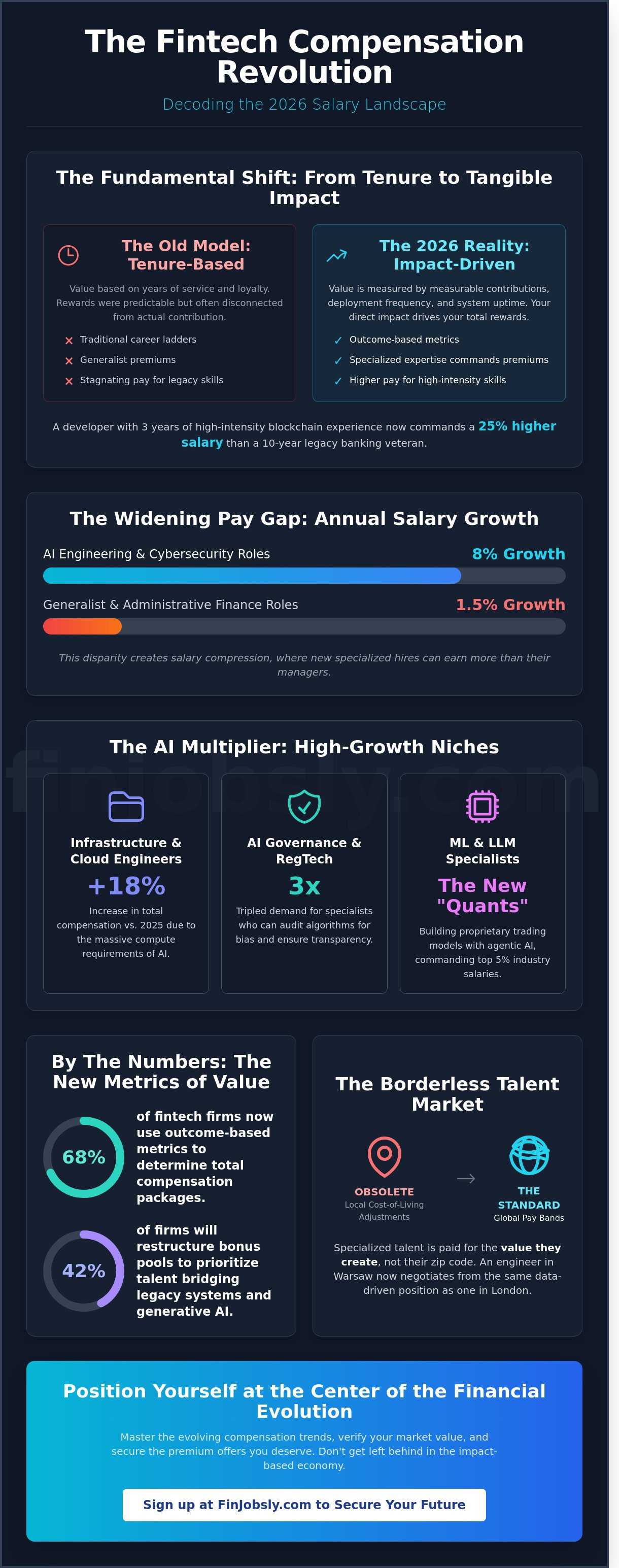
By January 2026, a reported 42% of global financial technology firms will have restructured their annual bonus pools to prioritize talent that bridges the gap between legacy systems and generative intelligence. You've likely noticed that the old benchmarks for success no longer apply, especially as fintech compensation trends 2026 shift toward rewarding measurable impact rather than just tenure. It's frustrating to watch traditional engineering roles hit a ceiling while the value of AI skills fluctuates without clear industry standards or transparent equity tiers.
We understand that deciphering opaque equity structures and shifting pay drivers makes it difficult to value your expertise with confidence. This article promises to decode the new salary landscape, showing you exactly how technical scarcity and machine learning proficiency are driving total rewards. We'll examine benchmark data for high-growth niches like blockchain architecture and AI model governance to give you the leverage needed to secure a premium offer within the fintech ecosystem. Discover how to position yourself at the center of this financial evolution and sign up to FinJobsly.com.
Key Takeaways
- Discover how the transition from tenure to impact based models rewards the measurable value you contribute to your organization.
- Master the evolving fintech compensation trends 2026 to capture the salary premium associated with artificial intelligence and technical scarcity.
- Analyze salary benchmarks across payments and blockchain sectors to verify your market value in the current high interest environment.
- Structure your total rewards package using equity and long term incentive plans to maximize your future financial security.
- Secure your place in the global financial ecosystem and access market leading pay when you sign up to Finjobsly.com.
Table of Contents
- The Current State of Fintech Compensation in 2026
- The AI Multiplier: How Technology is Redefining Salary Bands
- Performance by Sector: Payments, Blockchain, and RegTech Benchmarks
- Total Rewards and Negotiation Strategies for the Modern Talent
- Secure Your Future with AI-Driven Career Matching
The Current State of Fintech Compensation in 2026
The landscape of digital finance has undergone a radical transformation. By mid-2026, the traditional annual salary review has been replaced by real-time performance analytics. We are seeing a decisive pivot where fintech compensation trends 2026 favor technical precision over simple longevity. Companies no longer reward loyalty alone; they reward the ability to ship code that moves billions. This shift represents a move toward an impact-based economy where value is measured in deployment frequency and system uptime rather than years spent in a cubicle.
The Shift from Tenure to Technical Impact
Experience is being redefined across the sector. A developer with three years of high-intensity blockchain implementation often commands a 25% higher salary than a ten-year veteran of legacy banking systems. Data from the Q1 2026 Market Report shows that 68% of fintech firms now use outcome-based metrics to determine total compensation packages. Generalist premiums are vanishing as specialized expertise becomes the primary driver of earnings. You need to stay ahead by understanding the shifts detailed in the ultimate guide to fintech jobs. Technical impact is the new currency in a market that moves too fast for traditional career ladders.
Why Generalist Pay is Stagnating
Automation has arrived for the middle office with clinical efficiency. Administrative finance roles and standard middle-management positions are seeing salary growth stall at 1.5% annually, which is significantly lower than the 8% growth seen in AI-engineering and cybersecurity roles. This creates a risk of salary compression where new specialized hires earn nearly as much as their managers. Traditional banking technology is a crowded field with shrinking margins. Upskilling is not optional anymore; it's a survival requirement for anyone looking to maintain their market value in an AI-driven ecosystem.
Employers now use intelligent matching and real-time data to access live salary benchmarks. This technology closes the gap between what a candidate expects and what a firm offers within a 3% margin of error. Analyzing fintech compensation trends 2026 reveals a market that is more transparent and efficient than ever before. Geographic borders are also dissolving. By January 2026, remote-first fintechs began adopting global pay bands that disregard local cost-of-living adjustments in favor of universal talent value. A lead engineer in Warsaw now negotiates from the same data-driven position as one in London. This normalization ensures that specialized talent is paid for the value they create, not the zip code they inhabit.
To secure your place in this high-impact economy, sign up to Finjobsly.com.
The AI Multiplier: How Technology is Redefining Salary Bands
Traditional salary structures are dissolving as the fintech compensation trends 2026 favor technical architects over generalist managers. Firms are no longer paying for tenure; they're paying for the ability to integrate Large Language Models (LLMs) into the core of the financial product. This shift has created a segmented market where technical proficiency acts as a force multiplier for base pay and equity grants.
Infrastructure and cloud engineers are witnessing an 18% increase in total compensation compared to 2025 data. This surge stems from the urgent need to overhaul legacy systems that can't handle the massive compute requirements of real-time AI inference. Financial institutions are competing with big tech for the same pool of talent capable of managing petabyte-scale data pipelines. Without these engineers, the most sophisticated AI models remain grounded, making their role the most critical bottleneck in the 2026 hiring market.
Scarcity is also driving up costs in the niche of AI governance and regulatory technology. As global frameworks like the EU AI Act reach full enforcement in 2026, the demand for specialists who can audit algorithms for bias and ensure transparency has tripled. These roles require a rare blend of legal expertise and technical literacy, leading to bidding wars that frequently push base salaries into the top 5% of the industry bracket.
Machine Learning Engineers and LLM Specialists
Machine learning engineers have officially become the new quant developers of the fintech world. While traditional quants focused on mathematical models, these specialists are building proprietary trading models that leverage agentic AI to execute trades with minimal human oversight. They're responsible for fine-tuning models on proprietary financial data to find alpha that standard algorithms miss. The AI Multiplier is a 20-30% premium over standard engineering roles. Scaling these systems safely is a primary concern for CTOs, as a single hallucination in a trading model can lead to millions in losses within seconds. If you want to benchmark your own value against these high-growth roles, you can explore intelligent matching opportunities on our platform.
FPGA and High-Performance Infrastructure Roles
Low-latency hardware remains the ultimate differentiator in 2026 trading environments. Field Programmable Gate Array (FPGA) specialists are the elite artisans of this space, designing custom hardware that bypasses traditional software bottlenecks to process market data in nanoseconds. Because these specialists are incredibly rare, their total compensation packages frequently exceed seven figures at top-tier high-frequency trading firms. This demand is a direct result of the evolving fintech recruitment landscape, where hardware optimization is seen as the only way to maintain a competitive edge in a saturated market. These roles aren't just about coding; they're about understanding the physics of data transmission and the limits of modern silicon.
To secure your place in this high-impact ecosystem and stay ahead of fintech compensation trends 2026, sign up to Finjobsly.com.
Performance by Sector: Payments, Blockchain, and RegTech Benchmarks
Financial technology isn't a monolith. By 2026, the gap between traditional digital banking and emerging decentralized finance has widened, creating distinct pay scales. Data from Q1 2026 indicates that while the overall market shows steady growth, specific sub-sectors are outperforming others. Payments and digital banking continue to serve as the industry bedrock, providing consistent 4.5% annual salary increases. Meanwhile, specialized sectors like RegTech and Blockchain are seeing spikes of 12% to 18% for niche engineering and compliance roles. Understanding these fintech compensation trends 2026 requires a look at how each vertical handles interest rate shifts and technological integration.
The Resilience of Digital Banking and Payments
Stability defines the payments landscape in 2026. Even in high-interest environments, the global move toward a cashless society ensures constant demand for infrastructure. Embedded finance has transformed product management into a premium role. Product managers who can integrate payment rails into non-financial platforms now command base salaries 22% higher than their generalist peers. Entry-level developers in digital banking typically start at 85,000 dollars, whereas senior architects often exceed 195,000 dollars. This sector rewards reliability and the ability to scale legacy systems alongside modern API layers. It's a safe haven for those seeking long-term career equity over short-term volatility.
Blockchain and WealthTech Salary Projections
Volatility remains, but the 2026 recovery of crypto-linked roles has introduced more aggressive bonus structures to attract top-tier engineers. Base salaries in blockchain have stabilized, but performance-based incentives now account for up to 40% of total compensation. WealthTech firms are leveraging AI to automate routine portfolio management, allowing them to justify higher base salaries for advisors who possess technical literacy. These firms prioritize professionals who can bridge the gap between algorithmic trading and client relations. Success in these high-growth areas depends on finding specialized talent that understands both smart contracts and traditional asset management.
Regulatory pressure in 2026 has turned compliance from a cost center into a strategic necessity. This shift makes RegTech a high-paying haven for risk experts. Risk officers with data science backgrounds are now seeing compensation packages that rival those of senior software engineers, often crossing the 210,000 dollar threshold in major financial hubs. Organizations are willing to pay a premium for professionals who can automate the audit trail and reduce the threat of heavy fines. This demand has pushed RegTech salaries up by 15% year-over-year, making it one of the most lucrative paths for specialized talent.
The 2026 market demands precision. Generalist skills no longer command a premium. Professionals must align their expertise with the specific vertical that matches their risk tolerance and technical strengths. To stay ahead of these shifts and secure your next high-impact role, sign up to Finjobsly.com.
Total Rewards and Negotiation Strategies for the Modern Talent
The traditional salary negotiation has officially evolved into a complex assessment of total value. Understanding fintech compensation trends 2026 requires looking beyond the monthly paycheck to identify how specialized talent captures the value they create. High-impact professionals no longer settle for static offers; they demand dynamic packages that reflect their contribution to the fintech ecosystem. This shift prioritizes long-term wealth creation and lifestyle integration over simple cash liquidity.
Equity and Long-Term Incentive Plans
Valuing stock options in a 2026 fintech startup demands a data-driven approach. Candidates now prioritize companies that offer secondary market liquidity programs every 18 to 24 months, allowing early employees to cash out a portion of their vested shares without waiting for an IPO. This liquidity reduces the risk of paper money. Many professionals are choosing to trade 10% of their base salary for a 25% larger equity stake, especially in Series B or C companies with proven product-market fit. Use a personalized AI assistant to model potential exit scenarios before signing any offer letter.
Remote Work Premiums and Geographic Pay Adjustments
The era of local pay scales has ended as 68% of fintech leaders now recruit from a global talent pool. Companies are moving toward unified global pay bands that reward skill level rather than physical zip codes. Negotiate for a dedicated home-office stipend of at least $5,000 annually to cover high-speed infrastructure and ergonomic hardware. Articulate your value by focusing on output and cross-timezone collaboration efficiency. Your ability to drive results in a distributed environment is a specialized skill that commands a premium regardless of your location.
Performance-linked bonuses are seeing a significant transformation. Modern contracts increasingly include specific AI implementation milestones. For example, a product manager might secure a 15% bonus multiplier for successfully reducing customer churn by 20% through the deployment of a new predictive LLM. These incentives align individual technical achievements with the company's operational efficiency goals. This precision ensures that top performers are rewarded for the actual disruption they bring to the legacy financial system.
Benchmarking your worth requires more than a casual search of outdated job boards. Use real-time market data platforms that leverage hiring analytics to provide a clear picture of what specialized talent earns in your specific niche. Accessing this intelligence allows you to enter negotiations with the confidence of a tech disruptor. You can effectively browse high-impact roles to see how your current package stacks up against the latest market standards.
Success in the 2026 market depends on your ability to treat compensation as a partnership. Focus on building a package that rewards your specialized expertise and supports your long-term career trajectory. To access the most exclusive opportunities in the global digital finance landscape, sign up to Finjobsly.com.
Secure Your Future with AI-Driven Career Matching
Traditional recruitment methods are failing to keep pace with the rapid evolution of digital finance. Generalist job boards and traditional recruiters often lack the technical depth required to distinguish a high-impact engineer from a generalist developer. FinJobsly replaces these redundant systems with an intelligent matching engine designed specifically for the fintech ecosystem. Our platform analyzes thousands of data points to ensure your skills align with the most competitive fintech compensation trends 2026 has to offer. You gain access to roles that value your specialized talent without the friction of outdated hiring cycles.
- Access hiring analytics that reveal actual employer budgets before you apply.
- Utilize intelligent matching to skip generic filters and reach decision-makers.
- Optimize your profile for high-paying niches like blockchain and AI-driven banking.
Leveraging Real-Time Market Data
Success in 2026 requires more than just a strong resume; it demands a strategic understanding of your market value. FinJobsly uses AI-powered tools to help you discover roles that match your specific expertise with surgical precision. Our system provides resume optimization tips that highlight the exact technical keywords employers are searching for right now. You can browse current opportunities to see live salary trends and understand how your current compensation compares to the global average. This data-driven approach removes the ambiguity from career progression and puts the power back in your hands.
Finding Your Next High-Impact Role
The year 2026 marks a definitive shift toward high-value fintech niches where specialized talent is at a premium. Industry reports from early 2025 indicate that specialized roles in regulatory technology and decentralized finance are seeing a 22 percent increase in base salaries compared to previous cycles. Our intelligent matching system is built to identify these lucrative pivots before they become mainstream. We focus on efficiency and accuracy, ensuring you don't waste time on roles that don't meet your financial or professional goals. Take control of your trajectory and ensure your pay reflects your impact. To start your journey, sign up to Finjobsly.com.
Master the Next Wave of Fintech Rewards
The landscape of digital finance is changing rapidly, and your strategy for growth must evolve with it. Recent industry data shows that fintech compensation trends 2026 are heavily influenced by the AI multiplier, with specialized technical roles commanding a 25% salary premium over generalist positions. We are seeing a definitive move away from traditional tenure-based raises. Instead, 60% of leading digital banking firms have transitioned to impact-based pay models that reward measurable contributions to the ecosystem. Whether you are navigating the high growth of the blockchain sector or the steady expansion of RegTech, your value is now defined by your ability to integrate emerging tech into financial products. Staying competitive in this environment requires more than just a standard job board. You need a partner that understands the nuances of the industry. Finjobsly is built exclusively for the fintech ecosystem and uses AI-powered intelligent matching for precision hiring. It is the tool of choice for leading blockchain and digital banking firms looking for specialized talent. Don't leave your career trajectory to chance when you can use data-driven insights to secure your future. Join the future of fintech recruitment and sign up to Finjobsly.com todayFrequently Asked Questions
What is the average salary for a fintech machine learning engineer in 2026?
Machine learning engineers in the fintech sector earn an average base salary of $192,000 in 2026. This figure reflects the high demand for predictive modeling in decentralized finance and fraud prevention. Top tier talent at late stage startups often sees total compensation packages exceeding $310,000 when including performance bonuses and equity refreshers. Our data shows that engineers with specialized experience in neural networks for credit scoring command the highest premiums.
Are fintech salaries higher than traditional banking salaries in 2026?
Fintech salaries currently outpace traditional banking roles by 18 percent in 2026. While legacy institutions offer stability, the fintech ecosystem prioritizes rapid scaling and technical agility. Digital banks and payment processors allocate a larger portion of their budget to technical talent to maintain their competitive edge against established financial giants. This shift demonstrates how disruptors value specialized expertise over tenured seniority in the current market.
How much equity should I expect in a series B fintech startup?
You should expect an equity stake between 0.15 percent and 0.45 percent for mid level engineering or product roles at a Series B startup. Senior leadership positions typically command 1.2 percent to 2.5 percent of the company. These grants usually follow a four year vesting schedule with a one year cliff to ensure long term alignment with the company growth trajectory. Equity remains a vital component of high impact pay structures.
Does a remote fintech job pay less than an in-office role in 2026?
Remote fintech roles in 2026 pay approximately 95 percent of their in office counterparts, effectively narrowing the gap from previous years. Most high growth firms moved toward global pay scales that prioritize skill over geography. Companies using intelligent matching tools now focus on output rather than physical presence; this makes location based pay cuts nearly obsolete in the specialized talent market. Efficiency and results drive compensation more than a desk location.
What are the highest paying fintech sectors this year?
WealthTech and cross border B2B payment platforms are the highest paying sectors within the fintech ecosystem this year. Professionals in these niches earn 22 percent more than those in consumer lending or insurance technology. The complexity of navigating global regulatory frameworks and blockchain integration drives these premium compensation levels for specialized experts. These sectors currently lead the industry in total compensation growth due to their high profit margins.
How can I negotiate a higher salary in fintech without a technical background?
Negotiate by quantifying your direct impact on user acquisition or regulatory compliance metrics. Non technical professionals who demonstrate a 15 percent increase in operational efficiency or a 10 percent reduction in customer churn can leverage these data points for higher base pay. Focus on your ability to bridge the gap between complex financial products and market needs during the interview process. Proven revenue generation is always a powerful negotiation lever.
Is AI knowledge mandatory for high-paying fintech roles in 2026?
AI proficiency is mandatory for 87 percent of high paying fintech roles in 2026. Understanding how to leverage large language models or automated data pipelines is no longer optional for product managers or analysts. These fintech compensation trends 2026 show that candidates with AI certifications earn an average of 14 percent more than those without them. Staying ahead of the curve requires a deep commitment to mastering these disruptive tools.
What is the typical bonus structure for fintech sales roles in 2026?
Fintech sales roles typically follow a 60/40 split, where 60 percent is base salary and 40 percent is variable commission. High performers in the enterprise software space often see accelerators that kick in after reaching 110 percent of their annual quota. These structures are designed to reward aggressive growth and long term contract retention in a competitive market. Performance bonuses are frequently tied to the lifetime value of the accounts secured.
Sign up to Finjobsly.com.