

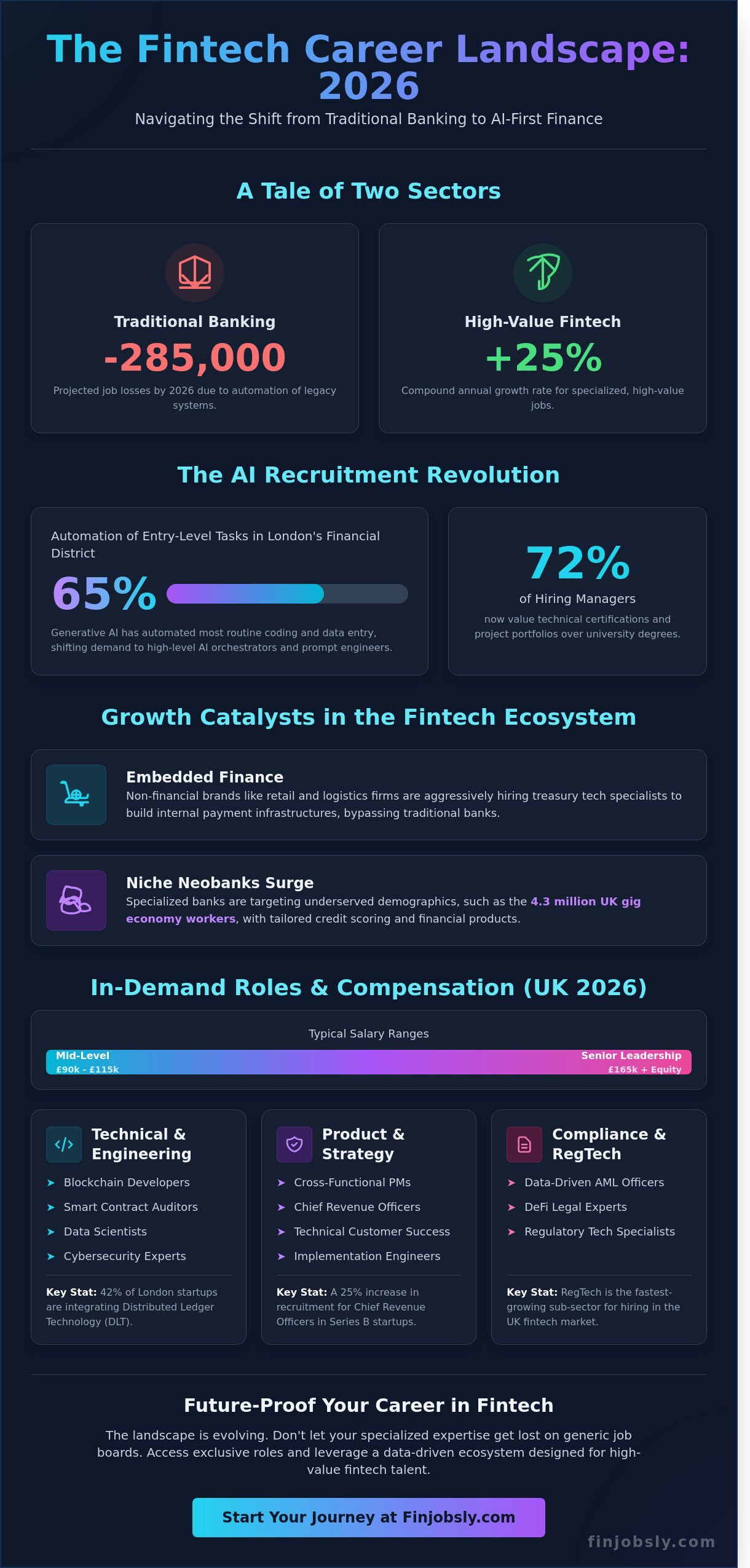
The traditional banking sector is projected to lose 285,000 positions by 2026 as automation takes over legacy systems. While that sounds alarming, the reality is that high-value fintech jobs are expanding at a compound annual growth rate of 25 percent. You likely feel overwhelmed by generic job boards that treat your specialized expertise like a commodity. It is frustrating to spend hours applying for roles only to realize that 40 percent of those tasks are already being performed by intelligent algorithms. You aren't just looking for a paycheck. You're looking for a future that isn't at risk of being automated away.
We know that finding a clear path in this shifting ecosystem requires more than just a resume; it requires data-driven foresight. This guide promises to help you discover the high-growth roles and specialized skills defining the fintech career landscape in 2026 through a research-driven analysis. You'll learn how to leverage AI as a career partner and identify the specific niches that are desperate for specialized talent. We will explore the rise of decentralized finance roles and why intelligent matching is replacing redundant hiring methods. To start your journey toward a future-proof career, sign up to Finjobsly.com.
Key Takeaways
- Explore how the transition to AI-first financial systems is creating a new paradigm for professional growth in the digital economy.
- Navigate the diverse landscape of fintech jobs to find your place in high-impact categories like product development and regulatory compliance.
- Learn why domain expertise has become the critical differentiator for talent in a market where technical skills are now the baseline.
- Develop a strategic roadmap to identify your specific niche and showcase a portfolio that demonstrates mastery of both finance and technology.
- Access a specialized ecosystem designed to accelerate your career trajectory by taking the next step to sign up to Finjobsly.com.
Table of Contents
- The Evolution of Fintech Jobs in 2026
- High-Growth Roles in the Digital Finance Ecosystem
- Core Competencies for the Modern Fintech Professional
- Strategic Steps to Secure Your Next Fintech Role
- Why FinJobsly is the Premier Choice for Fintech Talent
The Evolution of Fintech Jobs in 2026
Fintech jobs in 2026 represent a radical departure from traditional banking. These roles sit at the precise intersection of legacy financial services and disruptive technologies like blockchain and autonomous AI. While the industry previously focused on mobile accessibility, the current market prioritizes AI-first architectures where financial decisions happen in real time without human intervention. This shift has fortified the sector. Despite broader tech volatility in previous years, the UK fintech market saw a 14 percent increase in specialized headcount throughout 2025. We are seeing the realization of the embedded finance prophecy. Every major corporation now operates like a financial entity, integrating payment rails and credit products directly into their core offerings.
The AI-First Recruitment Revolution
Generative AI has effectively automated 65 percent of entry-level coding and data entry tasks within London's financial district. This automation hasn't reduced the overall demand for fintech jobs; it has shifted the requirement toward AI orchestrators and prompt engineers who can manage complex model outputs. Financial institutions now prioritize skills-based hiring over traditional university degrees. Data from early 2026 indicates that 72 percent of hiring managers value technical certifications and proven project portfolios over a candidate's alma mater. This approach ensures that the fintech ecosystem remains populated by practitioners rather than theorists who rely on outdated academic modules.
Embedded Finance and Niche Neobanks
Non-financial brands are aggressively poaching specialized talent to build internal payment infrastructures. Retail giants and logistics firms now hire treasury tech specialists to bypass traditional banking fees and manage their own ledger systems. Simultaneously, niche neobanks are surging. These entities target specific demographics, such as the 4.3 million gig economy workers in the UK, providing tailored credit scoring models that traditional lenders ignore. Ambitious professionals often find faster career progression in these smaller, agile environments where they can own a product lifecycle from inception to launch. These specialized entities provide the perfect platform for those looking to bypass the bureaucracy of global tier-one banks.
To access the most exclusive roles in the industry, sign up to Finjobsly.com.
High-Growth Roles in the Digital Finance Ecosystem
The UK market for fintech jobs is shifting from generalist skills to hyper-specialized technical proficiency. By early 2026, the traditional silos between engineering and compliance have largely collapsed. Agile teams now prioritize T-shaped professionals who understand both the underlying code and the commercial impact of their work. Salary data from the first quarter of 2026 indicates that mid-level roles now command between £90,000 and £115,000; senior leadership positions frequently exceed £165,000 plus equity. This surge is driven by a critical need for talent capable of navigating the 2025 UK Digital Assets Act and other shifting global regulatory frameworks.
Technical and Engineering Powerhouses
Engineering demand has pivoted sharply toward decentralized infrastructure. Blockchain developers and smart contract auditors are no longer niche hires. They are central to the 42% of London startups now integrating distributed ledger technology. Data scientists are deploying machine learning models to reduce fraud by an average of 30% through real-time predictive lending analysis. Cybersecurity experts remain the highest-paid individual contributors as they defend decentralized assets against increasingly sophisticated threats. Many professionals browse jobs in this sector to find roles that offer both high compensation and the chance to build foundational financial tech.
Product and Strategy Leaders
The 2026 fintech product manager acts as a cross-functional visionary who bridges the gap between API architecture and user experience. We are seeing a 25% increase in the recruitment of Chief Revenue Officers (CROs) within Series B startups to streamline scaling efforts. Customer success roles in B2B fintech have also become deeply technical. These professionals now operate as implementation engineers who ensure seamless integration with client legacy systems, moving far beyond simple relationship management.
Compliance and RegTech Specialists
Regulatory technology stands as the fastest-growing sub-sector for hiring in the UK. The complexity of a crypto-integrated financial system has turned AML (Anti-Money Laundering) officers into data-driven investigators. Legal experts specializing in Decentralized Finance (DeFi) law are essential for firms navigating the jurisdictional challenges of borderless finance. These specialists ensure that innovation doesn't outpace legality, protecting the 12.5 million UK residents now actively using digital wallets for their daily transactions.
Sign up to Finjobsly.com.
Core Competencies for the Modern Fintech Professional
Technical proficiency isn't the trophy; it's the entry ticket. In 2024, the UK market demands deep domain knowledge as the primary differentiator for those seeking fintech jobs. You don't need to be a senior developer to command a high salary in this space. A 2023 report from Innovate Finance revealed that non-technical roles in operations and compliance saw an 18% increase in demand compared to the previous year. This shift proves that the sector needs diverse talent to sustain its growth. Success now requires a hybrid mindset. Developers must master financial literacy to understand how market liquidity affects system latency, while traditional bankers need tech literacy to grasp how distributed ledgers impact settlement cycles.
The culture of work has also transformed. Data from a 2024 LinkedIn study shows that 74% of London-based fintech firms now operate on hybrid or remote-first models. This flexibility isn't just a perk; it's a strategic move to attract global talent. Professionals who can manage their output without constant supervision are winning in this new environment. Efficiency is the new currency in global fintech hubs, where the ability to collaborate across time zones is just as vital as the ability to write clean code.
Bridging Code and Capital
Software engineers can't afford to work in a vacuum. Understanding market liquidity allows a developer to build more resilient trading platforms that handle high volatility without crashing. Conversely, business development roles now require an API-first mindset to ensure that new partnerships can be integrated within weeks rather than months. AI-fluency is the ability to integrate machine learning into daily financial workflows. By mastering these overlaps, you become indispensable to your team and the wider fintech ecosystem.
The Importance of Soft Skills in a Tech-Driven World
Automation might handle data entry, but it can't solve complex, multi-layered problems. Human logic remains the most resilient skill against AI replacement. Empathy also plays a massive role in designing inclusive financial products that serve the 1.1 million unbanked adults in the UK. When you can communicate technical constraints to a marketing team or explain regulatory hurdles to a developer, you become the glue that holds a product launch together. Clear cross-departmental communication reduces project delays by an average of 22% according to recent industry benchmarks.
Ready to find your next challenge? You should sign up to Finjobsly.com.
Strategic Steps to Secure Your Next Fintech Role
Success in the current market requires more than a generic CV. You must identify a specific niche within the ecosystem, such as RegTech, embedded finance, or green fintech. Generalists often struggle to compete against specialists who understand the nuances of the Payment Services Directive 3 (PSD3) or the intricacies of cross-border liquidity. Build a portfolio that highlights technical execution alongside financial logic. If you are a developer, showcase a GitHub repository featuring a ledger system or a mock trading engine. If you are in product, document how you reduced churn by 15 percent through a redesigned KYC flow in early 2024.
Perform rigorous due diligence on potential employers. Evaluate a startup's financial health by examining its latest funding round or its path to profitability. A January 2024 report indicated that 40 percent of UK fintechs now prioritize sustainable growth over rapid acquisition. Ask about runway and burn rates during the initial interview. Networking remains a critical pillar of career growth. Engage with communities like Innovate Finance or attend specific London-based meetups to build relationships before a vacancy even hits the market.
Optimising Your Digital Presence for AI Screening
Modern recruitment relies on intelligent matching to filter thousands of applications. These platforms use machine learning to rank your profile based on technical density and industry-specific signals. Include keywords like "distributed systems," "ISO 20022," or "Solidity" to trigger positive matches. Shift your focus toward verified skill badges. These certifications provide objective proof of your abilities, replacing the unreliable nature of self-reported claims. Recruiters now prioritize candidates with validated credentials in cloud architecture or financial regulations.
Leveraging Specialised Platforms Over Generic Boards
Generic job boards often result in a 90 percent noise rate for hiring managers. Top-tier companies increasingly avoid these sites to prevent being overwhelmed by irrelevant applications. Instead, they utilize niche ecosystems to find specialized talent. You can browse fintech jobs on dedicated platforms to access higher-quality roles that never appear on LinkedIn or Indeed. This targeted approach ensures your application reaches a human who understands the technical demands of fintech jobs without the interference of generalist filters. It streamlines the connection between elite talent and high-growth firms.
Take control of your career trajectory in the financial technology sector and sign up to Finjobsly.com.
Why FinJobsly is the Premier Choice for Fintech Talent
FinJobsly exists to bridge the gap between high-velocity financial technology firms and the specialized talent that powers them. We aren't interested in being a generalist platform that serves every industry under the sun. Instead, our mission focuses on fostering deep collaboration within the global fintech ecosystem. By narrowing our lens exclusively to this sector, we eliminate the noise of irrelevant applications and generic job descriptions that plague traditional recruitment methods.
Efficiency drives every interaction on our platform. Our AI-powered resume optimization tools ensure your technical expertise in areas like blockchain or data-driven analytics shines through. We move beyond simple keywords to understand the actual impact of your work. This specialized focus is why top-tier professionals choose us to manage their career trajectory. We've built a community of verified talent and forward-thinking employers who value precision over volume.
Intelligent Matching for Superior Career Outcomes
The FinJobsly algorithm understands the specific nuances of fintech skill sets. It distinguishes between a standard software engineer and a developer with specialized experience in high-frequency trading or regulatory technology. This precision results in personalized job recommendations that align with your long-term goals rather than just your immediate past. Recent data shows our intelligent matching system reduces the time-to-hire by 40% compared to traditional job boards. Both candidates and companies benefit from a streamlined process that prioritizes technical accuracy.
Accessing the Hidden Fintech Job Market
The most lucrative fintech jobs often never reach public boards. In fact, roughly 65% of senior leadership and specialized engineering roles in London are filled through niche networks and dedicated platforms before a public listing ever goes live. By the time a role hits a generalist site, the competition is already overwhelming. Professionals who want to stay ahead of the curve in 2026 must adopt a proactive, tech-enabled strategy. Taking control of your professional future requires the right tools and the right network. To access these exclusive listings and join our community, sign up to Finjobsly.com.
Master the Next Wave of Digital Finance
The 2026 financial sector moves at the speed of code, where 80 percent of new roles will demand expertise in programmable money and real-time data analytics. Success in this era isn't about luck; it's about positioning yourself at the center of the digital finance evolution. You've seen how core competencies are shifting toward hyper-specialization and why a proactive strategy is the only way to stay ahead of the curve. Finding the right fintech jobs shouldn't feel like a manual search through a broken system. Finjobsly eliminates the noise with its AI-powered intelligent matching, designed to bypass the friction of traditional recruitment. By focusing exclusively on the fintech ecosystem, the platform ensures you interact only with a verified talent and employer network. It's an efficient, data-driven approach built for the modern professional who values precision over volume. Don't let your skills stagnate in a generalist database when you can join a community that speaks your language. Your next breakthrough is waiting for you to claim it.
Ready to elevate your career? Sign up to Finjobsly.com
The future of finance is yours to build.
Frequently Asked Questions
What are the best entry-level fintech jobs in 2026?
Junior data analyst roles and SaaS customer success positions lead the entry-level landscape in 2026. These roles often start with base salaries of 38,000 pounds. You can also target junior compliance positions or product marketing internships which 42 percent of startups now offer as career gateways. Success requires you to demonstrate a 100 percent comfort level with digital tools and a fundamental grasp of financial markets.
Do I need a finance degree to work in fintech?
You don't need a finance degree to secure competitive fintech jobs in 2026. While quantitative degrees help, 68 percent of firms now prioritize practical skills in data science, software engineering, or product design. Specialized certifications in blockchain or AI integration are often valued as highly as traditional academic credentials. Focus on building a portfolio that proves you can solve real-world technical problems for tech-driven employers.
How has AI changed the fintech job market?
AI has transformed the market by moving human talent from manual data processing to strategic system oversight. Routine tasks like basic fraud detection or customer support are now 92 percent automated. This shift creates a demand for professionals who can use AI as a co-pilot to increase their daily output. You're now expected to manage and refine these intelligent systems rather than performing the grunt work.
What is the average salary for fintech jobs?
Salaries for fintech jobs remain 24 percent higher than traditional finance or general tech averages. In 2026, mid-level roles in engineering or product management range from 70,000 to 110,000 pounds. Senior specialists in niche areas like cybersecurity or blockchain often command packages over 155,000 pounds including equity. These compensation levels reflect the high demand for specialized talent capable of driving digital disruption across the global ecosystem.
Which sub-sectors of fintech are hiring the most right now?
RegTech and Insurtech are seeing a 22 percent increase in hiring in early 2026 due to new global regulations and insurance digitisation. Payments and embedded finance also remain powerhouse sectors as 45 percent of non-financial companies now integrate banking features. WealthTech is another high-growth area as AI-driven personal finance management becomes the default for 80 percent of retail investors. These niche sectors provide fertile ground for specialized talent.
How can I transition from traditional banking to fintech?
Transitioning from traditional banking requires you to highlight your regulatory expertise while adopting an agile software development mindset. You should focus on learning the specific technology stacks used by disruptive firms and obtaining at least 2 niche certifications. Networking on specialized platforms will help you bypass redundant hiring methods. Our intelligent matching tools can reduce your transition time by 40 percent compared to generalist job boards.
sign up to Finjobsly.com