

By 2026, Gartner predicts that 80 percent of B2B sales interactions will occur in digital channels, effectively ending the era of the relationship-only leader. If you are currently operating as a sales director, you likely feel the mounting pressure to trade your intuition for algorithmic precision. It's exhausting to manage the friction between product development and revenue targets while trying to figure out where AI fits into your team's daily workflow. You aren't alone in feeling that the traditional playbook is crumbling under the weight of the 2024 technological shift.
This guide delivers the strategic roadmap you need to lead a high-growth revenue team in the global fintech ecosystem. You will discover how to move beyond tactical oversight to master high-level strategy and align your sales efforts with marketing and product teams seamlessly. We will break down the essential skills for 2026, from understanding complex revenue metrics to implementing AI-powered intelligent matching systems that build elite teams. Prepare to gain the confidence required to steer a modern financial technology organization toward unprecedented growth. Sign up to FinJobsly.com.
Key Takeaways
- Learn how the role of a sales director has evolved from managing individual closers into architecting scalable revenue engines within the tech economy.
- Identify the critical distinctions between daily sales management and the strategic leadership required to drive sustainable organizational growth.
- Master the integration of AI-powered tools and data-driven hiring analytics to build high-performance teams in the modern fintech ecosystem.
- Develop high-impact go-to-market strategies that align executive vision with frontline execution for maximum resource efficiency.
- Build a powerful personal brand to land your next senior leadership role and sign up to Finjobsly.com to accelerate your career.
Table of Contents
- Defining the Sales Director in a Tech-First Economy
- Key Responsibilities of a Modern Revenue Architect
- Sales Manager versus Sales Director: Understanding the Strategic Shift
- Essential Skills for Leading High-Growth Sales Organizations
- How to Land Your Next Senior Leadership Role in Fintech
Defining the Sales Director in a Tech-First Economy
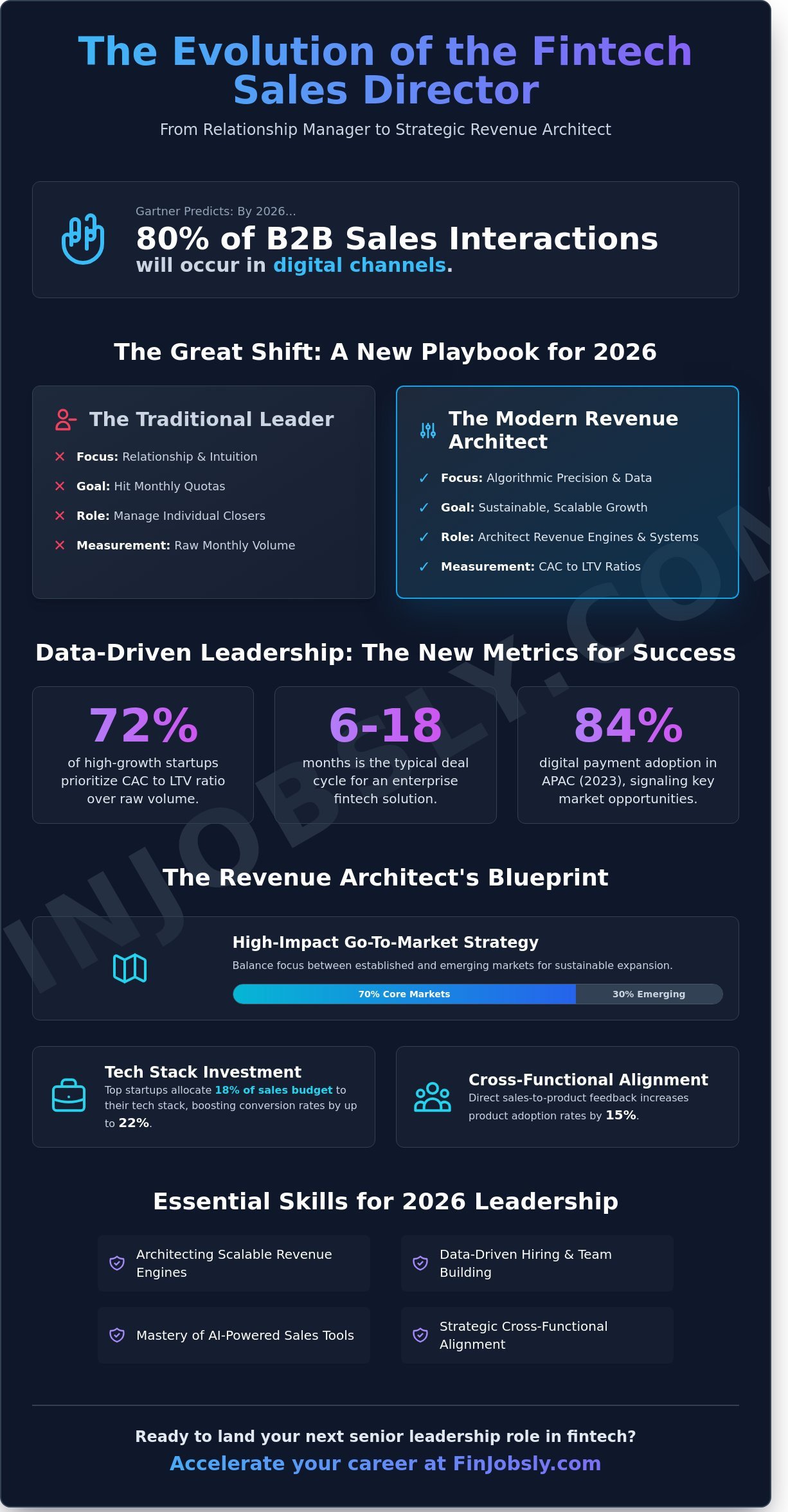
The traditional image of a sales leader shouting at a whiteboard is dead. Within the 2025 tech-first economy, a sales director is a strategic revenue architect responsible for long-term market positioning. They no longer just manage a group of closers; instead, they design scalable revenue engines that function with machine-like precision. In high-growth environments, the distance between a CEO's vision and the actual sales floor can be vast. The sales director bridges this gap by translating high-level strategy into actionable workflows for the team. Success in 2026 is measured by sustainable growth rather than just monthly quotas. Data from 2024 shows that 72% of high-growth startups now prioritize Customer Acquisition Cost (CAC) to Lifetime Value (LTV) ratios over raw monthly volume. This shift requires a leader who understands data-driven forecasting and intelligent matching of talent to territory.
The Core Purpose of Sales Leadership
Leadership starts with culture. A sales director establishes the high-level sales culture and ethical standards that prevent aggressive tactics from damaging the brand. They identify new market opportunities and expansion territories based on hard data. For instance, a fintech firm might target the APAC region where digital payment adoption hit 84% in 2023. They apply fundamental sales management principles to ensure the team remains disciplined and professional. Balancing short-term revenue needs with long-term brand health is a constant act. If you push too hard for a Q4 win, you might burn out a client relationship that would've been worth 10 times more over five years. Modern leadership isn't about hitting a number at any cost. It's about building a reputation that attracts specialized talent and keeps customers coming back.
The Impact of the Fintech Ecosystem
Selling in the fintech ecosystem is different. You aren't just selling software; you're selling trust in a highly regulated environment. A sales director must lead teams that navigate GDPR, SOC2, and regional banking laws without losing momentum. SaaS and BaaS cycles are complex and rarely follow a straight line. A typical enterprise fintech deal takes 6 to 18 months to close. The director leads teams that sell specialized technology products to sophisticated buyers who care about API documentation and uptime SLAs. They use hiring analytics to ensure every team member has the technical depth required to speak to a CTO or a Head of Compliance. This level of precision is why traditional hiring methods fail. They don't account for the specialized knowledge required to close a blockchain integration or a cross-border payment solution. You need a leader who understands the cold precision of AI and the human-centric mission of digital finance.
sign up to Finjobsly.com.
Key Responsibilities of a Modern Revenue Architect
Transforming a startup into a market leader requires more than just high-energy cold calls. It demands a sophisticated blueprint for growth. A modern sales director acts as the master architect of the entire revenue engine; they don't just manage people, they build systems. This role has shifted from a tactical closer to a strategic visionary who interprets complex market signals to drive sustainable expansion.
Executing a comprehensive go-to-market strategy in the 2024 fintech climate involves balancing a 70% focus on core markets with 30% exploration of emerging niches like decentralized finance or cross-border payment rails. Understanding the key responsibilities of a sales director involves recognizing this shift from tactical manager to strategic visionary. They ensure that every dollar spent on the sales budget generates a measurable return. Recent data from Q3 2023 shows that top-performing startups now allocate 18% of their total sales expenditure specifically to their tech stack to automate lead qualification and improve conversion rates by up to 22%.
Cross-functional alignment is the heartbeat of a scaling organization. The sales director bridges the gap between the product roadmap and marketing campaigns. When sales teams provide direct feedback to developers, product adoption rates typically see a 15% increase because the features actually solve user pain points. This collaboration prevents the silo effect that often kills momentum in fast-moving tech environments. Identifying the right leaders who can facilitate this harmony is easier when using specialized hiring analytics to pinpoint candidates with proven cross-departmental success.
Recruiting specialized sales talent is the final pillar of this architectural role. In the fintech ecosystem, generalist recruiters often miss the nuances of blockchain or regulatory compliance. A true revenue leader identifies skill gaps early and builds a team that reflects the global nature of digital finance. They focus on hiring professionals who understand the technical complexities of the product while maintaining the emotional intelligence required to close high-value enterprise deals.
Strategic Planning and Forecasting
Predictive analytics have replaced gut feelings in the boardroom. Modern leaders utilize data-driven models to build multi-year revenue projections that maintain a margin of error under 5%. They monitor real-time competitor movements and adjust pricing or outreach strategies within 24 hours of a market shift. Creating contingency plans for economic volatility is no longer optional; it's a survival requirement. High-growth firms now maintain at least three distinct financial scenarios to ensure they remain agile regardless of interest rate hikes or venture capital cooling periods.
Team Building and Mentorship
Building a high-performance team requires a move away from outdated "sink or swim" mentalities. Effective leaders design compensation structures that reward both individual performance and collective collaboration, often utilizing a 60/40 split between base salary and performance incentives. They prioritize diversity and inclusion because data from 2023 indicates that diverse sales teams outperform their peers by 21% in terms of profitability. Identifying specific skill gaps allows for targeted training modules that reduce ramp-up time for new hires by an average of 30 days. This proactive mentorship ensures the organization isn't just filling seats but is actually cultivating the next generation of fintech leaders.
sign up to Finjobsly.com
Sales Manager versus Sales Director: Understanding the Strategic Shift
A sales manager optimizes the team while a sales director optimizes the entire revenue function. This distinction defines the trajectory of a scaling fintech startup. Managers focus on the daily how by ensuring reps hit their call quotas and follow the established script. They reside in the trenches, providing immediate feedback on individual calls. The sales director, however, focuses on the strategic why. They analyze why a specific market segment converts at a 12% higher rate than others and adjust the overarching strategy to capitalize on that data. This shift moves the needle from individual deal coaching to systemic process optimization that fuels long term growth.
Transitioning into a director role requires a fundamental change in perspective. Instead of fixing a single broken demo, the director identifies why the demo process fails across the entire organization. They build the framework that allows managers to succeed. Since January 2024, data from high growth tech firms shows that companies with clearly defined director roles see a 22% increase in sales tech stack ROI. Directors must manage up to the board by presenting revenue forecasts and CAC metrics while simultaneously managing down to ensure managers stay aligned with the company's 2025 vision. They bridge the gap between the granular activity of the sales floor and the high level expectations of investors.
Tactical Execution versus Strategic Vision
Managers handle individual performance issues and lead generation tactics with precision. They ensure the CRM is updated and that the team follows the Q3 outreach plan. A sales director evaluates the efficacy of the entire sales stack and channel strategy to prevent technical debt. They look at the 18 month horizon rather than the 30 day sprint. Understanding the modern sales director's responsibilities involves moving from managing people to managing systems and outcomes. They decide which software integrations will automate 15% of manual entry tasks and which lead sources provide the highest lifetime value.
Internal versus External Focus
Managers stay primarily focused on internal team dynamics and activity metrics like daily dials or weekly meetings. They are the cultural anchors of the sales floor. Directors spend significant time on external partnerships and market positioning to expand the company's footprint. They represent the organization at industry events and executive summits like Money20/20 to build relationships with key stakeholders. In the 2024 fintech ecosystem, 68% of successful enterprise deals originate from these high level external interactions. This external focus ensures the company stays ahead of market shifts and competitor movements while the internal team executes the vision. To find the talent capable of leading this strategic evolution, sign up to Finjobsly.com.
Essential Skills for Leading High-Growth Sales Organizations
Leading a sales team in a high-growth environment requires more than just charisma; it demands a technical edge. A modern sales director must act as a systems architect, blending human intuition with machine precision. This role has evolved beyond managing quotas to designing scalable engines that can withstand the volatility of the fintech ecosystem. Success depends on the ability to interpret complex datasets while maintaining the emotional agility to lead a team through the inevitable pivots of a scaling startup.
Digital Literacy and AI Integration
The modern sales director doesn't just use technology; they weaponize it. Selecting and implementing the right CRM and sales intelligence platforms is a foundational requirement. According to a 2023 Gartner report, 75 percent of B2B sales organizations will augment traditional sales playbooks with AI-guided selling by 2025. You must train your team to use AI for personalized outreach and resume optimization to ensure every interaction is high-value. This isn't about replacing humans. It's about using data to identify friction points in the customer journey, such as a 15 percent drop-off during the technical demo phase, and fixing them with surgical precision.
Intelligent matching is no longer restricted to hiring. It applies to lead prioritization too. High-growth leaders use AI-powered tools to score prospects based on historical closing data. This allows the team to focus on accounts with a 40 percent higher probability of conversion. By automating the mundane aspects of CRM entry and lead qualification, you empower your specialized talent to focus on what they do best: closing deals and building relationships.
Hiring is the most expensive mistake a startup can make. Traditional interviews often fail because they rely on gut feeling, which has a success rate of roughly 50 percent. Developing a deep understanding of data-driven hiring analytics allows you to identify specific traits that correlate with high performance in digital finance. By analyzing the performance metrics of your top 10 percent of performers, you can build a profile for future hires that increases retention by 30 percent. This methodical approach ensures the sales director builds a resilient team capable of hitting aggressive targets.
Advanced Communication and Influence
Mastering the art of storytelling is essential to sell the vision to both investors and employees. You aren't just selling a product; you're selling a future where your technology disrupts a legacy financial process. This requires a level of communication that transcends standard sales pitches. You must lead difficult conversations regarding performance and organizational pivots without losing the trust of your team. When a shift in market conditions requires a change in strategy, your ability to articulate the "why" determines whether your team stays motivated or starts looking for the exit.
Building strong relationships with the CEO and other C-suite executives is equally vital. The sales director acts as the bridge between the market's reality and the company's vision. You need to negotiate complex deal architectures that involve five or more stakeholders, each with competing interests. This requires high emotional intelligence to navigate internal politics and external demands simultaneously. You're responsible for ensuring that the sales strategy aligns with the broader goals of the fintech ecosystem, keeping the company agile and competitive.
Ready to build your high-performance sales engine with specialized talent? Find your next sales leader today and sign up to Finjobsly.com.
How to Land Your Next Senior Leadership Role in Fintech
The fintech space demands more than traditional leadership. It requires a blend of technical literacy and aggressive revenue focus. If you're aiming for a role as a sales director, your strategy must reflect the current shift toward embedded finance and decentralized systems. Start by establishing yourself as a tech-driven thought leader. Share data-driven insights on platforms where founders and venture capitalists congregate. This isn't about posting generic updates. It's about analyzing how a 12% rise in interest rates affects digital lending margins or how blockchain integration reduces cross-border settlement times by 40%.
Quantifying your impact is the only way to stand out in a competitive field. Investors and founders look for specific metrics that prove you can handle the pressure of a scaling startup. Don't just say you grew the team. State that you scaled a sales organization from 5 to 25 people while maintaining a 22% month over month growth rate. Highlight how you optimized the sales stack to reduce the average closing cycle from 90 days to 55 days. These numbers prove you understand the strategic levers of a high-growth company.
Preparation for the final interview requires deep research into the target startup's unique hurdles. Don't just read their press releases. Analyze their latest Series B funding announcement from June 2024. Identify their burn rate and their expansion plans into the European market. If they're struggling with a 15% churn rate in their enterprise segment, walk into the room with a 90 day plan to stabilize those accounts. This level of preparation proves you're ready to operate as a partner to the CEO. It shows you aren't just looking for a job; you're looking to solve their specific revenue problems.
Navigating the 2026 Job Market
By the year 2026, the recruitment landscape will rely heavily on verified track records within niche sectors like regtech or wealthtech. Traditional resumes often fail to capture the nuance of these roles. You should use AI-driven matching tools to bypass the noise of generalist job boards. These systems analyze your specific technical competencies and match them with companies that need your exact skill set. You can browse specialized roles right now to understand how market requirements are evolving for the next generation of leadership.
Optimizing Your Path to the Top
Education doesn't stop at the C-suite. Pursue executive education programs focusing on fintech law or digital transformation at institutions like Oxford or MIT. These certifications signal to employers that you're prepared for the complexities of a regulated global market. Networking remains vital. Connect with other revenue leaders to discuss how they're handling the 30% increase in compliance costs seen across the industry since 2023. You can create a profile to access intelligent matching that connects you with high-growth firms looking for your specific sales director profile.
sign up to Finjobsly.com
Master Your Evolution as a Revenue Architect
The transition from traditional management to a strategic sales director role requires more than just leadership skills. It demands a deep integration of data analytics and a tech-first mindset. By 2026, Gartner predicts that 80% of B2B sales interactions will happen through digital channels. This shift means your ability to navigate the fintech ecosystem determines your success. You've learned how to leverage AI tools and bridge the gap between sales and product development. Now, it's time to apply these insights to your career trajectory within the global financial technology sector.
Stop wasting time on generalist job boards that don't understand the nuances of digital finance. Traditional recruitment is broken, but we've fixed it with an exclusive focus on the fintech ecosystem. Our platform utilizes AI-powered intelligent matching to connect you with high-growth organizations looking for a verified specialized talent pool. You can skip the noise and find senior leadership roles that match your specific expertise in blockchain or decentralized finance. Take the next step in your professional journey today. Sign up to Finjobsly.com and secure your place at the forefront of the industry. The future of fintech revenue is waiting for you to lead it.
Frequently Asked Questions
What is the average salary for a Sales Director in the fintech industry?
The average base salary for a Sales Director in the fintech industry is $185,000 according to 2024 compensation data from industry benchmarks. Total on-target earnings often reach $320,000 when including performance bonuses and equity. These figures reflect the high demand for specialized talent capable of navigating complex regulatory environments and long enterprise sales cycles.
How many years of experience do I need to become a Sales Director?
You typically need 8 to 12 years of professional experience to become a Sales Director in the financial technology space. This usually includes at least 5 years of direct B2B sales and 3 years in a leadership role managing high-performing teams. Employers prioritize candidates who've successfully scaled revenue from $1 million to $10 million in previous roles.
Can a Sales Director also be a Chief Revenue Officer (CRO)?
This leadership position can transition into a Chief Revenue Officer role, but these positions serve different strategic purposes as a company matures. In 2023, approximately 40 percent of series A startups combined these duties under one leader to streamline operations. A CRO focuses on the entire revenue lifecycle across marketing and customer success, while the director remains laser-focused on closing new business.
What are the most important KPIs for a Sales Director to track?
The most critical KPIs for this role include Customer Acquisition Cost (CAC), Lifetime Value (LTV) ratios, and pipeline velocity. Tracking a 3 to 1 LTV to CAC ratio ensures sustainable growth within the fintech ecosystem. You should also monitor monthly quota attainment and lead-to-close conversion rates to maintain a data-driven approach to sales management.
How is AI changing the daily work of a Sales Director?
AI is revolutionizing the daily work of this role by automating lead scoring and providing real-time hiring analytics. Modern leaders use AI-powered platforms to analyze thousands of sales calls for sentiment and coachability. These tools reduce administrative tasks by 30 percent, allowing leaders to focus on high-level strategy and intelligent matching of talent to specific accounts.
Is an MBA necessary to land a Sales Director role at a fintech startup?
An MBA isn't necessary to land this role at a fintech startup, as 70 percent of current leaders prioritize a proven track record of revenue growth over advanced degrees. Founders look for deep industry knowledge and the ability to navigate blockchain or payment processing complexities. Practical experience in the field often outweighs academic credentials in this fast-moving sector.
What is the best way to handle a sales team that is missing its targets?
The best way to handle a team missing its targets is to conduct a root cause analysis using CRM data from the last 90 days. Identify whether the issue lies in lead quality, sales scripts, or individual performance gaps. Implement a 30 day intensive coaching plan to course-correct and ensure every team member utilizes data-driven insights to hit their numbers.
How does a Sales Director collaborate with the Product department?
The leader collaborates with the Product department by providing bi-weekly feedback loops based on direct customer objections and feature requests. This ensures the product roadmap aligns with market demand and solves real pain points for financial institutions. Successful leaders act as the bridge between technical developers and the end-user to drive 25 percent higher product adoption rates.
To find your next high-impact role in the fintech ecosystem, sign up to Finjobsly.com.