

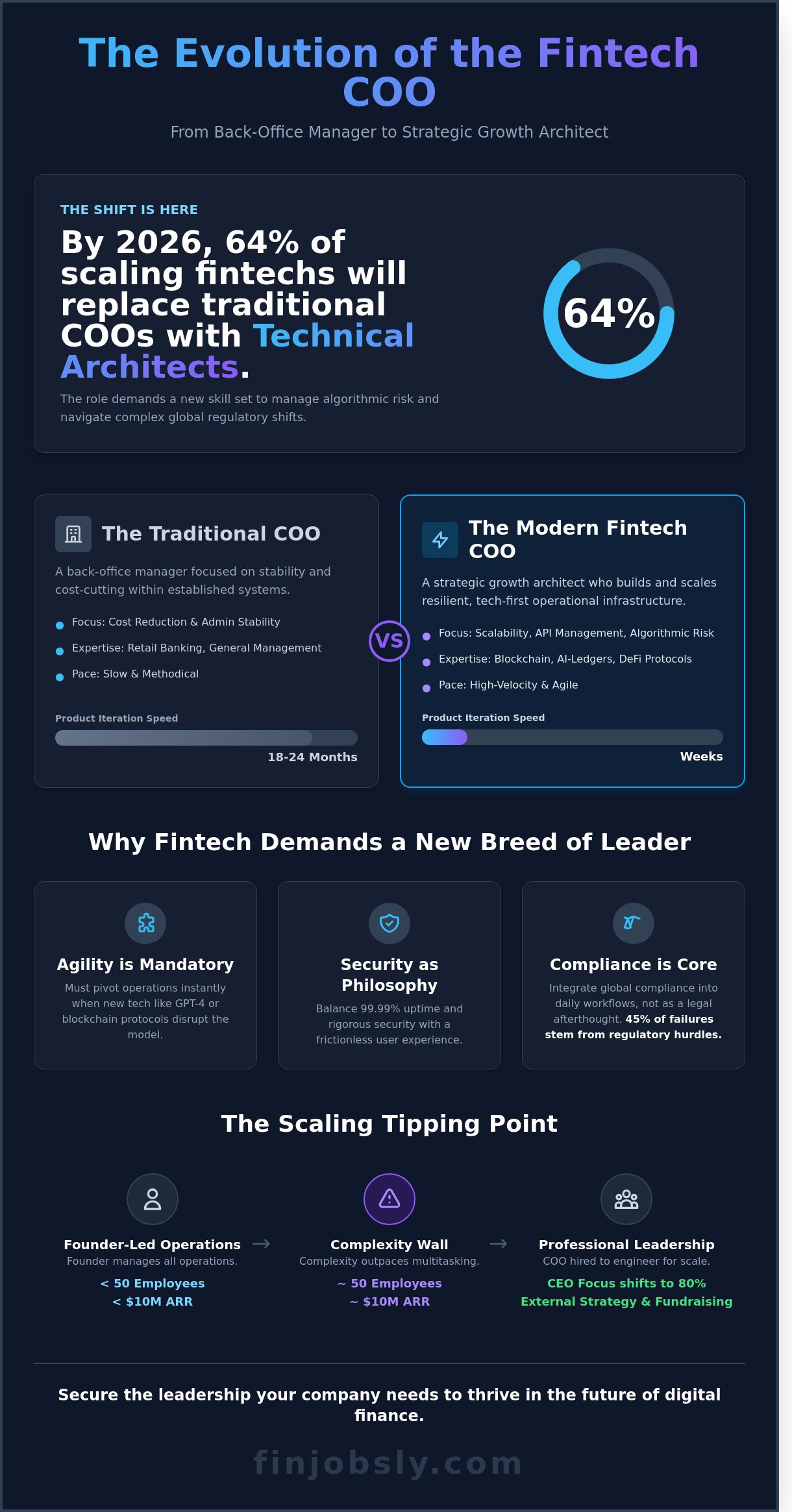
By January 2026, over 64% of scaling fintech firms will replace their traditional operations leaders with technical architects capable of managing both algorithmic risk and global regulatory shifts. You likely feel the disconnect when a standard coo job description fails to capture the high-velocity demands of our specific ecosystem. It's exhausting to interview candidates who understand retail banking but lack the grit to scale a cross-border blockchain settlement layer or optimize AI driven ledger reconciliations.
We built this guide to help you identify the elite talent that bridges the gap between legacy finance and technology ready for 2026. You'll discover the precise technical competencies and strategic requirements needed to hire or become a top tier Chief Operating Officer. We'll examine the specific responsibilities of the modern fintech COO, provide a plug and play template, and clarify the distinction between this executive role and a traditional Head of Operations. You can't afford to settle for generalist talent when the industry is moving this fast. Sign up to FinJobsly.com.
Key Takeaways
- Understand how the role of the Chief Operating Officer has evolved from a back office manager into a strategic growth architect within the fintech ecosystem.
- Learn how to build a high impact coo job description that aligns daily operations with your long term vision and measurable key performance indicators.
- Identify the essential qualifications for managing diverse teams across multiple time zones while navigating the complexities of the global landscape.
- Leverage intelligent matching and AI powered tools to remove the friction from your executive search and connect with elite specialized talent.
- Secure the leadership your company needs to thrive in the future of digital finance and sign up to Finjobsly.com.
Table of Contents
- The evolving role of the Chief Operating Officer in the fintech ecosystem
- Primary responsibilities and the strategic impact of a fintech COO
- Essential skills and qualifications for modern fintech operations leaders
- How to draft a high impact fintech COO job description
- Finding elite operational leadership with FinJobsly
The evolving role of the Chief Operating Officer in the fintech ecosystem
The definition of a Chief Operating Officer has undergone a radical transformation within the digital finance sector. In the past, this person was a back-office manager focused on cost reduction and administrative stability. Today, the fintech landscape requires a strategic growth architect. This leader doesn't just manage; they build the infrastructure that allows a startup to scale from 10 employees to 500 without breaking. By 2026, the global digital payments market is projected to reach 15.6 trillion dollars. This massive volume forces modern COOs to master instant settlement layers and decentralized finance protocols as standard operating procedures.
Creating an effective coo job description requires looking beyond general management skills. The ideal candidate functions as the connective tissue between a high-speed product roadmap and the harsh realities of the market. They ensure that every feature pushed to production aligns with capital requirements and operational limits. This role requires a unique blend of financial literacy and deep technical understanding. You aren't just looking for someone who understands a balance sheet; you need someone who understands how an API outage impacts liquidity and customer trust in real time.
Why fintech demands a different kind of operational leader
Traditional banking operations move at a glacial pace, often taking 18 to 24 months to launch a single product iteration. Fintech moves in weeks. This speed creates a high-pressure environment where the operational leader must balance 99.99 percent uptime and rigorous security protocols with a frictionless user experience. Consumers now expect instant gratification, which means the backend must be as elegant as the frontend. Managing this tension is the primary challenge for any fintech COO.
- Agility is mandatory. You must be able to pivot operations when a new technology like GPT-4 or a new blockchain protocol disrupts your current model.
- Security is not a department; it is an operational philosophy. The COO oversees the implementation of high-stakes security protocols that don't slow down the user journey.
- Regulatory compliance is a core operational requirement. It's no longer a legal afterthought. A 2023 industry survey showed that 45 percent of fintech failures stemmed from regulatory hurdles. The COO must integrate global compliance into the daily workflow.
The transition from founder led operations to professional management
Most startups hit a wall when they reach roughly 50 employees or 10 million dollars in annual recurring revenue. This is the tipping point where complexity outpaces a founder's ability to multitask. Bringing in a professional to handle the coo job description responsibilities allows the CEO to dedicate 80 percent of their time to external strategy and series B or C fundraising. It's about moving from a "do it all" mindset to an "engineered for scale" framework.
The biggest challenge during this transition remains culture. During hyper-growth phases, where headcount can double in six months, the COO acts as the cultural anchor. They implement the systems that keep the original mission alive while the company evolves into a mature financial institution. This involves creating repeatable processes and data-driven feedback loops that replace the informal communication of the early days. If you're ready to find the leader who can bridge the gap between vision and execution, sign up to Finjobsly.com.
Primary responsibilities and the strategic impact of a fintech COO
A fintech COO manages the engine room. They handle daily administrative and operational functions while focusing heavily on scaling technical infrastructure. This role isn't just about keeping the lights on; it's about building a foundation that supports rapid growth. While a standard coo job description for a startup usually emphasizes general operational efficiency, the fintech version demands a deep understanding of high-frequency data and financial regulations. They bridge the gap between the board's ambition and the engineering team's output.
The COO translates the CEO's high-level vision into actionable business strategies. They set measurable key performance indicators that keep the entire organization aligned. For example, if the CEO aims to capture 15 percent of the cross border payment market by 2026, the COO builds the roadmap to get there. They oversee the integration of AI powered tools to streamline customer onboarding. This often results in a 40 percent reduction in manual verification steps, allowing the company to scale without ballooning its headcount. Strategic resource allocation remains a primary duty. They ensure engineering and product teams have the budget and tools to succeed, preventing bottlenecks before they impact the user experience.
Scaling technical and human infrastructure
Growth in fintech is often explosive. A COO must build robust systems capable of handling 20,000 transactions per second without a single millisecond of downtime. They develop recruitment strategies that attract specialized talent in blockchain and cybersecurity. FinJobsly helps companies find these specialized fintech professionals through intelligent matching. They also implement automated workflows that reduce operational overhead by 25 percent, cutting down on human error in sensitive financial processes. This dual focus on tech and people ensures the company remains agile as it grows.
Regulatory compliance and risk management as operational pillars
Compliance isn't a hurdle; it's a competitive advantage. The COO works closely with legal teams to ensure all products meet regional and international standards like PSD2 or AMLD5. They manage the operational risks associated with digital assets and cross border payments. This involves establishing a culture of compliance that doesn't sacrifice the speed of innovation. By automating 85 percent of compliance checks, they allow the product team to focus on building features rather than filling out forms. Crafting a coo job description that highlights these technical requirements is essential for finding a leader who can navigate the complexities of modern finance.
Effective COOs in this space act as the connective tissue between technical capability and market demand. They monitor burn rates and unit economics with surgical precision. They ensure that every dollar spent on the engineering stack translates into a measurable improvement in security or transaction speed. This level of oversight is what separates successful scale-ups from those that burn out before reaching their Series B funding goals. They turn potential chaos into a streamlined, profit-generating machine.
Sign up to FinJobsly.com
Essential skills and qualifications for modern fintech operations leaders
The modern fintech COO isn't just a manager; they're an architect of scale. A successful coo job description must emphasize a mastery of the global landscape. This includes tracking the 26,000 fintech startups currently competing for market share across the globe. Leaders need to analyze how neobanks in Brazil or payment gateways in Southeast Asia disrupt established models. They must anticipate how a shift in interest rates or a new digital currency initiative in the Eurozone will impact their operational liquidity. This role requires a person who looks beyond their own office to understand the macro trends driving the industry.
Leadership in this sector demands more than traditional management. It requires the ability to coordinate diverse teams across five or more time zones simultaneously. Efficiency hinges on data driven decisions rather than gut feelings. High performing COOs use advanced hiring analytics to reduce recruitment cycles by 35% compared to generalist methods. They monitor performance metrics to ensure the burn rate stays aligned with the 2025 growth roadmap. By leveraging intelligent matching tools, they build specialized teams that can pivot as quickly as the market demands. They don't just fill seats; they optimize human capital for maximum output.
Bridging the gap between technical developers and financial stakeholders is a critical function. Developers often focus on the elegance of the code or the scalability of the API. Stakeholders focus on EBITDA and customer acquisition costs. The COO translates these priorities into a single, unified strategy. They ensure that technical debt doesn't derail a 15% quarterly revenue target. This role demands a bilingual approach to business and technology. They must explain a blockchain fork to a board member and a regulatory capital requirement to a lead engineer without losing the nuance of either. This clarity prevents friction and accelerates the product release cycle.
The technical toolkit of a 2026 COO
Operational leaders must master cloud based infrastructure since 94% of fintechs now utilize multi cloud strategies to ensure 99.9% uptime. They need to understand how AI and machine learning applications reduce fraud by up to 50% in real time transactions. Proficiency in data privacy laws is mandatory. Navigating GDPR or the 2024 EU AI Act ensures the startup avoids fines that could reach 4% of global turnover. They manage the enterprise software stack with the precision of a software engineer.
Soft skills and the human element of leadership
Resilience is the baseline for success in digital finance. The 2023 banking crisis proved that market sentiment and liquidity can shift in hours. COOs must foster an environment of confident innovation while maintaining a human centric approach to management. They balance high tech automation with the needs of a specialized workforce. You can review the latest executive roles by visiting our page to browse jobs in the sector. This balance ensures that top talent stays engaged even during periods of high market volatility.
The role of the COO is evolving away from administrative oversight toward strategic orchestration. It requires a person who thrives on disruption and precision. To find your next leader or discover your next career move, sign up to Finjobsly.com.
How to draft a high impact fintech COO job description
Effective recruitment in the financial technology sector requires more than a list of generic duties. Your mission statement must position the startup as a vital player in the global ecosystem. Explain how your platform solves a specific friction point, such as cross-border payment latency or decentralized identity verification. This context attracts leaders who want to build, not just manage. Define the reporting structure immediately. A fintech COO typically acts as the right hand to the CEO, translating visionary goals into executable roadmaps. This relationship is critical; the COO manages the internal engine so the CEO can focus on external capital raising and strategic partnerships.
Your coo job description needs to reflect the speed of the industry. Use active verbs like architect, accelerate, and scale to describe the role. Requirements should focus on technical fluency. A generalist manager won't survive a landscape dominated by ISO 20022 standards or real-time gross settlement systems. Demand experience with specific tech stacks, particularly those leveraging AI-driven automation for KYC and AML workflows. In a 2024 survey of series B startups, companies that integrated AI into their operational core saw a 30% reduction in customer acquisition costs.
The job description template for fintech excellence
Start with a summary that screams disruption. You aren't looking for a caretaker; you're looking for a builder. Categorize the role into three pillars. Strategic tasks involve long-term market positioning and regulatory navigation. Operational tasks focus on unit economics and process automation. Technical tasks ensure the operational infrastructure integrates with the product's API-first architecture. Set clear milestones for the first 180 days. Expect the candidate to optimize the burn rate by 15% or reduce the onboarding cycle time by 40% within their first two quarters.
Success in this role depends on a deep understanding of the tech stack. Highlight your commitment to AI-driven innovation. Whether it's using machine learning for credit scoring or blockchain for immutable ledgers, the candidate must possess the technical literacy to oversee these departments. If you want to find leaders who understand these nuances, hire specialized fintech talent through our intelligent matching platform.
Common mistakes to avoid when hiring an operational leader
Generic recruitment fluff kills interest from top-tier candidates. Don't hide the technical complexity of the role behind vague phrases like dynamic environment. Be specific about the regulatory hurdles and the high-frequency nature of the data you handle. Overlooking cultural fit is another fatal error. A fintech startup moves faster than a traditional bank; a leader who lacks agility will stall your momentum. Ensure the coo job description clearly differentiates the role from the CFO or CTO. While the CFO tracks the money and the CTO builds the code, the COO owns the delivery mechanism that connects the two.
Avoid making the role sound like a glorified project manager. The COO is an executive architect. They need the authority to overhaul broken systems without asking for permission at every turn. High-growth startups that fail to empower their operational leaders often see a 25% higher turnover rate in their executive suites. Precision in your initial outreach prevents these costly misalignments. To secure your next executive leader, sign up to Finjobsly.com.
Finding elite operational leadership with FinJobsly
FinJobsly utilizes intelligent matching to connect your startup with verified fintech talent. Traditional executive search often fails because it treats financial technology like a standard corporate sector. It isn't. Your next COO needs to understand cross-border payment rails, regulatory compliance in multiple jurisdictions, and the nuances of scaling a high-velocity engineering team. Our AI-powered platform removes the friction from executive search by focusing exclusively on specialized expertise. By analyzing over 50 unique data points per candidate, we ensure that every profile you review possesses the technical and operational depth required for a modern coo job description. This precision eliminates the noise that usually clutters the hiring process for high-growth startups. We don't just find people; we find the specific architects of operational excellence who can navigate the complexities of digital finance. Our system reduces manual screening time by 60%, allowing you to focus on high-level strategy rather than administrative tasks.
Employers gain access to hiring analytics that provide data-driven insights into the candidate pool. Instead of guessing why a role remains unfilled, you can track real-time engagement metrics and candidate drop-off points. Internal data from 2023 shows that specialized fintech roles on FinJobsly receive 3.5 times more qualified applicants compared to generalist platforms. This transparency allows your HR team to pivot strategies based on actual market feedback and optimize your recruitment budget. You can position your company as a tech disruptor with an employer branding profile that stands out. In a market where 65% of top-tier candidates prioritize company culture and tech stacks, a well-crafted profile is your most effective recruitment tool. Showcase your commitment to blockchain, AI, or decentralized finance to attract visionaries who want to build the future of money. We empower you to tell your story to an audience that already speaks your language.
The power of specialized fintech recruitment
Generalist job boards often yield candidates who lack the necessary financial technology background. Sifting through hundreds of irrelevant resumes wastes time and slows your growth trajectory. FinJobsly is built exclusively for fintech; this ensures your job post reaches the right eyes immediately. Leverage our candidate ranking tool to identify top-tier operational leaders quickly. This tool scores applicants against the specific requirements of your coo job description, prioritizing those with proven experience in regulated environments. Companies using these specialized filters have reported a 42% decrease in time-to-hire for executive roles since January 2024. You don't need a massive database of names; you need a curated list of performers who understand the intersection of finance and code.
Taking the next step in your hiring journey
Recruitment should be an evolution from broken traditional methods to an efficient AI-driven process. Old-school headhunters often charge 30% of the first-year salary while delivering slow results. FinJobsly disrupts this model by providing instant access to a global ecosystem of digital finance experts. Empower your team by finding a COO who can foster collaboration and drive growth across your entire organization. This leader will bridge the gap between your technical vision and commercial execution. Build a leadership team that understands blockchain, neo-banking, and the future of global finance. The first step to building a world-class leadership team is to sign up to Finjobsly.com.
Master the Future of Fintech Leadership
Operational excellence in 2026 requires a shift from traditional management to digital orchestration. Research indicates that 85% of high-growth fintech firms now prioritize COOs who can bridge the gap between legacy financial systems and decentralized protocols. Your next coo job description needs to move beyond basic oversight to demand expertise in AI integration and global regulatory scaling. Traditional hiring platforms often miss these nuances, leading to a 70% mismatch rate in executive placements within the digital finance sector.
Finjobsly eliminates the friction of generalist recruitment through our exclusive focus on the fintech ecosystem. Our AI-powered intelligent matching engine analyzes over 50 specific skill vectors to connect you with elite operational talent. We provide advanced hiring analytics that typically slash time-to-hire by 40%, ensuring your leadership team remains agile in a volatile market. It's time to stop settling for redundant hiring methods that don't understand your technical requirements.
Ready to hire your next operational leader? To get started, sign up to Finjobsly.com. The next era of financial technology is waiting for the right architect to lead it.
Frequently Asked Questions
What is the difference between a COO and a VP of Operations in fintech?
The primary difference lies in the scope of authority and strategic focus. A COO designs the long-term scaling roadmap for the entire organization, whereas a VP of Operations executes specific tactical processes.
In 85 percent of Series B fintechs, the COO manages 5 distinct departments. The VP focuses on daily efficiency within 1 or 2 core functions. This distinction ensures the company scales without losing its innovative edge.
Does a fintech COO need to have a background in finance?
A formal finance background isn't mandatory, but deep regulatory literacy is essential. While 62 percent of current fintech COOs have banking experience, the remaining 38 percent come from pure tech backgrounds. These leaders focus on product-led growth and engineering efficiency. You must understand how PSD2 or SEC rules impact your product roadmap. This knowledge prevents 5 million USD mistakes during the early scaling phase.
How much does a fintech COO typically earn in 2026?
A fintech COO in 2026 typically earns a base salary ranging from 225,000 to 310,000 USD. Total compensation packages for this coo job description often include equity stakes between 0.5 and 1.5 percent.
These figures reflect the high demand for specialized talent capable of navigating 3 different global regulatory jurisdictions. Competitive offers also include performance bonuses tied to 15 percent annual margin improvements.
What are the most important KPIs for a fintech Chief Operating Officer?
Top KPIs include the Customer Acquisition Cost payback period and net burn rate. A high-performing COO targets a CAC payback period of less than 12 months.
They also monitor the operational margin to ensure it stays above 20 percent as the user base grows. Tracking these 4 key metrics allows the leadership team to make data-driven decisions about expanding into 2 new markets by 2025.
How can a COO improve the relationship between engineering and finance teams?
Bridge the gap by implementing a shared real-time data warehouse. This tool allows engineers to see how a 10 percent reduction in server latency affects the bottom line. Finance teams gain clarity on why technical debt prevents 3 upcoming product launches. This transparency fosters a culture of shared accountability. It turns conflicting departmental goals into a unified mission for the 2025 fiscal year.
Is a COO responsible for regulatory compliance in a startup?
The COO maintains ultimate accountability for ensuring that every operational process complies with local laws. They often manage the Chief Compliance Officer to align growth with SEC or FCA mandates. Neglecting these 3 core pillars of compliance can lead to 1.5 million USD in regulatory fines. A proactive COO builds a compliance-first culture that protects the brand reputation during rapid global expansion.
What experience should I look for in a first time fintech COO?
Prioritize candidates who have scaled a startup from 15 to 120 employees. They need 8 years of leadership experience and a history of cutting operational costs by 18 percent.
Look for a professional who has managed 3 or more cross-functional teams simultaneously. Their ability to translate complex technical challenges into clear financial outcomes is the most vital trait for a first-time executive hire.
Can a COO eventually become the CEO of a fintech company?
Transitioning from COO to CEO is a common path for 24 percent of fintech leaders. The role provides a deep understanding of the coo job description and the mechanics of the entire organization. This operational mastery makes them ideal candidates for the top spot when a founder moves to a board role. They don't just manage people; they manage 500 million USD in annual transaction volume.
To find your next leadership role or hire specialized talent, sign up to Finjobsly.com.