

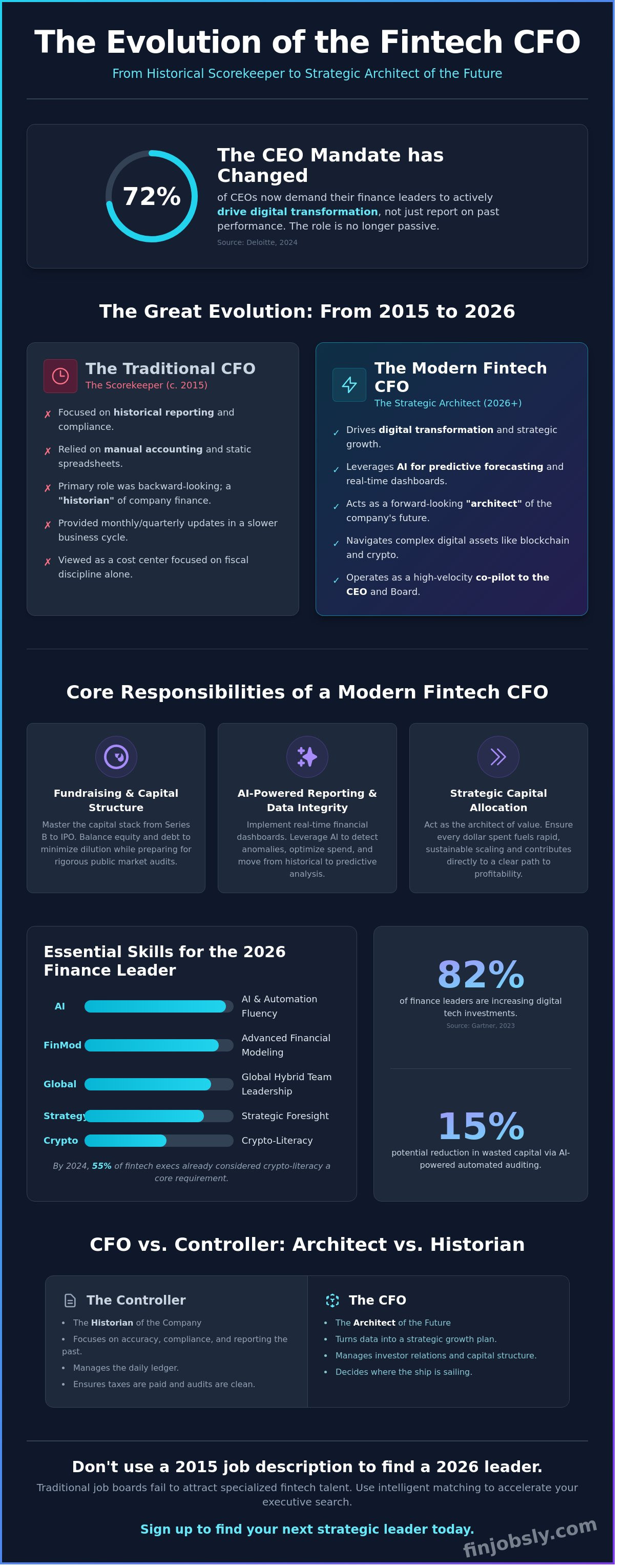
By 2026, the traditional balance sheet expert will be obsolete in the high growth fintech ecosystem. Recent data from a 2024 Deloitte survey indicates that 72 percent of CEOs now demand their finance leaders drive digital transformation rather than just reporting on it. You likely feel the pressure of this shift as you struggle to find a candidate who bridges the gap between complex blockchain protocols and quarterly earnings. Your current cfo job description probably feels like a relic from 2015; it fails to attract the strategic thinkers who actually understand how AI impacts the daily workflow of a modern finance department. Old templates don't work anymore.
We understand that the search for specialized talent in 2026 requires a radical departure from broken recruitment methods. This article provides you with a comprehensive, customizable cfo job description template designed to filter for deep tech expertise and strategic foresight. You will discover exactly how the role has evolved within the fintech ecosystem and learn which specific skills are non-negotiable for a 2026 leader. We are going to break down the intelligent matching criteria you need to accelerate your executive search and secure a partner who can navigate the cold precision of AI with a human-centric mission. To start finding your next strategic leader today, sign up to FinJobsly.com.
Key Takeaways
- Understand how the finance leader has evolved from a traditional scorekeeper into a strategic architect for the modern fintech ecosystem.
- Identify critical responsibilities for 2026 including rapid capital allocation and managing investor relations from Series B to IPO.
- Access a customizable cfo job description template designed to attract elite talent who thrive in high growth digital environments.
- Evaluate essential qualifications such as advanced financial modeling and the ability to lead global hybrid teams through intelligent matching.
- Discover how specialized AI tools outperform generalist job boards for executive search and sign up to Finjobsly.com.
Table of Contents
- The Evolution of the CFO: From Scorekeeper to Strategic Architect
- Core Responsibilities of a Modern Fintech CFO
- Essential Skills and Qualifications for the 2026 Finance Leader
- Customizable CFO Job Description Template
- Optimizing Your Executive Search with FinJobsly AI
The Evolution of the CFO: From Scorekeeper to Strategic Architect
Finance is no longer a back-office function hidden behind stacks of ledgers. The modern Chief Financial Officer (CFO) operates as a high-velocity co-pilot to the CEO and the Board. This transformation isn't just a change in title; it's a complete overhaul of the finance function. The fintech ecosystem moves too fast for traditional methods. Static spreadsheets and monthly closing cycles are relics of a slower era. Today, the cfo job description demands a leader who can navigate complex digital assets while maintaining fiscal discipline. You aren't just reporting the news; you're making it happen.
Predictive AI-driven forecasting has replaced the gut feelings of the past. A 2023 report from Gartner indicated that 82% of finance leaders planned to increase their digital technology investments. This shift allows teams to move from historical reporting to real-time analysis. Instead of asking what happened last quarter, modern leaders ask what will happen in the next six months. They use data-driven insights to pivot strategies instantly. This level of precision is the new standard for anyone looking to browse jobs in high-growth tech sectors.
Why the Traditional CFO Role is Obsolete
Manual accounting is a liability in a world of instant transactions. Relying on backward-looking data creates a blind spot that competitors will exploit. Agility is the new currency for finance leaders. You need to understand how blockchain and decentralized finance impact global liquidity and settlement speeds. In 2024, a survey of fintech executives revealed that 55% now consider crypto-literacy a core requirement for senior roles. If you can't speak the language of smart contracts and automated workflows, you're becoming a dinosaur. The role now requires a tech-first mindset that prioritizes automation over manual entry. It's about being proactive, not reactive.
CFO vs. Controller: Understanding the Distinction
Many professionals confuse these roles, but the gap is wide. A Controller is the historian of the company. They focus on accuracy, compliance, and reporting the past. They ensure the taxes are paid and the audits are clean. The CFO is the architect of the future. They take the data provided by the Controller and turn it into a strategic growth plan. While they both share duties in risk management and internal controls, their board-level involvement differs significantly. The CFO manages investor relations and capital structure, while the Controller manages the daily ledger. One keeps the lights on; the other decides where the ship is sailing.
Are you ready to lead the next generation of digital finance? It's time to find a role that matches your specialized talent. Sign up to Finjobsly.com.
Core Responsibilities of a Modern Fintech CFO
The modern fintech CFO operates at the intersection of high-velocity growth and institutional stability. Their role has evolved far beyond traditional ledger management. Today, it centers on strategic capital allocation that fuels rapid scaling while maintaining the razor-sharp unit economics required for a path to profitability. This evolution is why the cfo job description now prioritizes data fluency and investor relations over simple accounting oversight. Leaders in this space act as the ultimate architects of value, ensuring every dollar spent contributes directly to sustainable market expansion.
Fundraising and Capital Structure
Fintech leaders must master the art of the capital stack. This involves balancing equity rounds with strategic debt financing to minimize dilution while maximizing runway. A CFO leading a company from Series B through an IPO manages more than just cash flow; they maintain a pristine cap table that stays attractive to late-stage investors. In 2024, 68% of successful fintech exits relied on this level of meticulous financial preparation. They prepare the organization for exit strategies by ensuring financial audits meet the rigorous standards of public markets long before the filing date.
Data Integrity and AI-Powered Reporting
Static quarterly reports are relics of a slower era. The current cfo job description requires the implementation of real-time financial dashboards that provide an instantaneous pulse on the business. Modern leaders leverage AI to detect anomalies in transaction patterns and optimize operational spend, often identifying a 15% reduction in wasted capital through automated auditing. This technical shift allows for a deep dive into customer acquisition costs and lifetime value metrics. Collaboration with the COO is essential to bridge the gap between financial targets and operational efficiency. If you're looking to step into this tech-driven role, you can browse specialized fintech openings to see how leading firms define these requirements.
Regulatory and Fintech Compliance
Operating in digital finance means navigating a labyrinth of global regulations. CFOs oversee the integration of robust Anti-Money Laundering and Know Your Customer protocols into the financial infrastructure. They must stay ahead of changing mandates from bodies like the SEC or FCA, ensuring that innovation doesn't outpace legal boundaries. 82% of fintech firms cited regulatory shifts as their primary risk in a 2024 industry survey. Researching the 12 essential skills for CFOs reveals that risk management and cybersecurity are now foundational to the C-suite. This specialized knowledge protects the firm's license to operate and maintains the trust of both users and global regulators.
sign up to Finjobsly.com
Essential Skills and Qualifications for the 2026 Finance Leader
The 2026 finance leader operates at the intersection of capital and code. A modern cfo job description now prioritizes advanced proficiency in financial modeling and intelligent matching analytics. You need to command global teams across time zones while maintaining a deep understanding of the fintech ecosystem. This includes mastering the nuances of cross-border payments and the agility of neo-banking platforms.
Traditional accounting knowledge remains the foundation, but it is no longer the ceiling. You must translate complex data into board-level strategy with surgical precision. This requires a shift from historical reporting to predictive architecture. Modern leaders don't just count value; they engineer it using the same disruptive tools that are currently reshaping the global economy.
Technical Mastery in the Age of AI
Efficiency starts with automated ERP and billing systems. Manual entry is a relic of 2015. Today, 70 percent of finance leaders prioritize data science literacy as a core skill for their executive teams. You must interpret raw data into actionable insights while maintaining rigorous cybersecurity awareness. Protecting the balance sheet now means protecting the data perimeter from increasingly sophisticated threats.
A comprehensive cfo job description requires experience with decentralized finance and blockchain integration. You need to understand how these technologies reduce friction in the fintech ecosystem. This technical fluency allows you to build scalable financial infrastructures that support rapid global expansion without increasing headcount proportionally.
Soft Skills for Executive Influence
High emotional intelligence drives success in high-growth environments. You act as a mentor to the wider finance department, fostering a culture of innovation and resilience. The Modern CFO's Strategic Evolution highlights how leaders must anticipate market change and activate digital agendas to stay competitive. This requires more than just technical skill; it demands the ability to lead through uncertainty.
Crisis management remains a vital component of the role. You will navigate market volatility and communicate shifts in strategy to stakeholders with clarity and confidence. Managing a remote or hybrid global finance team requires a proactive communication style that bridges geographical gaps. You must ensure every team member stays aligned with the overarching corporate vision regardless of their physical location.
To find your next high-impact role in the fintech space, sign up to Finjobsly.com.
Customizable CFO Job Description Template
Finding the right executive leader requires more than a list of generic tasks. It demands a narrative that attracts high-caliber talent. Traditional job boards are often cluttered with repetitive templates that fail because they don't capture the unique velocity of the fintech sector. Use this framework to build a cfo job description that resonates with modern finance professionals who prioritize data over intuition.
Role Summary and Company Vision
Start with why your company exists. A compelling opening should describe your mission to disrupt legacy systems or scale borderless payments. Avoid dry corporate speak. Instead, highlight your commitment to a tech-driven finance stack. If you're a fintech startup, emphasize that your CFO will act as a strategic architect of growth rather than a mere bookkeeper. You can view live executive roles to see how industry leaders are currently positioning their brand stories.
Example text for a startup: We are building the future of decentralized finance. Our team replaces manual reconciliation with automated smart contracts. We need a CFO who thrives in 400 percent annual growth environments and values intelligent matching over traditional networking.
Detailed Duties and Requirements
Specificity drives quality applications. Your candidate needs to know exactly what their first 90 days will look like. List the daily and weekly expectations clearly to filter out those who aren't ready for the pace of digital finance. Reviewing current job listings can provide a benchmark for how top-tier firms structure their internal requirements.
- Lead capital raising efforts, including Series B or C rounds and debt financing.
- Oversee the integration of AI-powered analytics into the monthly reporting cycle.
- Manage global tax compliance and cross-border regulatory frameworks.
- Direct the financial planning and analysis team to provide real-time runway projections.
- Present data-driven insights to the Board of Directors and key stakeholders.
Educational and professional requirements should remain rigorous. Most successful candidates hold an MBA from a top-tier institution or a CPA designation. Look for at least 10 years of experience, with a minimum of 4 years specifically within the fintech or high-growth SaaS ecosystem. This ensures they understand the nuances of recurring revenue models and customer acquisition costs. To reach this specific pool of verified talent, post your cfo job description on a specialized platform that understands the intersection of finance and technology.
sign up to Finjobsly.com.
Optimizing Your Executive Search with FinJobsly AI
Traditional recruitment methods often fail when applied to high-stakes leadership roles. Posting a cfo job description on a generalist board typically results in a deluge of unqualified applicants. Hiring teams waste dozens of hours sifting through resumes that lack the technical depth required for modern finance. FinJobsly AI disrupts this cycle. We focus exclusively on the fintech ecosystem, replacing the manual grind with intelligent matching. Our system understands the nuances of digital assets, regulatory compliance, and venture-backed scaling.
Reaching Specialized Talent in the Fintech Ecosystem
Elite finance leaders don't browse generic job sites. They operate within niche networks where their expertise in decentralized finance or algorithmic trading is respected. FinJobsly bridges the gap between these high-level professionals and tech-driven employers. Our platform verifies talent through a rigorous vetting process. We ensure candidates possess both the strategic vision and the technical literacy needed for a modern cfo job description. Intelligent matching algorithms analyze candidate history and skill sets to surface only those who align with your specific growth stage. This precision saves hours of administrative labor. It places your opportunity directly in front of the top 5 percent of available talent.
Reducing the Cost of a Bad Hire
Executive recruitment carries immense risk. Research from the U.S. Department of Labor indicates that the cost of a bad hire reaches at least 30 percent of the individual's first-year earnings. For C-suite roles, industry data suggests this figure often climbs to 213 percent of the annual salary. FinJobsly mitigates this risk through data-driven screening. Our hiring analytics identify potential mismatches before they reach the interview stage. We focus on cultural fit and technical competency simultaneously. Utilizing featured listings helps your role gain visibility among passive candidates who aren't actively searching but are open to the right disruptive opportunity. This proactive approach has helped our partners reduce their average time-to-hire by 40 percent compared to traditional agencies. Stop settling for the best available candidate. Start hiring the best possible fit.
Transform your leadership team today. Visit https://finjobsly.com/signup to sign up to Finjobsly.com.
Secure Your 2026 Finance Leadership Today
The role of the finance leader is shifting faster than traditional job boards can track. By 2026, McKinsey predicts that high-performing CFOs will spend over 60 percent of their time on strategic initiatives rather than transactional tasks. You can't rely on a generic template when the market demands a specialized architect who understands blockchain and decentralized finance. Your cfo job description needs to reflect this shift toward data-driven decision-making and real-time hiring analytics. We've built a platform that cuts through the noise of generalist recruitment. Finjobsly leverages AI-powered intelligent matching to connect you with talent specifically vetted for the fintech ecosystem. It's time to stop settling for candidates who look good on paper but lack the technical depth your firm requires. Secure your competitive edge with advanced hiring analytics that identify the top 5 percent of finance innovators. Our system processes thousands of data points to ensure your next hire is a perfect cultural and technical fit. Let's build the future of your finance department together.
Ready to find your next strategic finance leader? Sign up to Finjobsly.com.
Frequently Asked Questions
What is the typical salary for a fintech CFO in 2026?
A fintech CFO in 2026 can expect a total compensation package ranging from $450,000 to $750,000 depending on the company's valuation and funding stage. Base salaries typically sit between $300,000 and $450,000; however, equity grants often make up 30% of the total value. This represents a 15% increase from 2024 levels as the demand for specialized talent capable of navigating complex global regulations continues to surge across the ecosystem.
What are the most important qualifications for a modern CFO?
Modern CFOs need a blend of traditional financial mastery and deep technical literacy involving data-driven decision-making tools. While a CPA or MBA remains a foundational requirement for 85% of roles, proficiency in SQL or Python and experience with blockchain ledger systems is now mandatory for high-growth firms. Your cfo job description should prioritize candidates who have successfully led at least two funding rounds or managed a successful exit.
How does AI change the responsibilities of a Chief Financial Officer?
AI shifts the Chief Financial Officer's role from historical reporting to real-time predictive modeling and automated risk management. Instead of spending 40% of their time on manual data reconciliation, modern leaders use AI-powered tools to forecast cash flow with 98% accuracy. This transition allows them to act as a strategic partner, focusing on intelligent matching of capital to growth opportunities rather than just balancing the books.
Does a startup need a CFO or a Head of Finance?
Startups typically hire a Head of Finance during Seed or Series A stages and transition to a CFO once they reach Series B or exceed $20 million in annual recurring revenue. A Head of Finance focuses on operational accounting and monthly reporting. In contrast, a CFO takes on the heavy lifting of investor relations, capital structure, and long-term strategic planning required for a potential IPO or acquisition in 2026.
How long does it usually take to hire a qualified CFO?
It takes an average of 120 to 180 days to hire a qualified CFO in the current competitive market. This timeline accounts for the rigorous vetting process, multiple interview rounds with board members, and the standard three-month notice period common for executive-level professionals. Utilizing a specialized platform like Finjobsly can reduce this search time by 40% through intelligent matching and a pre-vetted pool of fintech experts.
What is the difference between a CFO and a Chief Revenue Officer?
The CFO manages the company's capital, financial risk, and reporting, while the Chief Revenue Officer focuses exclusively on driving top-line sales and market expansion. While both roles sit in the C-suite, the CFO ensures that the 25% annual growth generated by the CRO remains profitable. They collaborate to align sales targets with the 12-month cash runway requirements of the organization to prevent over-leveraging during aggressive scaling phases.
Can a CFO work remotely in the fintech industry?
Remote work is highly viable for fintech CFOs, with 62% of new job postings in 2025 offering hybrid or fully distributed options. Digital-first companies leverage cloud-based ERP systems and secure communication channels to maintain financial oversight from any location. This flexibility allows firms to access a global talent pool, ensuring they don't miss out on top-tier leaders who prefer an agile work environment over a traditional office setting.
What interview questions should I ask a potential CFO candidate?
When finalizing your cfo job description, ask candidates how they have utilized data-driven insights to pivot a strategy during a market downturn. Specifically, ask them to describe a time they improved EBITDA by at least 15% through specific operational efficiencies. Another vital question involves their experience with regulatory compliance across 5 or more jurisdictions, as this reveals their ability to scale rapidly in the global fintech ecosystem.
Sign up to Finjobsly.com.