

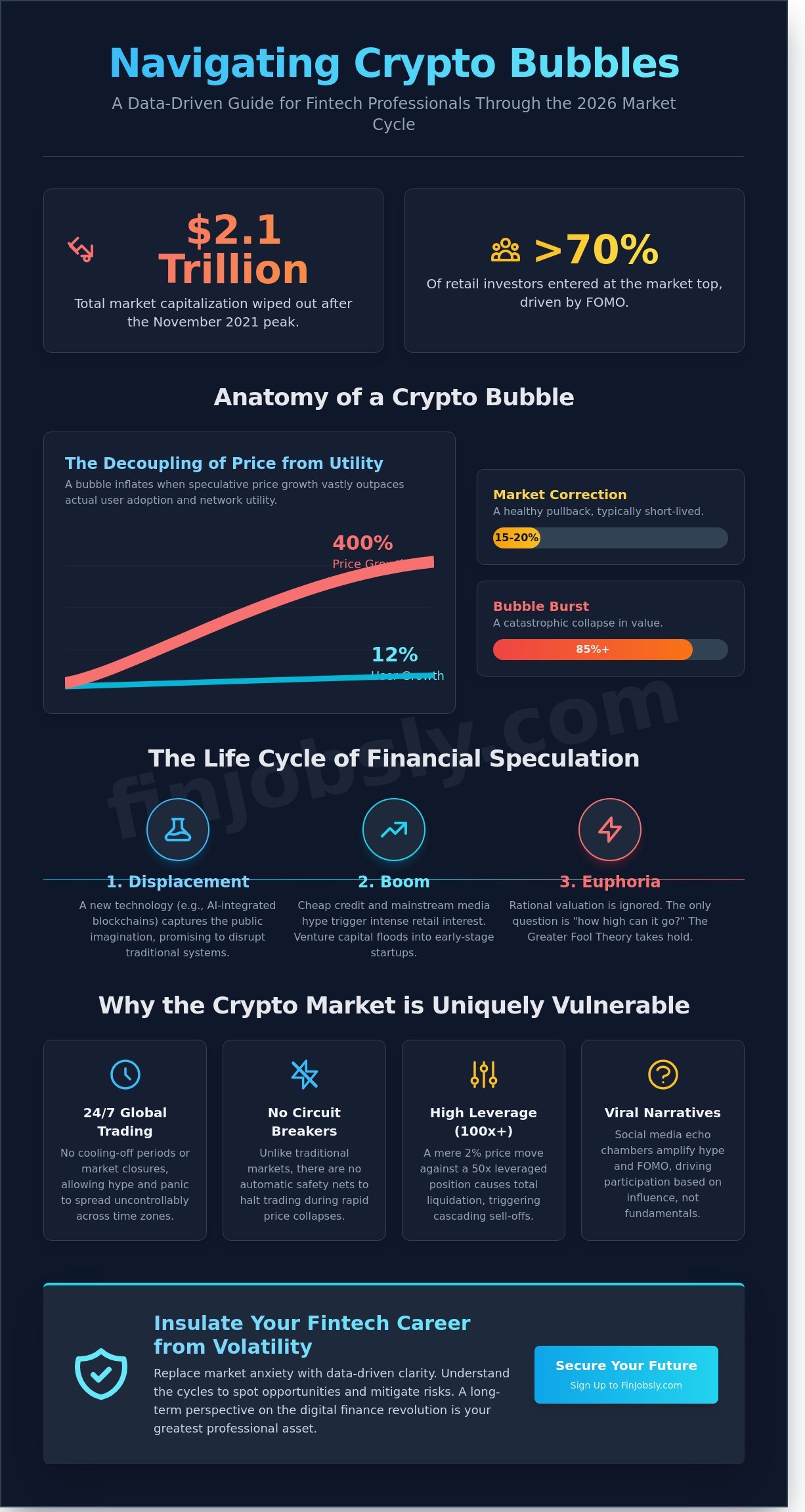
Your fintech career shouldn't depend on whether a meme coin hits a penny or a billion-dollar valuation. Historical data from the November 2021 market peak shows that over 70 percent of retail investors entered at the absolute top, driven by a fear of missing out that eventually triggered a 2.1 trillion dollar wipeout in total market capitalization. You likely feel that familiar tension as the market moves past the 2024 halving and accelerates toward the projected 2026 peak. It's difficult to distinguish between legitimate blockchain innovation and a classic bubble in cryptocurrency when your social feed is a non-stop stream of hype and overnight millionaires.
We're here to replace that anxiety with data-driven clarity and intelligent matching for your professional future. This guide breaks down the mechanics of market cycles so you can spot the warning signs before the correction begins. You'll learn how to identify the specific characteristics of a bubble while receiving actionable advice to insulate your career from the volatility of the 2026 cycle. We explore the transition from speculative frenzy to sustainable utility within the global fintech ecosystem. Secure your professional trajectory and sign up to FinJobsly.com.
Key Takeaways
- Identify the technical indicators of a bubble in cryptocurrency by analyzing the disconnect between speculative price surges and actual blockchain utility.
- Decode the market mechanics and psychological drivers like FOMO that fuel the Greater Fool Theory during periods of intense digital asset euphoria.
- Analyze how extreme market cycles reshape the fintech hiring ecosystem and the influx of venture capital into early stage startups.
- Utilize a professional risk assessment checklist to navigate your career through boom and bust cycles with data-driven precision.
- Maintain a long-term perspective on the digital finance revolution to protect your professional trajectory and sign up to Finjobsly.com.
Table of Contents
- Understanding the Anatomy of a Bubble in Cryptocurrency
- The Psychology and Mechanics Behind Market Euphoria
- From 2017 to 2026: A History of Boom and Bust
- How Crypto Volatility Reshapes the Fintech Job Market
- Navigating Your Fintech Career Through Market Cycles
Understanding the Anatomy of a Bubble in Cryptocurrency
A bubble in cryptocurrency defines a period where the market value of a digital asset wildly outpaces its actual utility or adoption metrics. You see this when prices skyrocket while the underlying protocol handles fewer than 1,000 transactions per day. It is a decoupling of reality from speculation. Traditional finance relies on intrinsic value metrics like dividends or tangible assets; crypto relies on network effects. We use Metcalfe’s Law to measure value, suggesting a network's worth is proportional to the square of its users. When price growth hits 400 percent but user growth stays at 12 percent, the bubble is inflating. By April 2026, several market signals point toward speculative overextension. We see a massive rise in low-utility meme coins reaching multi-billion dollar market caps while institutional liquidity remains stagnant. You must distinguish between a market correction, which is a healthy 15 to 20 percent pullback, and a total burst where assets lose 85 percent of their value in weeks.
The Life Cycle of Financial Speculation
Speculation begins with displacement. This occurs when a new technology, such as decentralized physical infrastructure or advanced AI-integrated blockchains, captures the public imagination. Investors see a future where traditional intermediaries vanish. Next comes the boom period. Central banks might lower interest rates by 25 basis points, making credit cheap and pushing capital into riskier assets. Mainstream media outlets start running headlines about overnight millionaires, which triggers intense retail interest. By studying the history of cryptocurrency bubbles, we recognize that the final stage is always euphoria. Rational valuation metrics are ignored. People stop asking what a token does and only ask how high it can go. This phase is characterized by a total lack of risk management and a belief that the old rules of economics no longer apply to the fintech ecosystem.
Why Crypto is Uniquely Prone to Bubbles
The digital asset market operates under conditions that amplify volatility. Crypto never sleeps; 24/7 global trading means there is no cooling-off period for heated markets. Unlike the New York Stock Exchange, which uses circuit breakers to halt trading if the S&P 500 drops 7 percent, crypto markets have no such safety nets. This environment is highly susceptible to viral narratives. Social media platforms act as echo chambers where retail participation is driven by influencers rather than data-driven hiring analytics or technical whitepapers. Several factors contribute to this unique vulnerability:
- High leverage availability where exchanges offer up to 100x margin on trades.
- Algorithmic trading bots that trigger massive liquidation cascades during small price dips.
- Lack of standardized regulatory oversight across different global jurisdictions.
- Instantaneous transfer of capital that allows for rapid, coordinated pump-and-dump schemes.
The impact of high leverage is particularly destructive. When a trader uses 50x leverage, a mere 2 percent move against their position results in total liquidation. This forced selling creates a domino effect, dragging prices down further and triggering more liquidations. This mechanical selling has nothing to do with the technology's value but everything to do with market structure. Finjobsly understands that the future of digital finance requires professionals who can navigate these turbulent cycles with precision and specialized expertise. To stay ahead of the curve in this evolving market, sign up to Finjobsly.com.
The Psychology and Mechanics Behind Market Euphoria
Euphoria in digital finance isn't a glitch; it's a functional feature of the current cycle. The Greater Fool Theory remains the dominant force driving the bubble in cryptocurrency today. This theory dictates that price increases stay sustainable only as long as a new participant is willing to pay a higher premium. When the pool of buyers dries up, the floor collapses. FOMO acts as the primary engine for this late-stage capital infusion. It triggers a psychological panic where investors prioritize potential gains over risk management. This behavior often leads to the entry of retail capital at the absolute peak of the market cycle.
Social validation accelerates this process. Platforms like X and Discord serve as high-velocity echo chambers. They amplify bullish sentiment while silencing dissent through community pressure. This environment makes it difficult for individual investors to maintain objectivity. Academic studies on Speculative bubbles and herding in cryptocurrencies confirm that herding behavior often overrides rational decision-making during periods of extreme volatility. Investors stop looking at whitepapers and start looking at follower counts. This shift marks the dangerous transition from smart money accumulation to a retail-driven frenzy.
The Role of Institutional Narrative
The landscape of 2026 differs significantly from the retail-led spikes of 2017 or 2021. Institutional adoption provides a new layer of perceived stability. The approval of spot ETFs in January 2024 brought over $12 billion in net inflows within the first three months of trading. Corporate treasuries, led by firms like MicroStrategy, now treat Bitcoin as a primary reserve asset. Professional analysts utilize sophisticated supply-demand models to justify high valuations. They point to the halving cycles and institutional liquidity as proof of a new era. However, this narrative often serves to mask the same speculative mechanics that define a bubble in cryptocurrency. The entrance of big money doesn't eliminate volatility; it simply scales the stakes for the entire fintech ecosystem.
Identifying the Inflection Point
Spotting the termination point requires looking past the headlines. On-chain data provides the most accurate roadmap for identifying market exhaustion. When whale wallets holding 1,000 or more BTC begin distributing their holdings to smaller retail addresses, the end is usually near. This redistribution phase often correlates with a surge in celebrity endorsements. In 2021, the peak coincided with high-profile Super Bowl commercials and mainstream media blitzes. Today, we track social sentiment spikes alongside exchange inflow data. When retail deposits increase by more than 40% in a single week, it often signals an overextended market. Staying ahead of these trends requires an intelligent matching of data-driven insights and human intuition. High-level fintech professionals use these metrics to hedge positions before the liquidity evaporates.
The transition from euphoria to panic happens in milliseconds. Smart money exits through the liquidity provided by late-arriving retail traders. Understanding these mechanics is essential for anyone operating within the modern financial technology sector. To stay updated on industry trends and find your next role in this fast-moving space, sign up to Finjobsly.com.
From 2017 to 2026: A History of Boom and Bust
The 2017 cycle defined the first global retail mania, turning a niche cryptographic experiment into a household name. Bitcoin surged from $900 in January to nearly $20,000 by December 2017, fueled by the Initial Coin Offering (ICO) craze. Data from Satis Group revealed that 80 percent of ICOs conducted in 2017 were identified as scams. This speculative fever eventually broke, leading to the 2018 regulatory winter where Bitcoin shed 84 percent of its value. Research from Utrecht University highlights that cryptocurrency market bubbles often dwarf historical precedents due to high leverage and 24/7 trading availability. This collapse forced a massive industry pivot toward technical viability over marketing hype.
Innovation accelerated during the 2021 cycle, shifting the focus to Decentralized Finance (DeFi) and Non-Fungible Tokens (NFTs). Total Value Locked in DeFi protocols exploded from $600 million in early 2020 to over $180 billion by November 2021. This era proved blockchain could handle complex financial logic, not just simple transfers. Even though the 2022 collapse of Terra-Luna and FTX wiped out $2 trillion in market capitalization, the recovery time was significantly faster than the 2018 correction. Institutional infrastructure began to solidify, paving the way for the current 2025 to 2026 cycle.
The 2025 to 2026 market cycle represents a fundamental shift toward AI-integrated blockchain ecosystems. We are no longer seeing a generic bubble in cryptocurrency driven by retail FOMO. Instead, growth is fueled by AI agents managing on-chain liquidity and decentralized compute networks like Fetch.ai and Render. These platforms provide tangible services to the tech sector. High-level fintech professionals now focus on building intelligent matching systems and data-driven protocols that solve real enterprise bottlenecks. This cycle's resilience stems from the fact that the technology is finally catching up to the original vision of decentralized efficiency.
Lessons Learned from Previous Crashes
Survival in the fintech ecosystem requires more than just capital; it demands utility. The strongest projects, such as Ethereum and Chainlink, emerged from previous rubble because they provided essential infrastructure. Regulation has also matured. The implementation of the Markets in Crypto-Assets (MiCA) framework in 2024 provided the legal clarity that was missing in 2017. Markets now punish speculative tokens faster while rewarding protocols that demonstrate consistent hiring analytics and developer growth. This evolution ensures that only the most efficient platforms thrive.
The 2026 Difference: Real-World Utility
The 2026 landscape differs from 2022 because of institutional rails and cash flow. BlackRock's BUIDL fund, launched in March 2024, signaled the era of tokenized real-world assets. Layer 2 solutions like Arbitrum and Optimism have reduced transaction costs by over 90 percent, making micro-payments feasible for global trade. Any 2026 correction will likely be less severe because the market is anchored by institutional liquidity rather than just retail speculation. We have moved from digital gold to digital utility, creating a more stable foundation for specialized talent to build lasting careers.
Sign up to Finjobsly.com
How Crypto Volatility Reshapes the Fintech Job Market
Market cycles dictate the flow of talent just as much as they dictate price action. When a bubble in cryptocurrency begins to expand, venture capital firms flood the market with liquidity. In 2021 alone, crypto startups secured over $33 billion in funding; this represented a 550% increase from the previous year. This capital creates an artificial hiring surge. Startups scale aggressively to capture market share, often prioritizing speed over sustainable unit economics. Candidates who join these early-stage ventures at a market peak face significant risk. History shows that when the bubble bursts, the first thing to go is the bloated headcount. Over 10,000 crypto professionals lost their jobs within months of the 2022 market correction.
Analyzing the previous bubble in cryptocurrency reveals that talent moves in waves, often trailing price action by three to six months. This lag occurs because companies take time to realize their burn rate is unsustainable after the initial price drop. Professionals should look past the hype of massive seed rounds and focus on the technical maturity of the product. Engineering teams that focus on scalability rather than marketing gimmicks tend to survive the inevitable contraction phases.
The Surge in Specialized Fintech Roles
Engineering and product management roles remain the bedrock of the fintech ecosystem. These positions often survive market corrections because the underlying infrastructure requires constant maintenance. We see a distinct shift in demand after price volatility. Post-2022, legal and regulatory compliance roles surged by 15% as agencies intensified their focus on digital assets. Companies now prioritize defensive hiring to ensure long-term survival. Smart professionals use FinJobsly browse jobs to monitor these shifting trends in real-time. Tracking which sectors are expanding during a downturn reveals which business models possess actual utility.
Protecting Your Career from Market Cycles
Resilience comes from diversification. Building transferable skills in AI and payment processing ensures you aren't tied to a single asset class. AI-driven fintech roles are projected to grow at a compound annual rate of 28% through 2030. You should evaluate potential employers by looking at their funding stage and revenue sources. Avoid companies that rely solely on transaction fees from retail trading. Look for those with institutional partnerships or B2B software contracts that provide steady cash flow.
Staying active in the ecosystem during a bear market is where the greatest career gains happen. The most successful founders and executives today are those who built through the 2018 winter. They developed the grit and technical depth that a bull market simply cannot teach. Efficient hiring during these times focuses on quality over quantity. Companies seek individuals who understand the intersection of traditional finance and decentralized technology. This specialized expertise is the ultimate hedge against market volatility.
Experience the future of intelligent matching and secure your place in a stable fintech firm. Explore stable opportunities and sign up to Finjobsly.com.
Navigating Your Fintech Career Through Market Cycles
Market volatility creates noise; your career trajectory shouldn't depend on a single price chart. While headlines debate whether we are seeing another bubble in cryptocurrency, seasoned professionals look at the underlying architecture. The 2022 market correction wiped out nearly 2 trillion dollars in total market cap, yet job postings for blockchain developers in the financial services sector grew by 22 percent in the following year. You need to distinguish between speculative hype and institutional adoption. True career security comes from building the systems that survive the burst. High-level talent must focus on the digital finance revolution as a decade-long transformation rather than a series of quarterly trades.
Assess your current professional risk with this checklist designed for the modern fintech era:
- Identify if your employer relies on retail trading fees or institutional infrastructure services that provide consistent recurring revenue.
- Evaluate if your core skill set is portable across different blockchain protocols like Ethereum, Solana, or Hyperledger to avoid platform lock-in.
- Confirm if your company has a runway of at least 24 months based on current Series B or C funding data or verified cash flow.
- Determine if you are working on compliance, security, or cross-border payments rather than pure speculative asset projects.
- Analyze if your professional network is restricted to a single niche or spread across the global fintech ecosystem through verified talent channels.
- Check if your current role offers exposure to emerging standards like ISO 20022 or tokenized real-world asset management.
Finding a stable role requires more than just browsing a database. It demands an intelligent approach to matching your specific expertise with companies that have passed rigorous fundamental checks. Traditional recruitment is broken because it treats specialized talent like a commodity. You need an AI-powered partner that understands the difference between a failing startup and a foundational infrastructure provider.
Finding Stability in the Fintech Ecosystem
AI-powered matching engines identify companies with sustainable unit economics rather than those burning cash on aggressive marketing. Focus on infrastructure-level firms that provide the plumbing for digital finance. Data from 2023 shows that B2B fintech providers maintained 85 percent of their headcount during market dips compared to retail exchanges. Specialized job boards offer better protection than generalist platforms because they prioritize verified talent networks. These niche environments connect you with employers who value technical depth over temporary buzz.
Next Steps for the Forward-Thinking Professional
Prepare your profile for the 2026 hiring landscape where Central Bank Digital Currencies and regulated tokenization will dominate. The historical bursting of a bubble in cryptocurrency often cleanses the market of weak players, leaving room for robust infrastructure to thrive. Monitor the market without emotional attachment to price fluctuations. Use intelligent matching tools to find roles that align with your long-term goals before they hit the public market. To secure your future in the next evolution of finance, sign up to Finjobsly.com.
Master the 2026 Market Shift
Observe how market cycles move with a predictable rhythm. The 2017 surge and the 2026 projections confirm that a bubble in cryptocurrency isn't just a risk; it's a structural phase of digital finance. Navigating these cycles requires more than just technical skill. It demands a strategic approach to your professional placement. Align yourself with resilient companies that value long-term innovation over short-term hype. Traditional recruitment methods often fail to filter for these opportunities, leaving professionals vulnerable during downturns.
Leverage our solution to cut through the noise. Our platform utilizes AI-powered intelligent matching to connect you with an exclusive network of 500+ verified fintech employers. We focus 100% on blockchain and financial technology to ensure your next move is a stable one. Secure your position at the forefront of the industry today. Build your future with confidence and sign up to Finjobsly.com.
Frequently Asked Questions
What exactly is a bubble in cryptocurrency?
A bubble in cryptocurrency happens when the market price of digital assets vastly exceeds their actual utility or fundamental value. Speculative mania drives these prices to unsustainable peaks; for example, the 2017 cycle saw Bitcoin surge to $19,783 before a sharp 80 percent correction. These events signal a shift from rational investment to emotional trading across the blockchain ecosystem.
How can I tell if the 2026 crypto market is in a bubble?
You can identify a potential bubble in cryptocurrency during the 2026 cycle by tracking the Market Value to Realized Value ratio. If this MVRV metric exceeds 3.7, historical data suggests the market is overextended and a crash is likely. Look for 40 percent weekly gains in low-cap altcoins and a surge in retail search volume as key indicators of a looming correction.
What happens to fintech jobs when a crypto bubble bursts?
Fintech employment typically experiences a 15 percent contraction at speculative startups during a crash while established firms accelerate their hiring. During the 2022 downturn, over 26,000 crypto professionals lost their jobs; however, 72 percent of those workers secured new roles within traditional finance or AI-powered platforms within 90 days. Finjobsly helps you navigate these shifts by matching specialized talent with resilient employers.
Should I quit my job to work for a crypto startup during a boom?
Transitioning to a crypto startup during a boom requires a calculated assessment of the company's capital reserves and series funding status. Data from 2023 indicates that startups with at least 24 months of runway are 60 percent more likely to survive a market reset. Use our intelligent matching tools to find roles at companies with proven revenue models rather than those relying solely on token appreciation.
Is Bitcoin the only cryptocurrency that experiences bubbles?
Bitcoin is not the only asset that experiences these cycles; every asset class within the digital finance space undergoes speculative phases. In 2021, the total NFT market cap reached $41 billion before experiencing a 90 percent drop in trading volume the following year. These cycles are inherent to the blockchain industry and affect every protocol regardless of its market dominance or technical utility.
How long do cryptocurrency bubbles typically last?
Historical trends show that crypto expansion phases usually last between 12 and 18 months before reaching a terminal peak. The 2020 bull run lasted approximately 530 days from the halving event to the all-time high in November 2021. Understanding these timelines allows high-level professionals to time their career moves with the precision of our AI-powered analytics and data-driven insights.
Can a bubble in cryptocurrency actually be a good thing for technology?
Speculative cycles act as a catalyst for rapid infrastructure development by attracting billions in venture capital to the sector. The 2017 boom funded the creation of Layer 2 scaling solutions and decentralized exchanges that now process over $2 billion in daily volume. These periods of disruption flush out weak projects and leave behind a more robust fintech ecosystem for serious innovators and specialized talent.
How do institutional investors impact the 2026 bubble cycle?
Institutional participation in 2026 will likely temper extreme volatility while increasing the total market cap beyond the $3 trillion mark seen in 2021. Large-scale asset managers now control over 10 percent of the circulating supply; this introduces professional-grade risk management into the sector. This shift creates a more stable environment for professionals looking to build long-term careers in the global financial technology ecosystem.
sign up to Finjobsly.com