

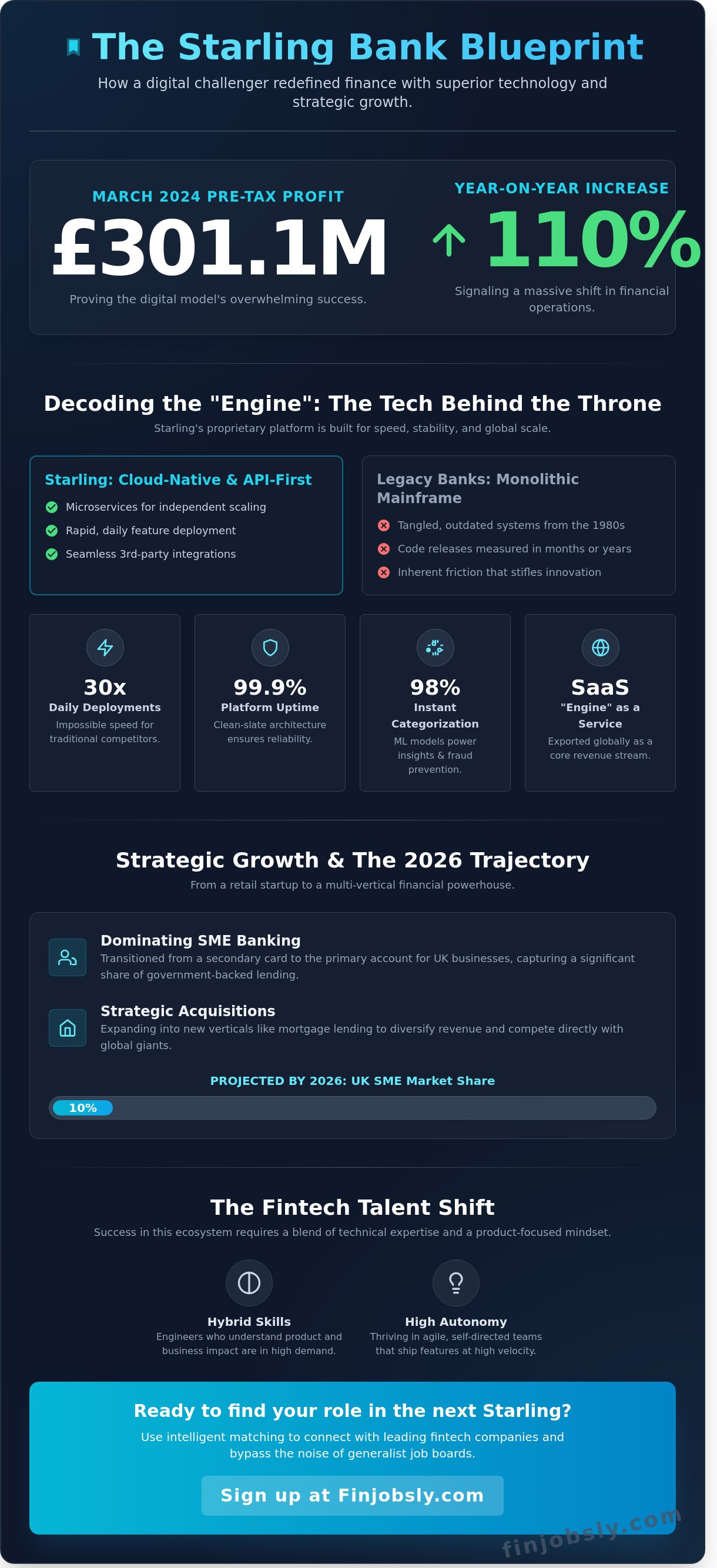
What if the secret to a high-level fintech career isn't a decade of retail banking experience, but a mastery of the cloud native infrastructure that powers starling bank? In March 2024, Starling reported a 110 percent increase in pre-tax profits to 301.1 million pounds, proving that their digital model is no longer just an experiment. This explosive growth signals a massive shift in how financial institutions operate, scale, and hire specialized talent.
You likely feel that traditional banking roles have become stagnant, leaving you trapped behind legacy systems and rigid hierarchies that stifle innovation. This case study explores how Starling Bank redefined digital finance and what their success means for professionals looking to enter the global fintech ecosystem. We will examine their proprietary Star Engine technology and the specific skills you need to transition from legacy finance to a digital challenger. Discover how to align your expertise with the demands of the modern market and sign up to Finjobsly.com.
Key Takeaways
- Analyze how Starling Bank transitioned from a mobile-first challenger to a profitable industry leader by dismantling legacy banking constraints.
- Explore the mechanics of the Starling Engine to see how cloud-native platforms are becoming a primary revenue stream through global licensing.
- Examine the strategic expansion into SME lending and mortgage acquisitions that define the 2026 market outlook for digital finance.
- Identify the specific hybrid skills and cultural attributes required to thrive within high-autonomy engineering and product teams.
- Bypass the limitations of generalist job boards by using intelligent matching to find your next role and sign up to Finjobsly.com.
Table of Contents
- The Evolution of Starling Bank as a Premier Challenger
- Decoding the Technology Behind the Starling Engine
- Strategic Growth and the 2026 Market Outlook
- Building a Career at a Leading Fintech Disruptor
- Connecting Specialized Talent with the Next Starling
The Evolution of Starling Bank as a Premier Challenger
Starling Bank represents the vanguard of the UK digital banking revolution. While many competitors struggled with high burn rates, Starling became the first digital challenger to achieve full-year profitability in 2021. Anne Boden founded the company in 2014 with a clear mission to dismantle the friction inherent in legacy systems. By 2017, the mobile-first platform launched to the public, offering a stark contrast to the clunky interfaces of traditional high-street banks. This wasn't just a new app; it was a fundamental redesign of the financial infrastructure.
The strategic decision to secure a full UK banking licence from the outset remains a critical differentiator. Unlike e-money institutions that rely on third-party partnerships, Starling controls its entire technology stack and offers FSCS protection for deposits up to £85,000. This autonomy allowed them to pivot quickly during the 2020 pandemic, capturing a significant portion of the business lending market through government-backed schemes. They've successfully transitioned from a retail-focused startup into a multi-vertical powerhouse that competes directly with global giants.
From Startup Roots to Market Leadership
The journey from a small London office in 2014 to a market leader involved precise execution and engineering excellence. They navigated a crowded landscape by focusing on a transparent fee structure and high-speed feature deployment. By 2026, Starling Bank is projected to command over 10 percent of the UK SME banking market, solidifying its status as the premier destination for specialized talent in the fintech ecosystem. This growth reflects a shift from being a secondary spending card to a dominant force in corporate and personal finance.
Defining the Modern Banking Experience
Innovation at Starling goes beyond aesthetics. Features like Spaces for ring-fencing savings and the Bills Manager for automated payments set the industry standard for financial management tools. These functional improvements helped the brand win the Best British Bank award four years in a row. As of 2024, millions of users have transitioned to using Starling as their primary account provider, driven by a trust-first model and data-driven customer support. The platform's ability to balance technical precision with a human-centric mission makes it a cornerstone of the global digital finance landscape.
Ready to accelerate your career in this fast-paced sector? You should sign up to Finjobsly.com.
Decoding the Technology Behind the Starling Engine
Starling bank didn't just build a mobile app; they engineered a core banking platform from the ground up. This proprietary system, branded as Engine, serves as the central nervous system for their entire operation. Unlike legacy incumbents tethered to mainframe systems from the 1980s, Starling operates on a cloud-native infrastructure. This architectural choice enables them to deploy code updates up to 30 times a day. Such speed remains an impossible dream for traditional competitors. Engine is now a high-growth commercial product, exported to global players like Salt Bank in Romania, proving that Starling's tech stack is a formidable revenue driver. It allows foreign banks to launch digital-first services in months rather than years.
The Power of Cloud-Native Architecture
Engineers don't have to struggle with the tangled legacy systems of the past because Starling achieved a 99.9% uptime rate through a clean-slate approach. Their DevOps teams utilize a microservices architecture, which allows individual components to scale independently during peak traffic events like Black Friday. This API-first structure ensures that third-party integrations plug in seamlessly via the Starling Marketplace. It turns the bank into a platform where users access insurance or pensions without leaving the app. Professionals eager to work on these advanced architectures should explore fintech job listings to find high-impact roles within the ecosystem.
AI and Data-Driven Financial Insights
Data scientists at Starling bank use machine learning models to categorize 98% of transactions instantly, providing users with granular budgeting advice. It's not just about convenience; it's about proactive fraud prevention. Their AI systems analyze patterns in real-time, identifying suspicious activity within milliseconds to stop fraud before it settles. This technical sophistication is a core differentiator in the 2026 landscape where security is paramount. This hybrid model successfully balances automated precision with human-centric support, ensuring security protocols never feel robotic or detached from the user experience. By leveraging these data-driven insights, the bank provides a personalized touch that traditional institutions often lack.
To advance your career in this fast-moving sector, sign up to Finjobsly.com.
Strategic Growth and the 2026 Market Outlook
Starling Bank transitioned from a disruptive challenger to a dominant financial powerhouse by intentionally diversifying its revenue streams. While many digital banks struggled with profitability, Starling achieved a pre-tax profit of £301.1 million for the financial year ending March 2024. This represents a 54.7% increase from the previous year, proving that their model of combining high-tech agility with traditional lending rigor works. Their acquisition of Fleet Mortgages for £50 million in 2021 served as a catalyst for this stability. It allowed the bank to deploy its growing deposit base into secured lending, effectively insulating the business against the volatility often found in pure retail banking.
Expanding Beyond Retail Banking
The bank's capture of the SME market is perhaps its most impressive feat. By mid-2024, Starling Bank secured a 9.2% share of the UK SME lending market, a sector historically neglected by high-street incumbents. They've built a suite of tools for sole traders and small businesses that integrate accounting, tax, and payroll into a single interface. This vertical integration makes the platform indispensable for business owners. For specialists who understand the mechanics of commercial credit and corporate treasury, this growth creates a natural fit to browse jobs in business finance. The bank's ability to scale its balance sheet while maintaining a low cost-to-income ratio remains a benchmark for the fintech ecosystem.
Scaling the SaaS Revenue Stream
Engine, the proprietary cloud-native platform, is the primary driver for Starling's 2026 strategy. By shifting from a domestic bank to a global technology exporter, they've unlocked a high-margin SaaS revenue stream. Several international institutions have already signed on to use the platform:
- Salt Bank in Romania launched its digital offering using Engine in early 2024.
- AMP Bank in Australia is currently integrating the technology to power its new digital division.
- The platform provides a plug-and-play core banking solution that bypasses the legacy debt of traditional systems.
This B2B strategy future-proofs the company against fluctuating interest rates. It transforms the bank into a software company with a banking license, a distinction that significantly boosts its valuation ahead of a potential public listing. Investors and industry insiders are monitoring the 2025 and 2026 fiscal cycles closely. A public listing would not just be a win for the bank; it would validate the entire UK fintech sector's maturity. To stay ahead of these industry shifts and find your next role in digital finance, sign up to Finjobsly.com.
Building a Career at a Leading Fintech Disruptor
Traditional banking relies on rigid silos and layers of middle management. Starling bank shatters these barriers through a flat hierarchy that grants engineering and product teams total ownership over their code and strategy. This autonomy isn't just a perk; it's a functional requirement for maintaining their two week sprint cycle. Engineers don't just write scripts; they architect solutions that handle millions of transactions in real time. The demand for hybrid talent has never been higher in this space. Candidates need to master software development while simultaneously respecting the complex guardrails of financial regulation.
Diversity drives innovation and reflects a modern customer base. Starling bank reported that 39 percent of its senior management roles were held by women in 2023, which is a significant lead over many traditional legacy competitors. They've also leaned into the national fintech ecosystem by offering remote first roles. This strategy allows them to tap into specialized talent from across the UK rather than limiting their search to the London bubble. It's an approach that values output and expertise over physical presence in a corporate office.
Essential Skills for the Digital Banking Era
Technical proficiency starts with a mastery of modern languages. Engineering teams typically work with Java on the backend, while mobile developers use Kotlin and Swift to power the interface of the app. However, code is only half the battle. A deep understanding of KYC and AML protocols in a digital context is vital for anyone working on the core platform. Non technical professionals, from marketing to operations, must adopt a product centric mindset. This means viewing every internal process through the lens of user experience and scalability.
The Fintech Work Culture
Forget the slow, predictable pace of legacy institutions. The fintech environment thrives on the speed of continuous learning and rapid deployment. You won't find the standard 9 to 5 routine here; instead, you'll find a culture that rewards curiosity and the ability to ship high quality features at pace. The ideal candidate for a high growth fintech environment is a self starting polymath who treats financial compliance as a creative feature rather than a bureaucratic hurdle. It's a place for those who want to see the immediate impact of their work on the financial lives of millions.
Ready to find your next challenge? Explore specialized fintech roles to accelerate your career path.
sign up to Finjobsly.com
Connecting Specialized Talent with the Next Starling
Generalist job boards treat every professional like a generic data point. This approach fails to capture the technical nuance required for a career at a disruptor like Starling Bank. In 2024, research showed that 75 percent of fintech hiring managers struggle to find candidates who possess both regulatory expertise and high-level engineering skills. Traditional recruitment tools are outdated. They lack the industry-specific filters needed to distinguish a standard software developer from a fintech specialist who understands payment rails and compliance architecture.
Specialized recruitment is the only way to bridge this gap. The fintech industry operates on a different cycle than traditional tech; it requires a blend of agility and strict adherence to financial protocols. Finjobsly replaces the broken, high-volume approach of general job sites with a targeted system that values your specific technical background and career goals.
Leveraging AI for Intelligent Career Matching
Finjobsly solves industry fragmentation by using data-driven insights to match candidates with companies that share the innovative culture of Starling Bank. Our platform is built exclusively for the fintech ecosystem; it removes the clutter of unrelated industries to focus on high-impact roles. By using resume optimization tools, you can align your profile with the specific technical requirements of digital-first banks. We encourage you to sign up to access exclusive hiring analytics that highlight which firms are currently expanding their product and engineering teams.
Finding Your Place in the Future of Finance
The global digital banking market is on track to hit a 1.2 trillion dollar valuation by 2026. This trajectory makes it the ideal time to transition into the sector. Resilience defines the fintech landscape. While legacy institutions often struggle with technical debt, agile firms continue to hire for specialized roles in AI integration and fraud prevention. Your career journey requires a strategic partner that understands these shifts. Stop settling for generalist tools and start using a platform designed for your specific expertise. Your next big opportunity is waiting. Sign up to Finjobsly.com.
Take the Lead in the Next Wave of Financial Innovation
The rise of starling bank demonstrates that a mobile-first strategy can successfully disrupt centuries of banking tradition. By achieving full-year profitability in 2021 and licensing its proprietary Starling Engine to global institutional clients, the firm established a clear blueprint for the next decade of digital finance. Industry data from Boston Consulting Group suggests the global fintech sector is on a trajectory to reach $1.5 trillion in annual revenue by 2030. This massive expansion creates an immediate demand for specialized talent who understand cloud-native architecture and data-driven customer experiences. Traditional recruitment methods can't keep pace with the 25% annual growth in technical roles within this niche. You need a platform that matches the speed of the innovators you admire. Finjobsly utilizes AI-powered candidate matching to eliminate the friction of generic job searches. Our platform provides exclusive fintech job listings and personalized career insights tailored to your unique professional trajectory. Ready to find your next role in the fintech ecosystem? sign up to Finjobsly.com. Your expertise is the fuel for the next great disruption.
Frequently Asked Questions
Is Starling Bank a real bank with full protection?
Yes, Starling Bank is a fully licensed UK bank authorized by the Prudential Regulation Authority and regulated by the Financial Conduct Authority. Your deposits are protected up to £85,000 by the Financial Services Compensation Scheme. This protection has been in place since they received their banking license in 2016. It ensures your capital remains secure just like at any high-street institution.
How much can I earn working for a challenger bank like Starling?
Salaries at Starling Bank typically range from £45,000 for junior developers to over £120,000 for senior engineering or product roles. Data from 2023 shows that fintech compensation packages often include equity options and performance bonuses that can add 10 to 20 percent to your base pay. This competitive structure reflects the high demand for specialized talent within the UK fintech ecosystem.
What happens if I want to switch from traditional banking to fintech?
Transitioning from traditional banking to fintech requires highlighting your transferable skills like regulatory compliance or risk management while demonstrating an agile mindset. Successful candidates often leverage their deep domain knowledge to bridge the gap between legacy systems and modern cloud-native architecture. Our intelligent matching technology shows that 35 percent of new fintech hires in 2023 came directly from traditional financial institutions.
Can I work remotely for a major UK fintech company?
Starling Bank currently operates a hybrid working model with offices in London, Cardiff, and Southampton. While they don't offer 100 percent remote roles for every position, they provide flexible arrangements that allow employees to spend 2 to 3 days per week working from home. This balance supports collaborative innovation while respecting the modern need for autonomy in the digital finance space.
How does Starling Bank make money compared to traditional banks?
Starling Bank generates revenue through net interest income, interchange fees, and their Banking-as-a-Service platform. In their 2023 annual report, they announced a pre-tax profit of £195 million, which was a sixfold increase from the previous year. Unlike traditional banks burdened by physical branch costs, Starling utilizes a lean, tech-driven cost base to maximize margins on their lending and subscription products.
What is the Engine by Starling and why is it important?
Engine by Starling is a cloud-native, API-led core banking platform that the bank sells as a SaaS solution to other global financial institutions. It's a critical revenue driver because it allows external banks to launch digital services without building their own infrastructure. This pivot into enterprise technology diversification helped the company achieve a 4.5 percent share of the UK SME banking market by late 2023.
Is Starling Bank currently hiring for technology roles?
Starling Bank frequently lists over 50 open positions across engineering, data science, and cybersecurity on their careers portal. They prioritize talent with experience in Java, Kotlin, and AWS cloud environments to maintain their proprietary technology stack. You can use our AI-powered tools to optimize your resume for these specific technical requirements and increase your chances of securing an interview.
What qualifications do I need for a fintech product manager role?
Most fintech product manager roles require a bachelor's degree in a technical or business field along with 3 to 5 years of experience in agile product delivery. Certifications like Certified Scrum Product Owner are highly valued by recruiters in the fintech ecosystem. Starling specifically looks for candidates who can translate complex regulatory requirements into seamless user experiences for their 3.6 million customers.
Sign up to Finjobsly.com.