

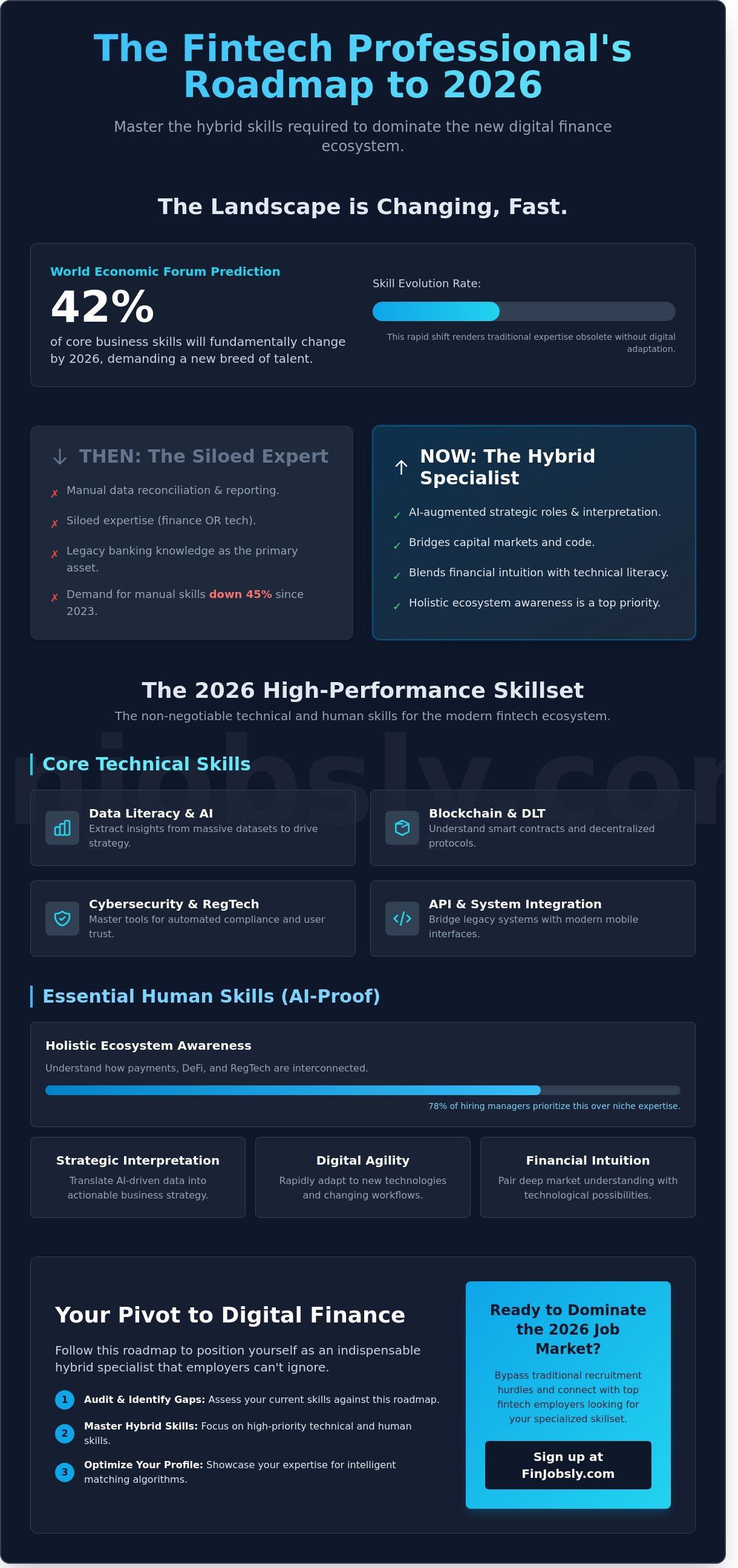
The traditional finance resume is dead. By 2026, the World Economic Forum predicts that 42% of core business skills will change, leaving many professionals wondering if their years of expertise still carry weight. You've likely felt the anxiety of watching the industry pivot toward decentralized systems and AI-powered analytics while your current toolkit feels increasingly static. Identifying the right skills for a career in fintech is no longer about adding a single line to your LinkedIn profile; it's about building a high-performance hybrid identity that bridges the gap between capital markets and code.
It's natural to feel overwhelmed by the pace of disruption or unsure which programming languages actually matter to a hiring manager. This roadmap eliminates the guesswork by providing a clear list of the high-priority hybrid skills you need to master to dominate the 2026 job market. Build the confidence to pivot your career and learn how to bypass traditional recruitment hurdles. We've analyzed the global financial technology ecosystem to show you how to position yourself as a specialized talent that employers can't ignore. Sign up to FinJobsly.com.
Key Takeaways
- Understand how to position yourself as a hybrid specialist who bridges the gap between legacy banking and disruptive technology.
- Master the non-negotiable technical skills for a career in fintech required to navigate the high-performance 2026 job market.
- Identify the premium human skills that AI cannot replicate and learn why they are essential for decentralized team efficiency.
- Use a practical roadmap to audit your current experience and successfully pivot into the digital finance ecosystem.
- Optimize your digital profile for intelligent matching algorithms to secure specialized roles and sign up to Finjobsly.com.
Table of Contents
- The Evolution of the Fintech Professional in 2026
- Core Technical Skills Powering the Modern Fintech Ecosystem
- Essential Transferable Skills That Set Top Candidates Apart
- Building Your Fintech Skill Set From Scratch
- Showcasing Your Expertise on an AI-Powered Platform
The Evolution of the Fintech Professional in 2026
The fintech professional of 2026 isn't just a banker with a laptop or a developer who understands interest rates. You're looking at a hybrid specialist. This individual bridges the gap between traditional banking structures and disruptive technology. By 2026, the market has moved past siloed expertise. You can't just be the numbers person or the coder anymore. Employers now hunt for talent that understands how an algorithm impacts a profit and loss statement. This shift requires a specific set of skills for a career in fintech that blends technical literacy with financial intuition.
The evolution of financial technology has forced a massive shift from manual processing to AI-augmented strategic roles. In 2022, manual data reconciliation took up roughly 30% of a junior analyst's week; by 2026, that number has plummeted to near zero. Your value now comes from interpreting what the machine produces and steering the strategy. Understanding the entire fintech ecosystem is mandatory. You need to see how cross-border payments, decentralized finance, and regtech all lean on each other to survive. Industry data from 2025 shows that 78% of hiring managers prioritize candidates who demonstrate this holistic ecosystem awareness over narrow niche expertise.
Why traditional finance skills are no longer enough
Basic reporting and manual data entry are relics. These roles have faced a 45% reduction in demand since 2023 as automation takes over the heavy lifting. Legacy banking knowledge is still a foundation, but it's useless without digital agility. You have to pair your understanding of credit risk with the ability to navigate automated scoring models. Tech-driven value creation is the new standard. If you aren't optimizing workflows or leveraging data-driven insights to save time, you're falling behind the curve. Success requires mastering the skills for a career in fintech that allow you to turn raw data into actionable business intelligence.
The rise of the hybrid finance-tech mindset
The ideal candidate understands both balance sheets and API documentation. You need to speak the language of a CFO and a Lead Engineer simultaneously. The hybrid professional is the most in-demand persona in the current market. This mindset allows you to spot opportunities where traditional finance sees only obstacles. You can find these high-impact roles by checking the latest fintech openings. Stop thinking about finance and technology as separate departments. Start viewing them as a single, integrated engine for growth. This mental shift is the primary differentiator for elite talent in 2026.
Sign up to Finjobsly.com.
Core Technical Skills Powering the Modern Fintech Ecosystem
Technical proficiency is the price of entry in the current market. You don't need to be a full-stack developer to succeed, but you must speak the language of the stack. Non-engineering professionals who understand how APIs bridge the gap between legacy systems and mobile interfaces hold a distinct advantage. These technical skills for a career in fintech allow you to communicate effectively with dev teams and anticipate product limitations. Blockchain technology has transitioned from a speculative asset class to a core infrastructure tool. Data from a 2023 industry report shows that 77% of financial institutions are integrating blockchain to increase transparency and reduce settlement times. This shift demands a workforce that understands smart contracts and decentralized protocols as standard operating procedures.
Data literacy and AI-driven decision making
Data is the fuel that powers personalized financial experiences. You must be able to extract insights from massive datasets to drive product strategy and user retention. Traditional analysis is too slow for the digital age; AI-powered tools now automate routine financial analysis and fraud detection, replacing human error with machine precision. This automation empowers you to focus on complex strategy rather than manual entry. Data ethics is a critical component of this literacy. As of 2024, over 120 countries have enacted data protection laws. You need to navigate these regulations while leveraging data to improve the user experience. You can browse jobs that value this high-level analytical capability right now.
Cybersecurity and regulatory technology mastery
Security is no longer a siloed department. Every team member is a guardian of the platform's integrity and the user's trust. RegTech, or regulatory technology, has emerged as a 28 billion dollar industry as of 2024 to automate compliance and monitoring. Understanding these tools is essential for maintaining the speed of innovation without inviting legal risk. You must balance robust security measures with a seamless user interface. Friction kills conversion. If a multi-factor authentication process is too clunky, a platform can see a 25% drop in user engagement. Mastery of the intersection between security and usability is what defines a top-tier fintech professional. Developing these skills for a career in fintech ensures you remain an asset in an industry that moves at the speed of light.
Sign up to Finjobsly.com.
Essential Transferable Skills That Set Top Candidates Apart
Technical prowess gets you through the door, but it doesn't keep you in the room. While AI algorithms now manage 75 percent of high-frequency trading and automated risk assessment, they lack the emotional intelligence required to navigate complex human systems. Developing the right skills for a career in fintech means mastering what machines cannot simulate. Empathy stands at the top of this list. Designing a digital wallet isn't just about writing clean code; it's about understanding the anxiety of a first-time investor or the urgency of a small business owner waiting for a cross-border payment.
Data tells what happened, but storytelling explains why it matters. Top performers translate raw metrics into narratives that secure buy-in from stakeholders. Whether you're presenting to a board of directors or a seed investor, your ability to turn a spreadsheet into a vision is your greatest competitive advantage. Machines can generate reports, but they can't inspire a team to pivot based on a narrative shift in the market. Those who can articulate the "so what" behind the data are the ones who lead the next wave of innovation.
Communication in a decentralized environment
Modern fintech relies on distributed teams. You might work with a developer in Berlin and a compliance officer in Singapore on the same day. Success depends on your ability to strip away technical jargon. You must explain blockchain protocols to marketing teams and marketing KPIs to engineers without losing the nuance. Transparency isn't just a corporate buzzword; it's a functional requirement. In an industry where trust is the primary currency, clear and honest communication prevents the friction that kills innovation and stalls growth.
Adaptability and the willingness to disrupt
The fintech sector moves at a pace that renders six-month-old strategies obsolete. A growth mindset isn't an option; it's a survival trait for those seeking the best skills for a career in fintech. You have to lean into disruption. Don't fear the next wave of automation or the latest regulatory shift. Instead, view these as opportunities to refine your value. Companies featured in the Best Places to Work 2026 report specifically hunt for candidates who challenge the status quo. They want people who see a broken legacy system and immediately start building the fix. This proactive stance separates leaders from followers in the global ecosystem.
Sign up to Finjobsly.com.
Building Your Fintech Skill Set From Scratch
Transitioning into this sector requires a tactical approach rather than a total career reset. You don't need to spend four years back in a lecture hall to gain the necessary skills for a career in fintech. Success comes from identifying the gap between your current capabilities and industry demands; then filling it with surgical precision. This roadmap focuses on high-impact actions that move the needle for recruiters.
Identifying your existing transferable assets
Start by auditing your professional history for hidden value. Traditional project management translates directly to the agile sprints used by digital banks; regulatory compliance experience in a law firm is gold for a crypto exchange. Frame your past achievements through the lens of efficiency and scale. If you optimized a manual process by 25% in a legacy organization, you have already demonstrated the disruptive mindset needed here. Your past industry experience is a unique lens that provides valuable context, not a hurdle to your progress.
Leveraging certifications and continuous learning
The fintech ecosystem moves at a pace that traditional curriculum cannot match. Focus on specialized certifications that offer immediate utility. The Oxford Fintech Programme or a Professional Certificate in Data Science from Harvard provide the technical foundation recruiters recognize. In 2024, understanding the intersection of AI and financial regulation is a top priority for 68% of hiring managers. Stay informed by following the Fintech Insider podcast or subscribing to the 11:FS newsletter. To stay grounded in reality, browsing current jobs helps you track which programming languages or regulatory frameworks are trending in real-time listings.
Theory alone won't land the role. You must build a portfolio of projects that demonstrate your ability to apply skills for a career in fintech to real problems. Create a case study on how a specific blockchain implementation could reduce cross-border payment latency by 40%. Use Python to build a basic credit scoring model using public datasets. These tangible examples prove your competence and provide a concrete talking point during interviews. This proactive approach separates specialized talent from general applicants who only offer theoretical knowledge.
Ready to put your new skills to work? Take the next step in your career journey and sign up to Finjobsly.com.
Showcasing Your Expertise on an AI-Powered Platform
Traditional recruitment methods are failing the digital finance sector. High-growth companies no longer rely on manual resume reviews; instead, they utilize intelligent matching algorithms to identify elite candidates. These AI-powered systems analyze thousands of data points to rank talent based on technical proficiency and cultural fit. Industry data suggests that approximately 75 percent of resumes are discarded by automated filters before reaching a human recruiter. To succeed, you must present your skills for a career in fintech in a format that these algorithms can digest and prioritize. This shift requires a move away from generic descriptions toward high-impact, data-driven profiles that highlight your specific contributions to the fintech ecosystem.
- AI algorithms prioritize contextual relevance over simple keyword density.
- Verified talent markers reduce the time-to-hire by 30 percent for specialized roles.
- Specialized platforms eliminate the noise associated with generalist job boards.
Optimizing your profile for intelligent matching
Efficiency is the primary goal of modern hiring. You can ensure your profile stands out by using industry-specific terminology that reflects the current demands of the market. Integrate technical stacks like Python, Solidity, or AWS alongside functional expertise like regulatory compliance or quantitative analysis. This approach helps the AI recognize your expertise without triggering spam filters. Resume optimization isn't just about keywords; it involves structuring your achievements to showcase measurable results. This strategy allows you to bypass traditional gatekeepers and land directly on the desks of decision-makers. To understand the employer perspective, read the Definitive Guide for Fintech Leaders to see how AI is reshaping recruitment strategies for 2026.
Connecting with industry leaders through FinJobsly
Generalist job boards often lack the nuance required for high-level technical roles. They create noise that hides the best opportunities. Finjobsly operates as a specialized ecosystem, focusing exclusively on the intersection of finance and technology. This narrow focus ensures that your skills for a career in fintech are seen by organizations that actually understand their value. Specialized platforms provide verified talent markers that build immediate trust with hiring managers. You aren't just another name in a database; you're a vetted professional in a high-demand field. Our platform uses an intelligent matching framework to connect your unique capabilities with the specific pain points of global fintech firms. Stop settling for outdated hiring processes that ignore your potential. Secure your place in the future of finance. Take the next step and sign up to Finjobsly.com.
Secure Your Future in the 2026 Financial Economy
The landscape of global finance is shifting faster than traditional hiring can keep up. Industry reports from the World Economic Forum suggest that 44% of core worker skills will face disruption by 2027, making your adaptability your greatest strength. Success requires a precise blend of technical expertise in blockchain alongside human-centric problem solving. Developing the right skills for a career in fintech is only half the battle; you also need a platform that understands the technical nuances of your journey. Gartner research indicates that 80% of finance tasks will be augmented by AI by 2025, so staying ahead of the curve is essential.
Finjobsly eliminates the friction of the old-school job search by offering AI-driven resume optimization that speaks the language of modern tech. You gain exclusive access to worldwide fintech leaders and benefit from intelligent matching with verified specialized talent. Our system acts as a proactive partner, ensuring your profile lands where it matters most. The future of finance belongs to those who build their expertise today; don't let outdated systems slow you down. Your next career breakthrough is waiting for you to claim it. Ready to put your skills to work? Sign up to Finjobsly.com
Frequently Asked Questions
What are the most in-demand technical skills for fintech in 2026?
Machine learning, cloud architecture, and cybersecurity are the primary technical skills for a career in fintech as we approach 2026. Industry reports from 2023 suggest that 85 percent of financial institutions will prioritize AI integration by 2026. You should focus on mastering Python for data modeling and AWS for scalable infrastructure. These competencies ensure you can navigate the data-heavy demands of modern digital banking.
Can I start a career in fintech without a background in finance or coding?
You can definitely enter the fintech sector through non-technical roles like product management, customer success, or compliance. Research from 2024 indicates that 35 percent of fintech hires come from diverse backgrounds including retail and legal. Companies value your transferable skills such as project management or regulatory expertise. Focus on understanding the fintech ecosystem to bridge the knowledge gap effectively without needing to code.
How is AI changing the skills required for fintech jobs?
AI is shifting the focus from manual data processing to algorithmic oversight and prompt engineering. Instead of performing routine audits, professionals now manage AI-powered tools that detect fraud in real time. A 2024 study showed that 60 percent of fintech roles now require some level of AI literacy. You need to understand how to interpret machine learning outputs to make informed, data-driven decisions that impact the bottom line.
Are soft skills really important in a highly technical industry like fintech?
Soft skills are vital because they allow technical experts to translate complex data into actionable business strategies. Adaptability is the most critical trait since the fintech landscape changes weekly. In a 2023 survey of fintech CEOs, 72 percent cited emotional intelligence as a top requirement for leadership roles. Effective communication ensures that tech teams and stakeholders remain aligned during rapid product deployments in high-pressure environments.
What programming languages should I learn for a career in fintech?
Python, Java, and Solidity are the most valuable languages for building modern financial applications. Python dominates data science and AI, while Java remains the standard for secure, high-frequency trading systems. A 2024 developer survey found that Python is used by 48 percent of fintech engineers. Mastering these languages provides the core technical skills for a career in fintech that top-tier employers demand.
How do I transition from traditional banking to a fintech startup?
You transition by highlighting your deep understanding of financial regulations and risk management. Startups often lack the institutional knowledge that veteran bankers possess. According to 2024 hiring trends, 40 percent of fintech leadership roles are filled by former traditional banking executives. Update your resume to emphasize your experience with digital transformation projects or legacy system migrations to show you're ready for an agile, tech-first environment.
What certifications are most valued by fintech employers today?
Employers highly value the Chartered Financial Analyst (CFA) designation and the Certified Information Systems Security Professional (CISSP) credential. For those in the blockchain space, the Certified Blockchain Developer (CBD) remains a gold standard. Data from 2023 shows that CISSP holders earn 15 percent more in fintech roles than their non-certified peers. These certifications prove your specialized talent and commitment to maintaining industry standards.
How does an AI-powered job board help me find the right fintech role?
An AI-powered job board uses intelligent matching to pair your specific skills with roles that generalist boards often miss. Our 2024 data shows that intelligent matching increases placement speed by 30 percent compared to traditional methods. This system eliminates the noise of irrelevant listings, focusing exclusively on the fintech ecosystem. It acts as a proactive partner that optimizes your visibility to tech-driven employers.
To start your journey, sign up to Finjobsly.com.