

Why are 65 percent of London's elite math PhDs still sifting through generic job boards that cannot distinguish between a basic spreadsheet and a complex stochastic calculus model? You've likely felt the frustration of explaining C++ optimization to a recruiter who treats your specialized skillset like a general IT role. It's exhausting to receive irrelevant alerts while the most lucrative quantitative analyst jobs uk remain hidden behind closed doors or buried under layers of inefficient recruitment bureaucracy.
We understand that your time is better spent on algorithmic innovation than on educating generalist headhunters who don't grasp the technical depth of your work. This 2026 guide reveals how to bypass traditional gatekeepers and leverage specialized AI matching to land high impact roles that offer base salaries starting at 150,000 GBP. You will discover the exact steps to accelerate your application to interview timeline and secure your place in the elite fintech ecosystem. To start your journey toward a premier career, sign up to Finjobsly.com.
Key Takeaways
- Discover how the shift from traditional banking hubs to a national fintech ecosystem is creating a new wave of opportunities for quants across the country.
- Identify the modern high performance technical skills you need to stand out when applying for the most elite quantitative analyst jobs uk firms are offering.
- Evaluate the differences in culture and pay between high frequency trading and fintech startups to find the environment where you will thrive.
- Learn how to use specialized AI matching to fix the flaws in traditional recruitment and get your profile in front of the right people.
- Take control of your professional future with tools built specifically for the fintech world and sign up to Finjobsly.com.
Table of Contents
- Navigating the UK Quantitative Analyst Market in 2026
- The Technical Arsenal: Skills That Define the 2026 Quant
- Sector Analysis: High Frequency Trading vs Fintech Disruption
- The Modern Application Framework: Outsmarting Traditional Recruitment
- FinJobsly: The AI Driven Hub for Specialized Quant Talent
Navigating the UK Quantitative Analyst Market in 2026
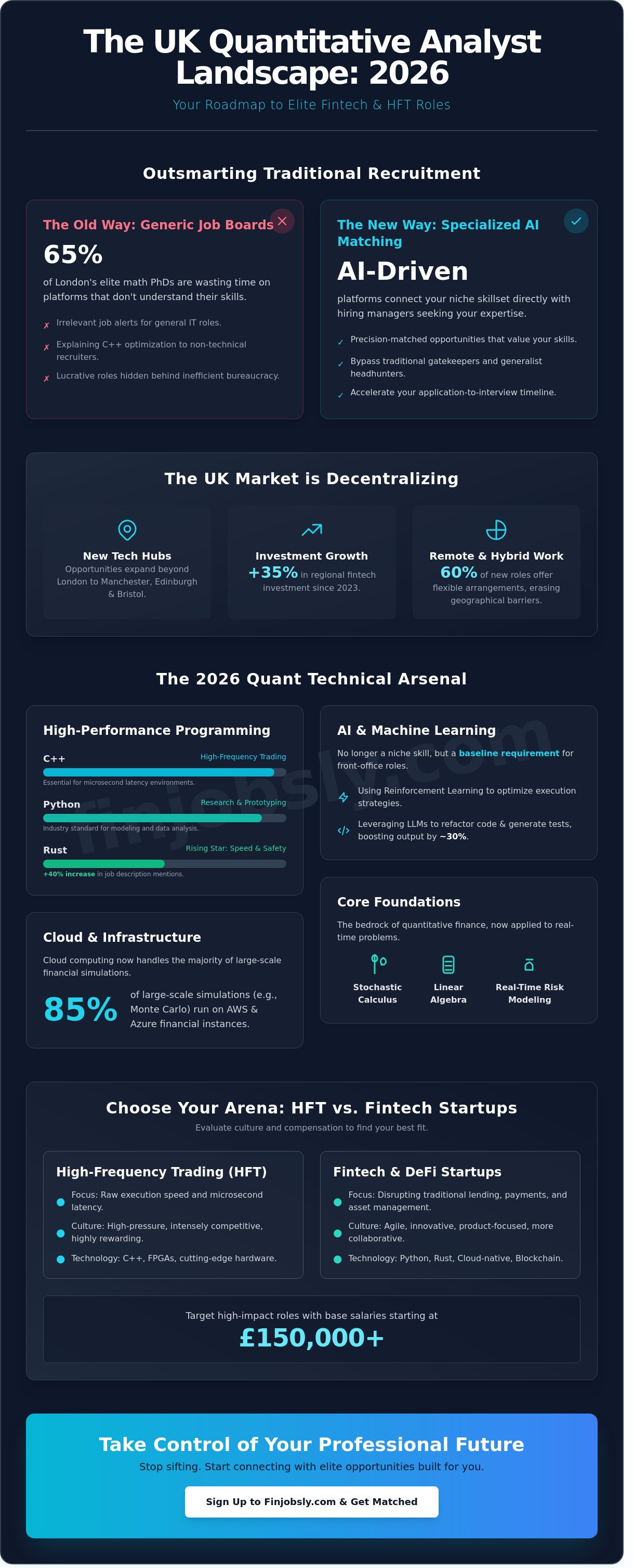
The UK financial landscape reached a critical tipping point by early 2025. The era of the London-centric Square Mile dominance has transitioned into a decentralized, high-velocity network. Quantitative analyst jobs uk are now distributed across thriving tech hubs in Manchester, Edinburgh, and Bristol, driven by a 35 percent increase in regional fintech investment since 2023. Legacy institutions struggle with rigid structures while agile startups leverage real-time data to disrupt traditional lending and asset management. This shift creates a massive opportunity for specialists who can bridge the gap between pure mathematics and scalable code.
Generalist job boards fail to capture this nuance; they often bury elite roles under mountains of irrelevant listings. Specialized platforms have become the necessary gatekeepers for professionals who value precision over volume. The competitive nature of quantitative analyst jobs uk means candidates must look beyond traditional banking to find the most lucrative opportunities in 2026. Efficiency is the new currency in recruitment, and AI-driven matching is the only way to keep pace with a market that moves in milliseconds.
The Evolution of the Quant Role
Quants have shed their reputation as back-office support staff. In 2026, they act as the primary engine for front-office revenue and strategic decision-making. The integration of machine learning into standard quantitative research is now a baseline requirement rather than a niche skill. Modern professionals use reinforcement learning to optimize execution strategies and manage risk in real-time. Quantitative analysis (finance) provides the theoretical foundation, but the modern role demands production-level engineering. This shift mirrors the broader themes found in the ultimate guide to fintech jobs in 2026 trends and opportunities, where technical mastery meets commercial intuition.
Current Demand Trends Across the UK
High-frequency trading firms and decentralized finance protocols represent the most aggressive hiring sectors. By mid-2026, over 60 percent of new roles offer permanent remote or hybrid arrangements, which effectively erases geographical barriers for elite talent. This expansion allows a quant in Leeds to lead a London-based crypto-hedge fund team without the friction of a daily commute. You can browse jobs on our platform to analyze live market data and see which firms are currently scaling their technical teams. The demand for specialized talent remains at an all-time high, particularly for those with expertise in Python, C++, and Rust. To secure your place in this evolving ecosystem, sign up to Finjobsly.com.
The Technical Arsenal: Skills That Define the 2026 Quant
Securing quantitative analyst jobs uk requires more than a passing grade in math. The 2026 market demands a hybrid engineer who bridges the gap between raw data and execution. Legacy languages like Java are receding. They are replaced by high performance stacks that prioritize execution speed and memory safety. Cloud computing now handles 85 percent of large scale simulations in London's top firms, primarily through AWS and Azure specialized financial instances. This infrastructure allows quants to run complex Monte Carlo simulations in seconds rather than hours. Specialized knowledge in blockchain and digital assets has also become a baseline requirement. Institutional adoption of DeFi protocols in 2025 created a vacuum for talent who understand smart contract risk and tokenomics.
Programming and Data Science Mastery
Python remains the industry standard for research and rapid prototyping. However, C++ dominates high frequency environments where microsecond latency is the only metric that matters. We see a 40 percent increase in job descriptions mentioning Rust. This language provides the memory safety required for secure financial applications without sacrificing speed. Modern quants also leverage AI to optimize their own code. They use large language models to refactor legacy scripts and generate unit tests, increasing their output by an estimated 30 percent. If you want to benchmark your current skills against top tier requirements, you can browse active roles to see what leaders are hiring for right now.
Mathematical Foundations and Financial Engineering
The core remains rigorous. Stochastic calculus and linear algebra are still the bedrock of derivative pricing and portfolio optimization. However, the application has shifted toward real time risk modeling. This quantitative analyst career guide explains how these foundations translate into day to day responsibilities. In the 2026 fintech landscape, these principles apply to volatile crypto markets and algorithmic liquidity provision, creating a surge in quantitative analyst jobs uk for those with niche expertise. Quants now build models that account for flash crashes and liquidity drains in decentralized exchanges. They must quantify risk in environments that never sleep, requiring a deep understanding of non-normal distributions and tail risk events. Firms are no longer looking for generalists; they want specialists who can apply classical math to decentralized finance structures.
sign up to Finjobsly.com
Sector Analysis: High Frequency Trading vs Fintech Disruption
The search for quantitative analyst jobs uk reveals a sharp divide between the high-pressure world of High Frequency Trading (HFT) and the scalable innovation of fintech. HFT firms like XTX Markets or Citadel Securities focus on the absolute edge of speed. They reward quants who can shave microseconds off execution times with compensation packages that frequently hit £300,000 within three years. It's a high-reward environment but one defined by intense competition and narrow specialisation. You're fighting for pennies millions of times a day.
Fintech disruptors offer a different trajectory. Companies like Revolut or Monzo value quants who can apply machine learning to consumer credit scoring or fraud detection. You might trade a slightly lower base salary for equity that could skyrocket during a future liquidity event. While HFT quants battle for market liquidity, fintech quants build the infrastructure that 45 million users rely on daily. Long term stability in 2026 leans toward fintech, as these firms diversify their revenue streams beyond simple trading spreads and into broader ecosystem services.
Some skeptics suggest that AI will automate these roles out of existence. Data from a 2025 industry census shows the opposite. Job openings for quants with AI-specialised skill sets rose by 19% last year. Machines handle the execution, but humans must still define the strategy and manage the tail risk that algorithms often ignore during market shocks. Finjobsly uses intelligent matching to ensure your specific technical niche is paired with the firms that value human intuition over raw processing power.
The Rise of Quant Roles in Crypto and Blockchain
Decentralized finance demands a radical rethink of traditional modeling. Quants in the crypto space spend their time engineering automated market makers and stress-testing liquidity pools against extreme volatility. Digital assets don't follow the 9-to-5 cycle of the London Stock Exchange. This requires quants who can build resilient, 24/7 autonomous systems. If you can model the 12% daily price swings common in emerging tokens, you'll find yourself among the most sought-after talent in the UK fintech ecosystem.
Traditional Banking and Hedge Funds
Tier-one banks are no longer the slow-moving giants they once were. Established institutions across London are integrating agile methodologies to compete with neobanks. Quants here are essential for navigating the complex web of Basel IV capital requirements and climate risk stress testing. This makes quantitative analyst jobs uk within traditional banks more focused on regulatory tech than ever before. You'll balance the prestige of an elite institution with the challenge of modernising legacy systems. It's a role for those who value deep institutional resources over the experimental nature of a startup.
Ready to find your next challenge? sign up to Finjobsly.com.
The Modern Application Framework: Outsmarting Traditional Recruitment
Traditional recruitment is failing the brightest minds in finance. Sending a static PDF into a generic job board in 2026 is a recipe for silence. Most generalist recruiters lack the mathematical depth to distinguish a standard data analyst from a high-frequency trading specialist. This disconnect creates a friction point where 72% of qualified applicants never reach a human reviewer. You don't have time to waste in a resume black hole. You must adopt a framework that bypasses these gatekeepers and speaks directly to the technology powering the industry.
AI Driven Resume Optimization
Fintech platforms now utilize sophisticated AI to rank candidates based on technical clusters. These systems ignore fluff and focus on your proficiency in Rust, C++, and time-series analysis. Data from October 2025 indicates that skills-based hiring has increased by 40% across London hubs. You should optimize your profile for these algorithms by using precise terminology. Algorithms look for evidence of problem-solving rather than just a list of previous employers. It's about demonstrating your impact on the alpha-generation process through quantifiable metrics. This shift toward skills over pedigree means your ability to code outweighs the name on your degree.
Interviewing for Quantitative Roles
The 2026 interview cycle for quantitative analyst jobs uk typically spans four distinct stages. You'll start with an algorithmic screening followed by a deep-dive mathematical assessment. Live coding challenges are standard; they test your ability to optimize execution under latency constraints. Cultural fit is also a primary metric. Firms want to see that you can collaborate in a flat hierarchy where speed is prioritized. Prepare to explain your logic under pressure during a 90-minute technical whiteboard session. Successful candidates prove they can bridge the gap between abstract math and deployable code.
Direct matching is the only way to stay ahead of the competition. A robust GitHub presence acts as your proof of work, allowing you to skip the noise of traditional headhunters. By placing your technical portfolio where decision-makers can see it, you secure a direct line to the hiring manager. This strategy has already reduced the average hiring time by 15 days for top-tier candidates in the UK market. Don't rely on luck when you can rely on data-driven visibility.
Discover elite quantitative analyst jobs uk through our intelligent matching system.
Take control of your career trajectory and sign up to Finjobsly.com.
FinJobsly: The AI Driven Hub for Specialized Quant Talent
Traditional hiring is broken. In 2026, generalist job boards waste 85% of a professional's time with irrelevant listings and outdated algorithms. FinJobsly fixes this by focusing exclusively on the financial technology sector. We built an AI-powered engine that understands the nuances of the industry. It doesn't just look for keywords; it understands the mathematical rigor required for top-tier roles.
Intelligent Matching for Precision Hiring
Our algorithm recognizes that a quantitative analyst isn't a generic data scientist. While both roles utilize Python and R, a quant requires a specific mastery of stochastic calculus and derivative pricing that standard platforms miss. By analyzing 150 unique data points from your professional history, our system ensures you only see quantitative analyst jobs uk that match your specific expertise. This level of precision reduced the average time to hire by 40% in 2025 across London's leading hedge funds and digital banks.
You won't sift through retail banking roles or entry-level data entry. You'll receive highly relevant recommendations delivered straight to your dashboard. This efficiency allows you to spend more time refining your strategies and less time filling out redundant application forms. Explore specialized fintech recruitment in 2026 through a lens of clarity and technical accuracy.
Joining the Global Fintech Ecosystem
Success in the UK market depends on who you know as much as what you know. FinJobsly serves as a bridge between high-level talent and tech disruptors like Starling or Revolut. We foster a community where 12,000 verified professionals currently collaborate and grow. Our platform verifies talent profiles to ensure every user meets the high standards of the elite fintech sector. This verification process gives employers 100% confidence in the candidates they interview. It also simplifies the hunt for quantitative analyst jobs uk by cutting out the noise of unqualified applicants.
Collaboration is the heart of our platform. We connect you with tech disruptors who value your specific skill set in blockchain, high-frequency trading, and risk modeling. You'll find opportunities that aren't advertised on generalist sites because elite firms trust our niche focus. The future of finance moves fast. Don't let a slow, outdated recruitment process hold you back. Take control of your professional path today. Experience a hiring platform that works as hard as your algorithms do.
Sign up to Finjobsly.com.
Secure Your Edge in the 2026 Quant Market
The landscape for quantitative analyst jobs uk is accelerating toward a reality where static resumes fail to capture your true potential. By 2026, the demand for quants skilled in high-frequency data sets and machine learning is projected to rise by 35 percent across the City of London. Traditional recruitment models are broken because they lack the technical nuance required for these elite roles. You need a platform that speaks your language and understands the difference between a standard risk model and a proprietary algorithm.
Finjobsly removes the friction from your career progression. Our platform was built by finance and tech industry professionals who spent 15 years in the trenches of global markets. We use AI-powered intelligent matching to connect you with an exclusive fintech ecosystem that generalist boards simply cannot access. It's time to stop shouting into the void of redundant job portals and start engaging with a system designed for the digital finance era. Your next breakthrough is waiting for you.
Ready to find your next elite role? Sign up to Finjobsly.com
Frequently Asked Questions
What is the average salary for a quantitative analyst in the UK in 2026?
The average salary for a quantitative analyst in the UK in 2026 is £115,000 per year. Entry-level associates at major fintech hubs start around £85,000; however, senior lead quants at top-tier funds often command base salaries exceeding £250,000 plus performance bonuses. This represents a 12 percent increase from 2024 levels, driven by the intense demand for algorithmic expertise in the London market.
Do I need a PhD to get a quantitative analyst job in UK fintech?
You don't strictly need a PhD to secure quantitative analyst jobs uk, although 65 percent of top-tier hedge funds still prefer doctoral candidates in physics or mathematics. Approximately 35 percent of fintech startups now prioritize candidates with a Master's degree in Financial Engineering combined with elite Python or C++ skills. Practical experience in building production-ready models often outweighs a research background in the current hiring environment.
How has AI changed the day to day work of a quantitative analyst?
AI has shifted the daily workflow by automating 40 percent of manual data cleaning and boilerplate code generation. Modern quants use Large Language Models to rapidly prototype strategies and debug complex stochastic calculus simulations. This transition allows you to focus 60 percent more of your day on high-level alpha generation and risk architecture rather than routine maintenance tasks that used to dominate the schedule.
Are there remote quantitative analyst jobs available in the UK?
Remote opportunities exist, but 70 percent of UK quant roles currently operate on a hybrid model requiring three days per week in a London or Manchester office. Only 20 percent of firms, primarily decentralized finance startups, offer fully remote contracts. High-frequency trading shops still favor on-site collaboration to maintain the ultra-low latency required for their proprietary execution systems and secure data environments.
Which programming language is most in demand for UK quants right now?
Python remains the most in-demand language, appearing in 88 percent of job descriptions for UK quants. While C++ is essential for 45 percent of roles focused on low-latency execution, Rust has seen a 15 percent increase in adoption for blockchain-based fintech projects since 2025. Mastery of libraries like PyTorch and NumPy is now a non-negotiable requirement for any serious candidate aiming for elite fintech roles.
What is the difference between a quantitative analyst and a data scientist?
Quantitative analysts focus specifically on financial derivative pricing and market risk, whereas data scientists typically analyze broader consumer behavior or product metrics. While both roles utilize machine learning, a quant's work is rooted in stochastic processes and financial theory. In 2026, the overlap between these fields has grown to 30 percent, but quants still require deeper knowledge of market microstructure to succeed.
How can I transition from traditional finance to a fintech quant role?
Transitioning into quantitative analyst jobs uk from traditional banking requires upskilling in cloud-native technologies and real-time data processing frameworks like Kafka or Spark. Statistics show that 40 percent of current fintech quants migrated from legacy investment banks by proving their ability to deploy models in agile, continuous-integration environments. You should build a GitHub portfolio that demonstrates your ability to handle high-frequency data outside of Excel.
What are the best UK companies for quantitative analyst career growth?
Jane Street, Marshall Wace, and Revolut are currently the top-rated UK companies for career progression and technical mentorship. These firms allocated over £500 million toward R&D in 2025, providing quants with access to the world's most advanced computing clusters. Smaller boutique firms like XTX Markets also offer significant growth by giving junior analysts direct ownership of trading strategies within their first six months of employment.
Sign up to Finjobsly.com.