

By 2026, the global algorithmic trading market will hit 31.49 billion dollars, yet the demand for specialized human oversight remains at an all-time high. You likely feel a sharp sense of anxiety as you watch autonomous agents process complex datasets that used to take teams weeks to analyze. It's natural to ask: is quant finance at risk from ai? You've spent years mastering stochastic calculus and high-frequency coding, only to fear that the democratization of these tools will slash salaries and erase your competitive edge. We recognize that the rapid pace of disruption feels overwhelming for even the most seasoned professionals.
This article proves that artificial intelligence is a powerful catalyst for transformation rather than a tool for professional termination. You will discover the specific technical skills that will dominate the next 24 months and learn why human intuition remains the ultimate filter for machine-generated noise. We provide a clear roadmap to ensure your career thrives within this evolving fintech ecosystem. You can transition from a position of uncertainty to one of specialized authority by leveraging the cold precision of AI to power your human-centric insights. Stop worrying about obsolescence and start mastering the intelligent tools of the future. Sign up to FinJobsly.com.
Key Takeaways
- Understand the critical distinction between automating repetitive tasks and replacing entire roles as we evaluate whether is quant finance at risk from ai in the current market.
- Explore the causal inference gap to see why human judgment remains the only defense against the inherent risks of black box financial models.
- Uncover how elite firms are empowering their teams with intelligent tools rather than moving toward a fully automated future.
- Master the blend of specialized technical skills and high-level soft skills needed to thrive within the modern fintech ecosystem.
- Secure your future by connecting with forward-thinking employers and specialized roles when you sign up to Finjobsly.com.
Table of Contents
- Is Quant Finance at Risk from AI? Separating Fear from Reality
- The Causal Inference Gap: Why AI Cannot Replace Human Judgment
- Busting the Myth of the Fully Automated Hedge Fund
- Building an AI-Resilient Quant Career: Skills You Need in 2026
- Navigating the New Era of Fintech Careers with FinJobsly
Is Quant Finance at Risk from AI? Separating Fear from Reality
The year 2026 marks a turning point where the financial sector has moved past the initial shock of large language models. Headlines often scream about the death of the analyst, but the reality on trading floors tells a different story. The question of whether is quant finance at risk from ai dominates boardroom discussions across London and New York. While some fear total displacement, the industry is actually experiencing a massive shift in how work gets done rather than a total erasure of roles. We're seeing a transition from manual data crunching to high-level system architecture.
The Evolution of Quantitative Roles
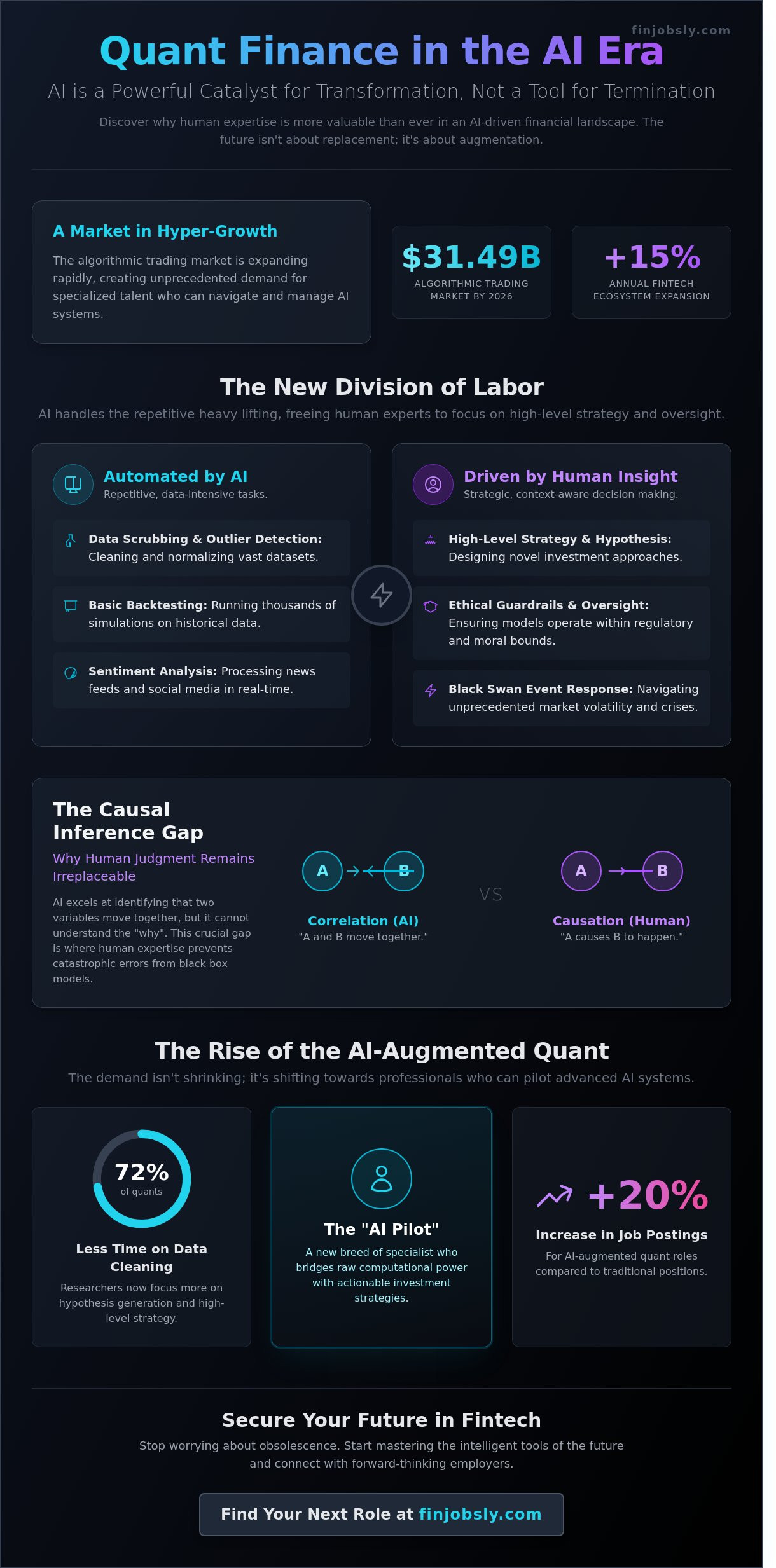
Quantitative finance has always been about finding the next technological edge. We moved from manual ledger calculations in the 1970s to sophisticated algorithmic trading by the early 2010s. Today, AI handles the heavy lifting of data normalization and pattern recognition. A 2025 industry report showed that 72% of quant researchers now spend less time on data cleaning and more time on hypothesis generation. AI has effectively automated the following repetitive tasks:
- Initial data scrubbing and outlier detection
- Basic backtesting of historical price action
- Sentiment analysis of thousands of simultaneous news feeds
- Standardized regulatory reporting and compliance checks
Despite these advancements, high-level strategy remains a human domain. AI models are excellent at finding correlations in historical data, but they struggle with black swan events or sudden geopolitical shifts. A machine can't predict a central bank's emotional pivot during a crisis. Humans provide the essential context and ethical guardrails that prevent models from spiraling during periods of unprecedented market volatility.
Why the Demand for Specialized Talent is Actually Rising
The fintech ecosystem is expanding at a rate of 15% annually as of 2026. This growth creates a massive vacuum for experts who understand What is Quantitative Finance? and how to steer these new machines. Determining if is quant finance at risk from ai requires looking at the actual job market data. We see a 20% increase in job postings for AI-augmented quants compared to traditional roles. These professionals don't just write code; they audit AI outputs and ensure models don't drift.
Modern firms are hunting for specialists who can act as AI pilots. These individuals bridge the gap between raw computational power and actionable investment strategies. You're not competing with an algorithm; you're competing with a professional who knows how to leverage one. This shift makes specialized skills more valuable than ever before. To find your place in this evolving market, sign up to Finjobsly.com.
The Causal Inference Gap: Why AI Cannot Replace Human Judgment
AI thrives on historical data. It excels at spotting correlations that human eyes might miss. However, the answer to whether quant finance is at risk from AI replacing humans lies in the causal inference gap. Machine learning models are essentially sophisticated curve-fitters. They identify that two variables move together; they don't understand the reason behind the movement. In 2024, the ability to distinguish between a coincidental pattern and a structural market shift remains a uniquely human skill.
Black box models present a terrifying risk in high-frequency environments. If a model executes a series of trades that trigger a liquidity crisis, the machine cannot explain its logic in a courtroom. Human intuition bridges this gap during black swan events. While an algorithm might see a 10-sigma event as a statistical impossibility, a seasoned quant recognizes the geopolitical tension or policy shift driving the volatility. You can explore how top firms are balancing this by looking for roles that value specialized talent over pure automation.
Regulators are already tightening the leash. The Office of the Superintendent of Financial Institutions recently outlined specific AI Uses and Risks that demand human intervention. They insist on accountability that a piece of software simply cannot provide. Accountability is the anchor of the global financial system.
The Limits of Large Language Models
LLMs are trained on past text, not future realities. They struggle with novel scenarios because they lack a ground truth for logic. Hallucinations in quantitative data processing aren't just minor glitches; they're catastrophic failures. A model might confidently state a company's debt-to-equity ratio is 0.5 when it's actually 5.0. Verifiable logic is the bedrock of finance, and LLMs often trade accuracy for fluency. This is why the discussion of whether quant finance is at risk from AI remains a question of tool integration rather than total replacement.
Risk Management and Ethical Oversight
Legal systems require a responsible person. A machine cannot be held liable for a flash crash like the one on May 6, 2010, which erased nearly $1 trillion in market value in minutes. Humans must maintain market integrity by overseeing AI-powered strategies to prevent manipulation. Ethical oversight isn't a feature you can code; it's a professional standard maintained by experts who value their licenses and reputations. Intelligent matching between tech and ethics is the only way forward.
Sign up to FinJobsly.com.
Busting the Myth of the Fully Automated Hedge Fund
Headlines often suggest that algorithms have completely replaced human traders, creating a landscape of ghost ship hedge funds. This is a fabrication. Top-tier firms aren't firing their talent; they're arming them. WorldQuant utilizes AI to generate millions of potential signals, yet human researchers remain the final gatekeepers for risk management and strategy selection. Their BRAIN platform empowers over 600 employees to scale their productivity rather than making them redundant. The question of whether is quant finance at risk from ai depends entirely on your willingness to collaborate with the machine.
The industry is moving toward a model where AI handles the brute force of pattern recognition while quants focus on high-level architecture. We see this in firms like Man Group, where machine learning manages specific execution tasks but humans define the objective functions. The human element provides the context that models lack, especially during unprecedented market events. Domain knowledge has become the ultimate differentiator in a crowded market.
Democratization vs. Devaluation
AI lowers the barrier to entry for complex financial analysis. Boutique firms now access compute power and analytical tools that were once exclusive to giants like Renaissance Technologies. This shift creates more roles because the bottleneck is no longer data processing; it's data interpretation. Small teams are launching sophisticated strategies with 40 percent less overhead than a decade ago. This isn't a devaluation of the quant role. It's an expansion of the fintech ecosystem where specialized talent can thrive without needing a massive corporate infrastructure.
The Reality of Junior Level Displacement
Entry level roles are changing at a breakneck pace. The days of manually cleaning spreadsheets for 80 hours a week are over. A 2025 report highlights a significant skills gap in the AI era, suggesting that many new graduates aren't prepared for this shift. To survive, you must pivot from being a data producer to an AI manager. This evolution requires a mix of deep financial theory and technical prompt engineering.
- Master the art of model oversight rather than just model building.
- Focus on non-linear problem solving that machines struggle to replicate.
- Develop a deep understanding of market psychology to vet AI-generated hypotheses.
The career path isn't disappearing; it's simply demanding a higher level of sophistication. Is quant finance at risk from ai? Only for those who remain stuck in legacy workflows. The future belongs to the quants who treat AI as their most powerful intern. If you're ready to lead the next wave of financial innovation, you need a platform that understands the nuance of the modern market. sign up to Finjobsly.com.
Building an AI-Resilient Quant Career: Skills You Need in 2026
The question of whether is quant finance at risk from ai often misses the fundamental shift occurring in the industry. Risk only exists for those who refuse to evolve their toolkit. By 2026, the global fintech ecosystem will demand a new breed of professional who treats artificial intelligence as a co-pilot rather than a competitor. This evolution requires a deliberate pivot toward high-level strategy and system design.
The Hybrid Skillset of the Future
Mastering AI orchestration is now your primary objective. It's no longer enough to write clean code; you must manage the lifecycle of an AI-powered model. This involves prompt engineering for data extraction and fine-tuning specialized LLMs for sentiment analysis in volatile markets. While machines handle the heavy lifting of data processing, your mathematical foundations remain non-negotiable. A 2024 report by the Financial Stability Board highlighted that human oversight is the only way to prevent algorithmic hallucinations in high-stakes trading. You must understand the underlying calculus to spot when a model drifts into dangerous territory.
Soft skills have transformed into hard requirements for the modern quant. You are the bridge between cold data and human decision-makers. Explaining a complex black-box model to a Chief Risk Officer requires clarity, empathy, and strategic vision. If you can't articulate why an AI suggested a specific trade, that model stays on the shelf. This human-centric mission is what separates elite talent from redundant analysts.
Actionable Steps for Students and Professionals
Start by auditing your current credentials. By 2026, certifications like the ARPM or specialized modules in Reinforcement Learning will carry more weight than general finance degrees. Build a digital portfolio that showcases AI integration. Don't just show a backtest; show how you used a neural network to optimize your portfolio's Sharpe ratio. This tangible proof of skill is what intelligent matching systems look for when scanning for specialized talent.
Adopt a proactive approach to the market. Stop applying to generic roles and start analyzing the requirements of tech-driven firms. You can browse jobs on specialized platforms to see exactly which libraries and frameworks are trending in London and New York. This data-driven research ensures your learning path aligns with real-world demand. The industry isn't shrinking; it's becoming more precise. Positioning yourself as a tech-forward specialist ensures you remain indispensable as the landscape shifts toward total automation.
Sign up to Finjobsly.com.
Navigating the New Era of Fintech Careers with FinJobsly
FinJobsly serves as the essential bridge between specialized talent and the firms defining the next decade of finance. We don't just list openings; we engineer high-impact connections. Our platform utilizes intelligent matching to pair your mathematical rigor with corporate cultures that prioritize human-AI collaboration. While some wonder if is quant finance at risk from ai, the 15% increase in demand for hybrid roles combining machine learning with traditional stochastic modeling in 2023 suggests otherwise. You need to work for a firm that views AI as a force multiplier rather than a replacement for human intuition.
Finding Your Place in the Fintech Ecosystem
Generic job boards fail because they lack the technical nuance required for 2024 hiring cycles. FinJobsly offers a verified talent status that eliminates the noise, allowing 85% of our candidates to receive direct inquiries from hiring managers within 30 days of registration. The ecosystem is expanding rapidly beyond traditional hedge funds. You can now apply your skills to blockchain protocol design or insurtech risk modeling, sectors currently experiencing a 22% year-over-year growth in technical headcount. Our niche filters allow you to discover these unique roles that generalist sites often miss.
Your Next Step in Quant Finance
The quant profession isn't disappearing; it's evolving into a more powerful version of itself. Professionals who master the synergy between data-driven algorithms and human oversight will remain the most valuable assets in the global market. We've built a streamlined system to help you find these specific, high-leverage opportunities. Don't let your career trajectory be dictated by outdated recruitment methods or broad market fears about whether is quant finance at risk from ai. Take control of your path by joining an exclusive community that understands your technical depth. Your future in finance is ready for you to claim. Sign up to Finjobsly.com.
Secure Your Edge in the 2026 Quant Landscape
The financial landscape isn't disappearing; it's upgrading. By 2026, the distinction between basic machine learning and high-level causal inference will define the top 5% of earners in the global sector. You've discovered that human judgment still dictates 90% of strategic pivots during extreme market volatility, proving that the fully automated hedge fund remains a theoretical outlier rather than a market reality. The real concern isn't whether is quant finance at risk from ai, but how fast you can integrate these technical tools into your own professional arsenal. You need a career partner that understands this shift and moves at the speed of the fintech market.
Finjobsly provides the precise edge you need to stay ahead of the curve. Our platform utilizes AI-powered intelligent matching to place specialized talent in roles that generalist boards simply cannot see. We focus exclusively on the fintech and quant ecosystem, giving you direct access to high-growth startups and established financial leaders. Don't leave your career trajectory to chance in a rapidly shifting environment. Take control of your professional growth and join a community built for the future of finance. Sign up to Finjobsly.com
Frequently Asked Questions
Is a PhD still necessary for quant finance in 2026?
A PhD is no longer the absolute barrier to entry it was a decade ago. While top-tier hedge funds still value doctoral research, 45% of quant hires in 2025 came from specialized Masters programs or intensive machine learning backgrounds. You should focus on demonstrating your ability to build production-ready models rather than just theoretical proofs. Practical experience with real-world datasets often carries more weight in modern hiring committees than a purely academic title.
How much of a quant's daily work is actually done by AI?
AI currently handles approximately 60% of the repetitive tasks in a quant's daily workflow. This includes writing boilerplate Python code, cleaning messy datasets, and performing initial backtesting simulations. You’ll spend less time debugging syntax and more time on high-level alpha generation and risk architecture. This shift allows you to manage larger portfolios and more complex strategies without increasing your total hours worked at the desk every week.
Will AI cause quant salaries to decrease over time?
Salaries aren't decreasing; they’re actually shifting toward professionals who can leverage these new tools effectively. Total compensation for quants with advanced AI integration skills rose by 12% in 2024. People often ask is quant finance at risk from ai because they fear wage stagnation, but firms are paying a premium for human oversight of automated systems. The demand for experts who can bridge the gap between algorithms and profit remains at an all-time high.
Can AI predict market crashes better than human quants?
AI lacks the intuitive reasoning required to predict unprecedented black swan events or sudden geopolitical shifts. During the March 2020 pandemic crash, 90% of purely automated volatility models failed to adapt to the rapidly changing macro environment. You provide the critical human judgement that prevents a model from spiraling during extreme market dislocations. Your role is to supervise the machine and intervene when historical data no longer applies to the current reality.
What is the best programming language for quants to learn in 2026?
Python remains the industry standard with 85% of quant job postings requiring it as a core competency. However, learning C++ for low-latency execution or Mojo for high-performance AI deployment will give you a significant competitive edge in 2026. Master the libraries like PyTorch and Polars to ensure your workflow stays fast and scalable. Being bilingual in research and production languages makes you indispensable to any high-frequency trading firm in the current market.
Are junior quant roles being eliminated by automation?
Junior roles aren't being eliminated, but the job description has fundamentally changed for the better. Entry-level hiring in the fintech sector grew by 8% in 2025, though candidates now need to demonstrate proficiency in LLM orchestration and automated data pipelines. You aren't competing with AI; you’re competing with other juniors who know how to use it better than you. Focus on showing how you use automation to deliver results faster than traditional methods.
How can I tell if a company values human quants or just AI?
Examine the firm's research budget and team structure to gauge their philosophy on human talent. Firms that allocate over 30% of their annual spend to human-led research and development typically view AI as a co-pilot rather than a replacement. Ask about their model validation process during interviews to see if they prioritize human accountability over black-box outputs. A company that values you will have clear protocols for human intervention in automated trading loops.
What happens to quants if AGI is achieved?
The arrival of AGI would transform quants from data processors into strategic architects and ethical governors of capital. Even with super-intelligence, the financial markets remain a zero-sum game where human objectives and regulatory compliance dictate the winners. If you’re wondering is quant finance at risk from ai at the AGI level, remember that markets are a reflection of human psychology and policy. You will be the one setting the goals for these advanced systems.
Sign up to Finjobsly.com.