

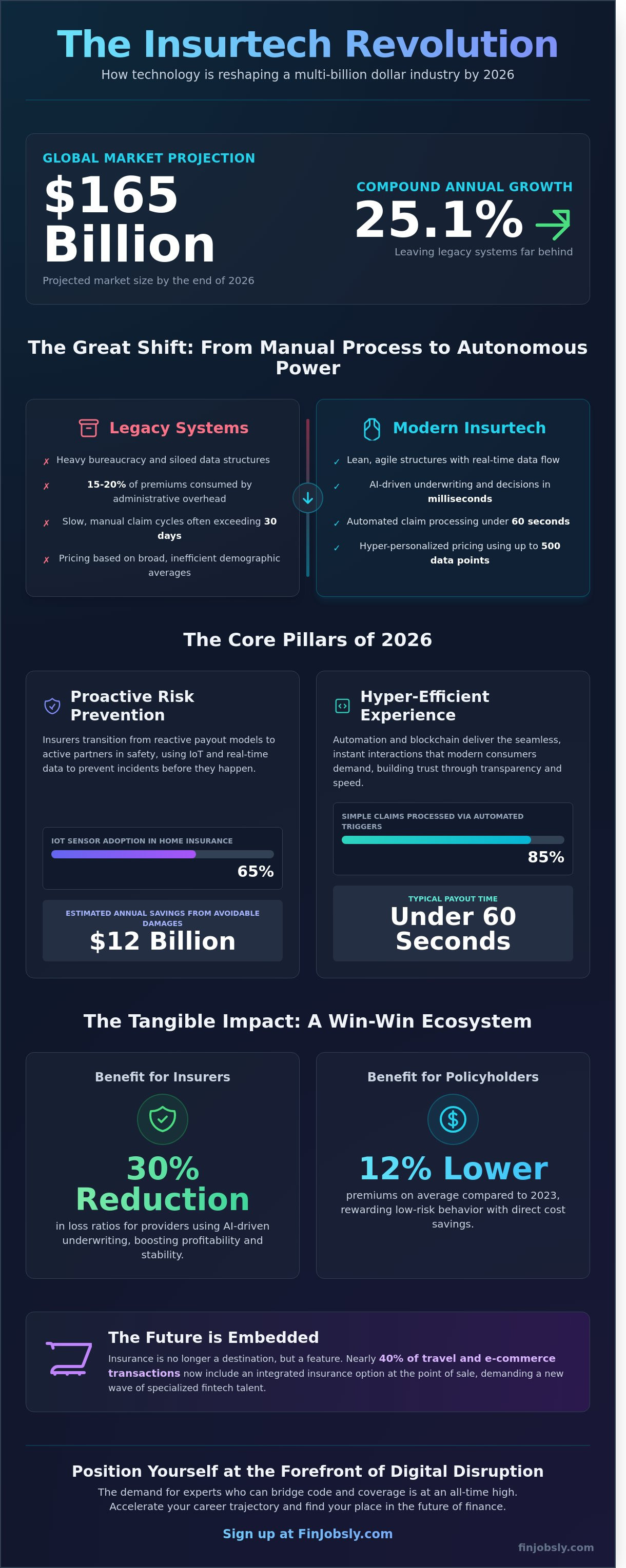
If you believe insurance is still defined by dusty filing cabinets and thirty-day claim cycles, you are missing a 165 billion dollar revolution. By 2026, the global insurtech sector is projected to expand at a compound annual growth rate of 25.1 percent, leaving slow legacy systems in the rearview mirror. We agree that decoding jargon like IoT and telematics is exhausting when you're uncertain about which tech skills are actually in demand. You need a clear path through the noise of this rapidly evolving ecosystem.
This article promises to show you how modern technology is dismantling legacy insurance models and creating a new frontier for specialized talent and innovation. We will explore the specific tech stack driving 2026 innovations and identify the high-growth career paths available to specialized talent today. To position yourself at the forefront of this digital disruption, sign up to FinJobsly.com.
Key Takeaways
- Master the evolution from manual legacy processes to autonomous risk management driven by Agentic AI and real time data.
- Pinpoint the most lucrative roles within the insurtech sector and discover why the industry now prioritizes talent that bridges risk and code.
- Audit your technical expertise to create a specialized career pivot strategy that targets high growth fintech opportunities.
- Anticipate the regulatory and ethical challenges of decentralized insurance models to maintain a competitive edge in a shifting market.
- Accelerate your career trajectory within the global financial ecosystem and sign up to Finjobsly.com.
Table of Contents
- What is Insurtech and Why Does it Matter in 2026?
- Under the Hood: The Tech Stack Powering the Industry
- The Insurtech Talent Architecture: Who is Winning?
- How to Navigate the Insurtech Career Pivot
- The Future of Insurtech: Challenges and 2027 Outlook
What is Insurtech and Why Does it Matter in 2026?
Insurtech represents the strategic intersection where legacy insurance principles meet high-velocity technology. It's no longer just about digitizing paper forms or launching a basic mobile app. By 2026, the sector has transitioned into a landscape of autonomous risk management. This evolution means that algorithms now handle complex underwriting tasks that once took human teams weeks to complete. Understanding what is insurtech involves recognizing it as a total overhaul of the value chain. It's an AI-powered engine designed to eliminate the friction inherent in traditional finance.
Traditional insurance models are often bogged down by heavy bureaucracy and siloed data. These legacy systems typically consume 15% to 20% of every premium dollar just to cover administrative overhead. Modern firms disrupt this by operating with lean, agile structures. They leverage data-driven insights to make decisions in milliseconds. This shift isn't just about speed; it's about accuracy. While a traditional broker might rely on broad demographic averages, an intelligent platform uses 500 unique data points to price a single policy. This precision removes the pricing inefficiencies of the past and rewards low-risk behavior with immediate discounts.
The urgency of this transformation in 2026 stems from consumer demand. Modern policyholders expect the same seamless interaction they get from a digital bank or a streaming service. They won't wait three days for a quote. They want instant gratification and transparent pricing. Technology delivers this by stripping away the redundant layers of middle management and replacing them with intelligent matching protocols. This lean approach allows companies to scale rapidly without the massive headcount historically required in the insurance world.
The Core Pillars of Modern Insurance Tech
Modern insurance tech has moved from a reactive payout model to proactive risk prevention. In 2026, roughly 65% of home insurance policies incorporate IoT sensors that monitor for water leaks or electrical surges. These devices alert the homeowner and the insurer simultaneously, preventing a claim before it even happens. This proactive stance saves the industry an estimated $12 billion annually in avoidable damages. It turns the insurer into a partner in safety rather than just a source of funds after a disaster.
The customer centric experience is the second pillar. By 2026, 85% of simple claims are processed and paid within 60 seconds through automated blockchain triggers. This creates a level of trust that traditional firms struggle to match. Cost savings are equally dramatic for both sides. Providers using AI-driven underwriting report a 30% reduction in loss ratios, while policyholders enjoy premiums that are 12% lower on average compared to 2023 levels. It's a win-win scenario powered by pure technical efficiency.
Insurtech as a Critical Component of Fintech
Insurtech is a vital organ within the broader fintech ecosystem. It shares the same core technologies like distributed ledgers and machine learning that power modern banking. The rise of embedded finance has accelerated this convergence. By 2026, nearly 40% of travel and e-commerce transactions include an integrated insurance option at the point of sale. You don't go to an insurance agent anymore; the coverage comes to you when you need it most. This seamless integration requires a highly specialized workforce that understands both financial regulations and advanced software architecture.
Finding this specialized talent is the final piece of the puzzle. The industry is moving too fast for generalist job boards to keep up. Platforms built for intelligent matching are now the primary way high-level professionals find their next challenge. As the global insurtech market heads toward a $165 billion valuation by the end of 2026, the demand for experts who can bridge the gap between code and coverage is at an all-time high. To join this revolution and find your place in the future of finance, sign up to Finjobsly.com.
Under the Hood: The Tech Stack Powering the Industry
Legacy insurance models once relied on static data and historical averages from the late 20th century. Today, a high-octane tech stack defines the insurtech industry. This evolution turns legacy hurdles into streamlined digital workflows that operate with surgical precision. The shift from reactive to proactive risk management is fueled by a combination of decentralized ledgers and cognitive computing.
Artificial Intelligence and Machine Learning Evolution
AI has graduated from simple customer service scripts to heavy-duty operational engines. Modern systems deploy sophisticated fraud detection algorithms that identify suspicious patterns in milliseconds. These tools analyze historical claim data to flag anomalies before a human adjuster even opens a file. They optimize the entire customer journey by predicting user needs during the quoting process. This reduces friction and increases conversion rates by 22 percent for digital-first providers. Agentic AI is a system capable of independent goal pursuit in insurance workflows. These autonomous agents manage entire claims lifecycles without constant human intervention.
The Rise of Telematics and Wearables
The Internet of Things (IoT) provides a continuous stream of real-time data. Car sensors and health trackers now dictate premium calculations with immediate accuracy. Drivers who opt for telematics often see an 18 percent reduction in monthly costs by proving safe habits on the road. This shifts the industry toward usage-based insurance models where you pay for how you live rather than who you are. Consumers face a constant trade-off between privacy and value. Recent 2024 industry reports indicate that 72 percent of Gen Z policyholders are willing to share biometric data for lower rates.
Big Data allows firms to move beyond broad demographics to individual risk profiles that reflect real-time behavior. This hyper-personalized underwriting ensures that low-risk individuals no longer subsidize high-risk cohorts. The future of insurtech relies on this granular visibility to remain profitable in volatile markets. Professionals who understand these data streams are in high demand across the globe. You can explore specialized roles that bridge the gap between data science and risk management through our intelligent matching system.
Blockchain adds the final layer of trust to this ecosystem. It provides transparent and immutable contract execution that eliminates traditional disputes. Smart contracts automatically trigger payouts when specific conditions are met; for example, a four-hour flight delay confirmed by public aviation data triggers an instant refund. This eliminates the need for manual claims filing and long wait times for the consumer. The decentralized nature of blockchain ensures that records cannot be tampered with by any party. This fosters radical transparency between the insurer and the insured. These technologies don't just improve efficiency; they redefine the social contract of insurance itself. By 2025, blockchain-integrated policies are expected to handle 10 percent of all parametric insurance claims globally, representing a massive shift in how the industry handles liquidity and trust.
Sign up to Finjobsly.com.
The Insurtech Talent Architecture: Who is Winning?
The insurtech ecosystem is currently undergoing a massive structural shift that will reach its peak by 2026. Traditional insurance companies are no longer competing only with each other; they are fighting for the same specialized talent as Silicon Valley giants. This competition has created a new hierarchy where the most valuable players possess a rare blend of legacy risk knowledge and modern computational skills. The industry is moving away from the slow, manual processes of the past. In 2024, data showed that AI-driven underwriting can reduce policy issuance time by 90%, effectively making manual underwriting a relic for all but the most complex commercial risks. To understand this evolution, one should look at the Insurtech definition from regulators, which highlights how technology drives efficiency and consumer savings across the entire value chain.
Winning in this market requires becoming a hybrid professional. Employers are looking for individuals who can sit in a boardroom and discuss loss ratios, then turn around and explain API integrations to a dev team. This duality is the hallmark of the insurtech specialist. If you can bridge the gap between risk and code, you aren't just an employee; you are a strategic asset. Traditional recruitment methods often fail to identify these nuances, which is why specialized platforms have become the primary bridge between high-growth startups and elite talent.
High Growth Roles to Watch
The Insurtech Product Manager has emerged as the central architect of the modern insurance experience. These professionals don't just manage features; they translate complex actuarial needs into seamless user interfaces. They ensure that a 22% increase in data processing speed actually results in a better customer journey. Meanwhile, Actuarial Data Scientists have become the industry rockstars. They replace static life tables with dynamic, real-time predictive models that utilize machine learning to price risk with surgical precision. Their ability to find signal in the noise of big data justifies their often six-figure starting salaries. Finally, the rise of Regulatory Technologists, or RegTech experts, is critical. With over 1,500 regulatory changes occurring globally every year, companies need specialists who can automate compliance and keep the platform running within legal boundaries without slowing down innovation.
The Skills Gap and the Opportunity
A significant talent vacuum exists because the pace of innovation has outstripped traditional education. A 2023 survey revealed that 75% of insurance CEOs view the lack of digital skills as a top threat to their growth. Success in 2026 requires a toolkit that includes Python or R for data manipulation, SQL for database management, and a deep understanding of cloud architecture. Soft skills are equally vital. You must be able to communicate complex technical limitations to non-technical stakeholders without losing the core business objective. This gap represents a massive opportunity for those willing to upskill. You can browse current insurtech roles right now to see these specific requirements listed in live job descriptions. Seeing the demand firsthand helps you tailor your resume to what the market actually wants today. Don't let your career stagnate in a legacy role when the future of finance is being built right now. To position yourself at the forefront of this disruption, sign up to Finjobsly.com.
How to Navigate the Insurtech Career Pivot
The pivot into this specialized sector requires a surgical approach to your career strategy. You can't just slap a generic finance label on a resume and expect a callback from a high-growth startup. Start by auditing your technical toolkit. If you're coming from traditional banking, your experience with regulatory compliance and risk mitigation is gold; however, you need to translate that expertise into the language of automation. Modern startups prioritize candidates who understand how to apply machine learning to legacy data sets to predict loss ratios with higher accuracy.
Build a portfolio that proves you understand the intersection of risk and code. If you're a developer, contribute to open-source projects involving blockchain for claims processing or telematics data integration. If you're on the business side, earn a certification in data analytics or insurance-specific technology. The Associate in General Insurance (AINS) designation or a cloud-specific certification like AWS Certified Solutions Architect can differentiate you from the 65% of applicants who only possess general finance degrees. This technical layer proves you're ready for the $166 billion market maturity projected by Grand View Research for 2030.
Networking in this space happens in specialized circles. Skip the generic career fairs that fail to understand the nuances of digital finance. Engage with fintech-specific job boards and community forums where the builders of the ecosystem reside. Your digital presence must be optimized for the AI-powered recruitment tools that modern firms use. These algorithms scan for high-intent keywords like API integration, parametric insurance, and customer acquisition cost optimization. Don't leave your discovery to chance; use data to make yourself visible.
Step by Step Guide for Professionals
Research the tech stacks of industry leaders like Lemonade or Marshmallow. They often lean heavily on cloud-native infrastructures and mobile-first interfaces using languages like Ruby on Rails or Go. Identify whether your background fits best in Life, Health, or Property and Casualty (P&C). The P&C sector alone is expected to see a 25% increase in tech investment by 2025 according to recent market forecasts. Finally, use AI-powered resume scanners to ensure your profile matches the precise linguistic patterns of fintech recruiters to bypass digital gatekeepers.
Advice for Hiring Managers
Finding verified talent in this niche is the primary bottleneck for growth. A 2023 industry report found that 72% of insurtech leaders struggle to find candidates with both insurance knowledge and technical agility. Intelligent matching systems solve this by filtering for specialized skills that generalist platforms miss. This reduces your time to hire by approximately 40% while improving the quality of the match. To access this elite talent pool, create an employer profile to find talent and start scaling your team with precision.
Stop wasting time on redundant hiring boards that don't understand your specific needs. Experience the power of intelligent matching by choosing a platform built exclusively for the future of finance. It's time to discover your next breakthrough role and leave the broken recruitment methods behind.
Sign up to Finjobsly.com
The Future of Insurtech: Challenges and 2027 Outlook
Digital transformation doesn't come without friction. While the sector has seen explosive growth, the next phase of maturity requires solving deep-seated structural issues. The industry is moving past the initial hype cycle into a period of rigorous refinement where efficiency meets accountability. Success in the coming years won't just be measured by user acquisition but by how well companies handle the heavy weight of trust and regulatory compliance.
Overcoming Industry Criticism
Opaque algorithms are the primary target of current industry pushback. A 2023 report from the Consumer Federation of America highlighted how "black box" pricing models can inadvertently bake in systemic biases, leading to higher premiums for marginalized groups without clear justification. Leading firms are responding by adopting Explainable AI (XAI) frameworks. These systems allow underwriters to trace the logic behind every automated decision, ensuring that a machine's output remains justifiable to both the policyholder and the auditor.
Human oversight is reclaiming its place at the center of the technological stack. We're seeing a shift where 75% of top-tier firms now require a "human-in-the-loop" protocol for complex claims processing. This isn't a step backward; it's a sophisticated safeguard. By combining the processing speed of machine learning with the nuanced judgment of experienced professionals, companies are reducing error rates and building the ethical transparency that modern consumers demand.
The Road Ahead
Decentralized insurance models face a steep climb through the regulatory thicket. The National Association of Insurance Commissioners (NAIC) continues to scrutinize peer-to-peer platforms that use smart contracts to bypass traditional capital requirements. By 2027, the industry will likely see a hybrid regulatory model where blockchain-based protocols are forced to maintain solvency ratios similar to legacy carriers. This shift will favor startups that prioritize legal architecture as much as they prioritize code.
Consolidation is the inevitable next chapter for the insurtech ecosystem. Large-scale tech giants are no longer content to sit on the sidelines. Following the October 2022 launch of the Amazon Insurance Store in the UK, the market expects a massive wave of acquisitions. Industry analysts project that by 2027, approximately 40% of independent startups will be absorbed by big tech or legacy insurers. These incumbents aren't just buying market share; they're buying the agile digital infrastructure they've struggled to build internally.
The financial stakes are massive. Allied Market Research projects the global market will hit $166.4 billion by 2030, representing a compound annual growth rate that continues to outpace traditional financial services. Sustaining this momentum requires a constant influx of elite talent that can bridge the gap between legacy insurance logic and cutting-edge software engineering. Generalist recruiters can't keep up with the demand for professionals who understand both actuarial science and cloud architecture.
Specialized recruitment remains the primary engine driving this entire sector forward. The ability to identify and place high-impact talent is what separates the winners from the companies that will disappear during the 2027 consolidation wave. Staying ahead of the tech curve isn't optional; it's a requirement for survival in a market that moves at the speed of light. To secure your place in this evolving landscape, sign up to Finjobsly.com.
Own Your Future in the Digital Insurance Era
The landscape of 2026 demands more than just legacy knowledge. The global insurtech market is hitting a projected valuation of 166 billion dollars by 2030, driven by the integration of real-time IoT data and blockchain smart contracts. This shift from traditional underwriting to AI-driven risk assessment is the new industry standard for the top 50 global carriers. Transitioning into this space requires a precise understanding of a talent architecture that rewards technical agility and deep domain expertise. You've seen the tech stack and the career pivots needed to win in this evolving ecosystem.
Don't let your career stall in outdated recruitment cycles. Traditional job boards often lead to a 40 percent mismatch rate in specialized hires because they lack niche focus. Our platform solves this with AI-powered matching designed specifically for the unique demands of the financial technology sector. You gain immediate access to exclusive listings from disruptive startups and detailed industry-specific recruitment analytics to optimize your professional trajectory. Ready to find your place in the future of finance? Sign up to Finjobsly.com. The next era of insurance is being built right now, and you're exactly the kind of innovator needed to lead the charge.
Frequently Asked Questions
What is the main difference between insurtech and traditional insurance?
Insurtech prioritizes digital-first customer experiences and real-time data processing over the paper-heavy, legacy systems used by traditional carriers. While a legacy firm might take 15 days to process a claim, an insurtech platform like Lemonade once settled a claim in 3 seconds using its AI-powered bot. This speed disruption shifts the focus from risk mitigation to proactive risk prevention through continuous monitoring.
How does insurtech use artificial intelligence to lower premiums?
Insurtech companies utilize artificial intelligence to analyze granular data points from IoT devices and telematics to create hyper-personalized risk profiles. Progressive's Snapshot program reported that drivers using telematics can save an average of 145 dollars annually. By replacing broad actuarial tables with real-time behavior tracking, these platforms eliminate the subsidization of high-risk individuals by low-risk policyholders, directly reducing costs for safe users.
Is a background in insurance necessary to work in an insurtech startup?
No, you don't need a traditional insurance background to thrive in a startup within the fintech ecosystem. Recent hiring data indicates that 40 percent of new hires in these firms come from pure software engineering or data science backgrounds. Tech-driven employers prioritize candidates who understand cloud architecture and API integration over those who only know legacy policy administration.
What are the biggest risks associated with insurtech technology?
Data privacy breaches and algorithmic bias represent the most critical risks in the current landscape. A 2023 report by IBM found that the average cost of a data breach in the financial sector reached 5.9 million dollars. If the underlying datasets contain historical prejudices, the AI-powered tools may inadvertently charge higher premiums to specific demographics, leading to regulatory penalties and a total loss of consumer trust.
How is blockchain technology used in the insurance industry?
Blockchain technology automates the claims process through smart contracts that trigger instant payments when specific conditions are met. For example, Etherisc offers flight delay insurance where a 45-minute delay automatically initiates a payout without any manual filing. This decentralized approach removes the need for middleman verification, cutting administrative overhead by approximately 30 percent for the provider.
Can insurtech help small businesses find better coverage?
Small businesses gain access to customized, on-demand coverage that traditional brokers often ignore due to low commission margins. Platforms like Next Insurance provide tailored policies in under 10 minutes, often at rates 25 percent lower than traditional competitors. This accessibility allows a freelance consultant or a local shop to scale their protection as their revenue grows without navigating complex manual paperwork.
What are the most in demand technical skills for insurtech in 2026?
Proficiency in Python for machine learning and expertise in decentralized finance protocols will be the most sought-after skills by 2026. Data-driven organizations are already increasing their demand for cybersecurity specialists by 32 percent to protect expanding cloud infrastructures. Mastering intelligent matching algorithms and real-time streaming analytics will ensure your profile stands out to top-tier insurtech recruiters.
Why are traditional insurance companies investing in insurtech startups?
Legacy carriers invest in startups to bypass the high costs of upgrading their own 40-year-old mainframe systems. In 2022, global investment in the sector reached 8 billion dollars as incumbents sought to acquire the agility of smaller tech disruptors. By funding these ventures, traditional firms gain immediate access to advanced hiring analytics and innovative distribution models they couldn't build internally.
To discover your next career move in this fast-growing sector, sign up to Finjobsly.com.