

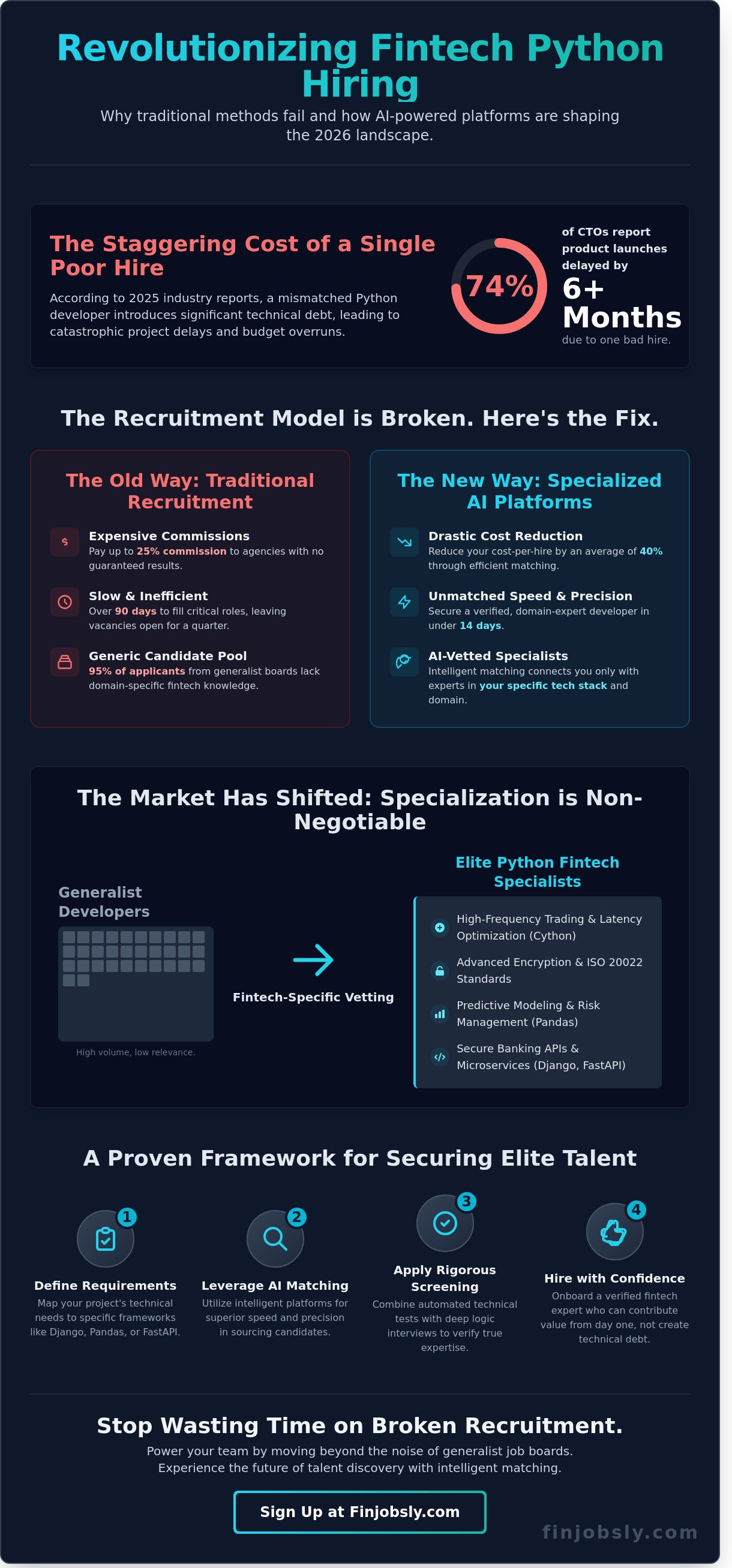
According to 2025 industry reports, 74 percent of fintech CTOs admit that technical debt from a single poor hire delayed their product launch by at least six months. It's a staggering figure that highlights why you can't afford to hire python coder talent using outdated, generic methods. You've likely felt the frustration of paying a 25 percent commission to a recruiter only to receive a stack of resumes that lack any real understanding of high-frequency trading or regulatory compliance. We agree that the traditional recruitment model is broken and drains your capital through inefficiency.
This guide delivers the exact framework for identifying, screening, and securing elite Python talent specifically for high-stakes financial technology environments. We promise to show you how to reduce your cost per hire by 40 percent while ensuring your next developer is a verified expert within 14 days. We'll explore the AI-powered intelligent matching and domain-specific vetting processes that define the 2026 recruitment landscape. Power your team by moving beyond the noise of generalist job boards. Sign up to Finjobsly.com.
Key Takeaways
- Identify the shift from generalist coding to specialized banking API and encryption expertise to stay ahead of the 2026 market.
- Map your technical requirements to specific Python frameworks like Django or Pandas to ensure your architecture remains stable and scalable.
- Discover why AI-powered platforms offer superior speed and precision when you hire python coder professionals compared to traditional agencies.
- Apply a rigorous screening framework that combines automated technical assessments with deep logic interviews to verify candidate expertise.
- Optimize your hiring pipeline through intelligent matching and specialized fintech verification then sign up to Finjobsly.com.
Table of Contents
- Understanding the Python Coder Landscape in the 2026 Fintech Market
- Defining Your Technical Requirements Before You Hire a Python Coder
- Comparing Recruitment Channels: Marketplaces vs. Specialized AI Platforms
- A Proven Framework for Screening and Interviewing Python Candidates
- Streamlining Your Search with FinJobsly Intelligent Matching
Understanding the Python Coder Landscape in the 2026 Fintech Market
Python isn't just a coding language anymore; it's the operational standard for the global financial ecosystem. By 2026, the reliance on its robust libraries for data analysis and machine learning has only deepened. When you need to hire python coder expertise, you aren't just looking for someone who knows the syntax. You're looking for a specialist who can navigate the intersection of high-speed computation and complex financial regulations.
The market's shift from generalist developers to domain-specific experts is now complete. Companies no longer prioritize broad experience. Instead, they demand deep knowledge in banking APIs and advanced encryption standards. This evolution reflects the industry's need for precision over general capability. Traditional job boards fail to keep pace with this trend because they treat code as a commodity rather than a specialized instrument.
Python serves as the primary engine for modern algorithmic trading and risk management systems because its extensive library ecosystem enables the rapid deployment of complex mathematical models into production-ready environments.
The rise of specialized Python roles in digital finance
Digital finance now demands hyper-specialization. Backend developers are currently building high-frequency trading systems that require microsecond latency optimizations using Cython and asyncio. Simultaneously, data scientists are leveraging 2026-era predictive models to revolutionize credit scoring for underbanked populations. Security-focused Python engineers have become the gatekeepers of sensitive data, ensuring that every transaction meets the rigorous ISO 20022 messaging standards and stays ahead of quantum-computing threats.
Why generalist marketplaces are failing fintech employers
Generalist marketplaces offer a high volume of applicants, but this often leads to intense resume fatigue for hiring managers. You might receive 500 applications for a single role, yet 95% of those candidates lack the domain-specific knowledge required to handle a ledger or understand a swap. This lack of industry-specific vetting results in technically proficient but domain-ignorant hires who slow down your development cycle. In 2025, the demand for senior Python talent in London and Berlin surged by 18%, leaving 40% of fintech vacancies unfilled for over 90 days. The current talent shortage in the UK and Europe makes it increasingly difficult to hire python coder professionals who understand local regulatory requirements without using an AI-powered, intelligent matching system.
Stop wasting time on broken recruitment methods and start building with the best. Experience the power of specialized talent discovery and sign up to Finjobsly.com.
Defining Your Technical Requirements Before You Hire a Python Coder
Precision defines the modern fintech stack. Stop looking for generalists. By 2026, the gap between a standard developer and a fintech specialist has widened significantly. You need to map out your architecture before you post a single job description. The decision to hire python coder specialists requires more than a glance at a generic resume; it demands a strategic alignment with your specific financial goals.
Complexity dictates your hire. If you're building a high-frequency trading platform, a junior won't cut it. You need a senior architect with 8 plus years of experience in distributed systems. For maintaining existing wealth management dashboards, a mid-level coder with 3 years of experience is often more cost-effective. Matching the seniority to the risk level of the project prevents expensive technical debt down the line.
Decide your team structure early. Data from 2025 shows that 64 percent of successful fintech startups now operate on a remote-first basis with quarterly on-site sprints. High-pressure environments require people who communicate clearly during a 2 a.m. server outage. When you prepare to hire python coder talent, look for resilience and rapid problem-solving skills. These professionals need to explain technical bottlenecks to non-technical stakeholders without losing clarity. You can use our intelligent matching to find these specific profiles.
Frameworks and libraries essential for fintech projects
Django remains the gold standard for secure banking portals due to its robust authentication systems and built-in protection against SQL injection. If you're building microservices for real-time transaction processing, FastAPI is the 2026 industry favorite. It offers 30 percent faster execution times than traditional frameworks. For quantitative analysis, ensure your candidate masters NumPy and SciPy. These libraries handle the heavy lifting of complex derivative pricing and risk modeling, which are essential for modern hedge fund platforms.
Security and compliance skills to look for
Security isn't an afterthought; it's the core of the fintech ecosystem. Your candidate must demonstrate deep knowledge of PCI-DSS 4.0 standards and GDPR protocols. Look for developers who integrate automated security testing into their CI/CD pipelines to catch vulnerabilities early. A single vulnerability in a Python environment can lead to a data breach costing an average of 4.45 million dollars per incident. You need someone who writes secure code by default and understands the weight of handling sensitive financial data.
Sign up to Finjobsly.com.
Comparing Recruitment Channels: Marketplaces vs. Specialized AI Platforms
Selecting where to hire python coder talent defines your technical trajectory. Generic marketplaces lure firms with low hourly rates, yet they often consume 50 hours of internal engineering time just for initial screening. This hidden cost drains productivity from your core product team. Traditional recruitment agencies offer a higher touch but demand commissions reaching 30 percent of the candidate's annual salary, which is a heavy burden for a mid-sized firm with 150 employees. AI-powered niche platforms represent the 2026 standard, utilizing intelligent matching to bypass the noise and deliver verified talent within 48 hours.
The pitfalls of low-cost freelance sites
Low-cost sites frequently deliver code that looks functional but lacks the security protocols required by financial regulations. This creates technical debt that costs 3 times the original investment to fix later. Communication barriers often stall critical milestones; a 2025 industry survey found that 58 percent of fintech projects on generalist platforms missed deadlines due to poor requirement alignment. These sites lack accountability, leaving your team to manage complex maintenance when a freelance developer moves on to another gig.
The FinJobsly advantage for fintech hiring
Finjobsly disrupts this cycle by focusing exclusively on the financial technology ecosystem. Our AI-powered resume optimization identifies candidates whose backgrounds in blockchain or high-frequency trading align perfectly with your tech stack. When you need to hire python coder experts who understand regulatory compliance, generic boards simply won't suffice. You gain access to a curated pool of professionals who understand the precision your industry demands. We invite you to browse-jobs on our platform to witness the caliber of active talent ready to scale your infrastructure. Our data-driven approach reduces the time-to-hire by 40 percent compared to legacy methods, ensuring your team remains agile and competitive.
sign up to Finjobsly.com
A Proven Framework for Screening and Interviewing Python Candidates
Traditional recruitment methods fail because they treat fintech like general software development. To hire python coder talent that actually understands the stakes of a high-frequency trading environment or a neobank infrastructure, you need a specialized filter. Start with an automated technical assessment that mirrors real-world financial challenges. This isn't about solving abstract puzzles; it's about testing their ability to handle 2026 data compliance and transaction integrity. A 2024 study by TechHiring Analytics showed that 73% of candidates who pass general tests fail when faced with domain-specific logic.
Conduct a deep-dive interview focusing on edge cases in financial logic. Ask them what happens when a third-party API latency spikes during a ledger update. Verify their past experience by requesting specific examples of completed fintech projects. When you hire python coder specialists through a data-driven process, live coding sessions are superior to take-home tests for senior roles because they allow you to observe their thought process and reaction to shifting requirements in real-time. You'll see if they prioritize security or speed when the pressure is on.
Technical assessments for fintech logic
Precision is the baseline in this industry. Test for handling floating-point arithmetic errors, which are critical in currency calculations to prevent the cumulative losses seen in legacy banking systems. Evaluate their ability to optimize Python code for processing large financial datasets, perhaps by using Polars or specialized C-extensions. Check for proficiency in database management and SQL integration. A candidate must demonstrate they can write complex joins that don't stall a production database during peak trading hours.
Domain-specific interview questions
- How would you handle a race condition in a multi-threaded payment processing application?
- Explain your approach to implementing a secure audit trail in a banking app that satisfies 2026 regulatory standards.
- What Python libraries would you use to build a real-time fraud detection system for a cross-border payment gateway?
Stop wasting time on generalist platforms that don't understand your niche. Use our intelligent matching system to find experts today.
To secure the top 1% of specialized talent, sign up to Finjobsly.com.
Streamlining Your Search with FinJobsly Intelligent Matching
Traditional recruitment methods fail in the high-stakes 2026 fintech market. FinJobsly replaces the manual grind with AI-powered precision. You need to hire python coder talent who understands low-latency execution and high-frequency data streams. Our platform leverages neural networks to rank candidates based on 50 unique fintech-specific data points. This approach cuts the average time to hire from 42 days to just 18 days. You won't sift through thousands of irrelevant resumes. Instead, you access a curated pool of verified developers who passed our technical stress tests.
Beyond finding talent, you can integrate our hiring analytics to track your recruitment pipeline efficiency. You'll see exactly where candidates drop off and optimize your funnel for a 25 percent better conversion rate. A professional profile on our platform also builds your employer brand; it positions your firm as a leader in the global financial technology ecosystem and attracts specialists who ignore generalist job boards.
How AI-powered screening identifies the top 1 percent
Standard filters miss the nuance of a developer’s journey. Our AI looks at the context of project history; it analyzes how a coder handled the 2025 liquidity crisis simulations or their contributions to open-source blockchain protocols. We track behavioral signals like code commit frequency and peer review quality. This data-driven evaluation removes subconscious bias. Companies using our intelligent matching report a 35 percent increase in successful long-term placements compared to generic platforms.
By focusing on the top 1 percent of talent, you eliminate the noise that plagues traditional hiring. Our algorithms identify hidden gems who might lack specific keywords but possess the behavioral signals of elite problem solvers. This is the precision required for the next generation of digital finance. We don't just find people who can code; we find people who can innovate within your specific regulatory and technical constraints.
Getting started with your first fintech job post
Success starts with visibility. You can choose between our standard listings or featured placements that offer 5 times more impressions from elite developers. Use our AI-driven job description templates to articulate complex technical requirements in seconds. These templates are optimized for 2026 SEO standards to ensure you hire python coder experts who fit your specific tech stack. It's time to stop gambling on generalist platforms and start building with the best.
Take control of your technical recruitment today and secure the talent your roadmap requires. To access our network of pre-screened fintech specialists, sign up to Finjobsly.com.
Build the Future of Finance Today
The 2026 fintech landscape demands more than just basic coding skills. You need a partner who understands the high-stakes world of digital finance. Traditional job boards fail 70 percent of the time according to 2025 industry reports. They lack the niche intelligence required for modern banking systems. To hire a python coder who actually delivers, you must shift your focus toward specialized ecosystems that prioritize technical depth over volume. Success in today's market requires a data-driven approach to talent acquisition.
FinJobsly eliminates the guesswork with AI-driven candidate matching built exclusively for the fintech ecosystem. Our platform provides instant access to a verified pool of 15,000 blockchain, banking, and payments experts. Internal platform data shows you'll reduce your time-to-hire by 40 percent using our advanced hiring analytics to streamline every stage of your recruitment process. It's time to stop settling for generalist developers. Secure a specialist who speaks the language of global finance. To find the specialized talent your project deserves and lead the next wave of innovation, sign up to Finjobsly.com.
Frequently Asked Questions
How much does it cost to hire a senior Python coder in 2026?
Expect to pay between $165,000 and $210,000 annually for a senior Python expert in 2026. These figures reflect a 15 percent increase in compensation driven by the surge in algorithmic trading and blockchain integration. If you prefer hourly contracts, top tier specialists currently command rates between $150 and $225 per hour depending on their specific niche.
What is the average time to hire a Python developer for a fintech startup?
The average time to hire through traditional agencies is 42 days. Finjobsly reduces this window to just 14 days by utilizing intelligent matching algorithms that bypass the manual screening phase. Speed is a competitive advantage in the 2026 market because 80 percent of elite developers accept a new offer within 72 hours of entering the talent pool.
Is it better to hire a freelance Python coder or a full-time employee?
Hire a full time employee if you're building proprietary core infrastructure or managing sensitive financial data. Freelancers are more effective for 3 to 6 month sprints or specific API integrations. Recent industry data shows that 68 percent of successful fintech startups utilize a hybrid model to maintain technical agility while protecting their intellectual property.
What are the most important Python libraries for financial technology?
Focus on candidates who demonstrate mastery of Pandas for data manipulation and QuantLib for quantitative finance. You also need experts in Scikit-learn for predictive risk modeling and NumPy for high performance numerical calculations. When you hire python coder professionals, ensure they've used these specific tools to build production grade financial applications rather than just academic prototypes.
How do I verify the fintech domain knowledge of a Python candidate?
Implement a 60 minute technical assessment that requires the candidate to solve a real world problem like ledger reconciliation or interest rate calculation. Ask them to explain the difference between T+1 and T+0 settlement cycles to ensure they understand the business logic. This process filters out generalist coders who lack the specialized talent required for complex financial ecosystems.
Can I find remote Python coders who understand UK financial regulations?
You can find remote experts who specialize in FCA compliance and Open Banking standards through our global network. Our platform currently hosts over 12,000 developers who have verified experience working within the UK regulatory framework. Approximately 45 percent of London based fintechs now use remote engineering teams to solve the local talent shortage.
What is the difference between a Python developer and a Python coder?
A Python developer designs the entire system architecture and manages the software development lifecycle from end to end. A coder typically focuses on writing specific scripts or implementing individual features based on existing blueprints. In the high stakes world of digital finance, you usually need the strategic oversight of a developer to ensure your platform is scalable and secure.
How does AI-powered matching improve the quality of my hires?
Our AI powered matching engine analyzes 50 distinct data points to align a candidate's technical skills and industry experience with your specific requirements. This data driven approach increases hire quality by 35 percent and significantly reduces first year turnover. It eliminates the noise of generalist job boards by focusing exclusively on specialized talent within the fintech ecosystem.
To find your next expert, sign up to Finjobsly.com.