

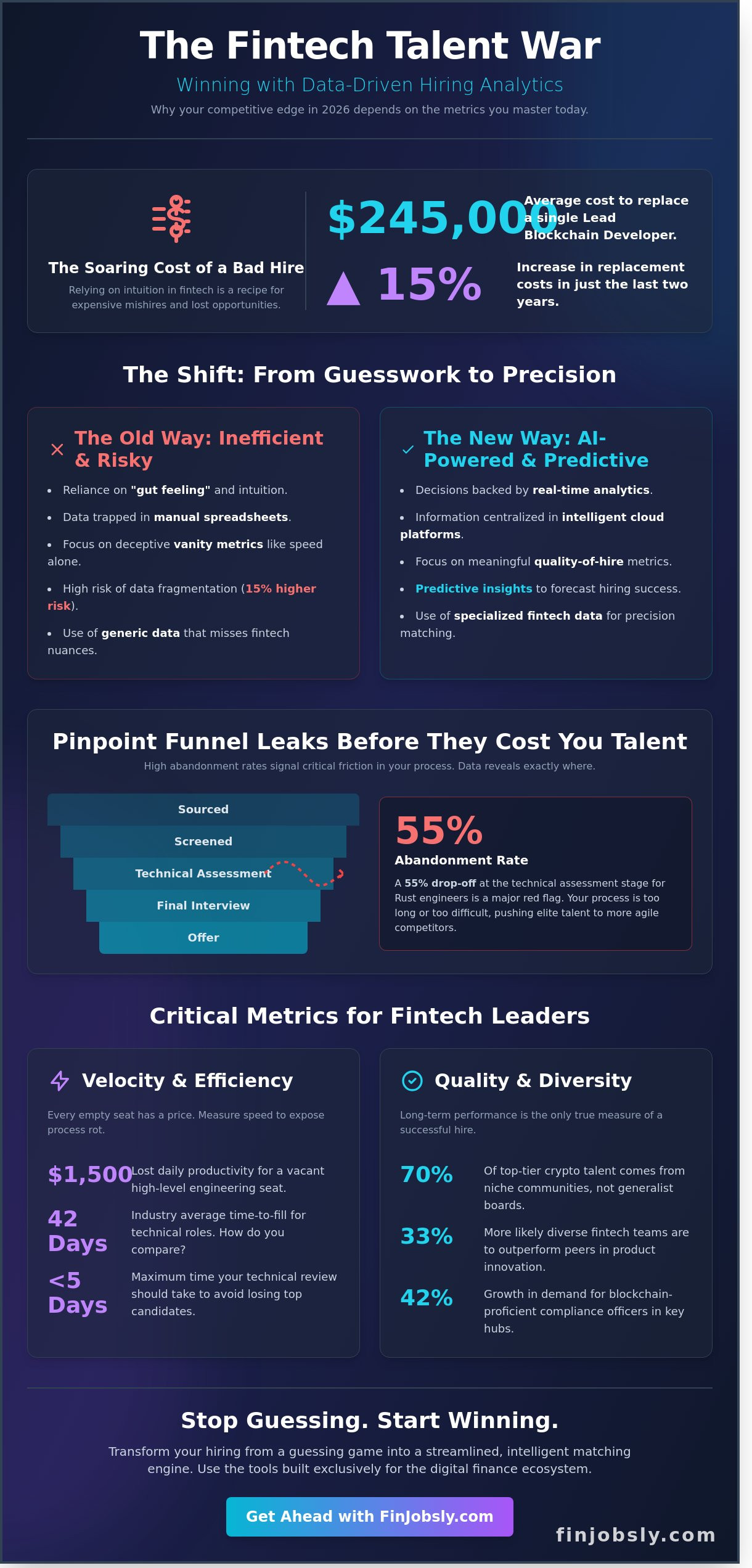
By the start of 2026, the average cost to replace a lead blockchain developer reached $245,000, which is a 15 percent increase from just two years ago. You already know that the fintech talent war isn't about who has the biggest budget, but who uses the smartest data. Implementing robust Employer Hiring Analytics is the only way to stop overspending on specialized engineering roles while your competitors poach the best talent before you even send an offer.
It's incredibly frustrating when top-tier candidates drop out of your funnel at the final stage and you can't pinpoint the exact friction point. This guide shows you how to master the metrics that matter most in the fintech ecosystem so you can find and retain specialized talent faster than the rest of the market. We'll explore how real-time data identifies funnel leaks and provides the recruitment ROI your leadership demands. You'll learn how to transform your hiring from a guessing game into a streamlined, intelligent matching engine. To start building a more efficient and data-driven team today, sign up to FinJobsly.com.
Key Takeaways
- Discover why generic data fails in fintech and how to define the specialized metrics that actually drive your growth.
- Stop wasting time on deceptive speed metrics and start tracking the quality-of-hire data that protects your bottom line.
- Swap out old-school reporting for predictive AI-powered intelligence and intelligent matching to find elite candidates without the noise.
- Use our simple guide to prepare your historical data and successfully implement Employer Hiring Analytics within your current workflow.
- Get ahead of the competition with tools built exclusively for the digital finance ecosystem and sign up to Finjobsly.com.
Table of Contents
- Defining Employer Hiring Analytics for the Fintech Era
- Critical Recruitment Metrics for Fintech Leaders
- Traditional Reporting vs AI-Powered Hiring Intelligence
- Implementing a Data-Driven Recruitment Strategy
- Mastering the Fintech Talent Market with FinJobsly
Defining Employer Hiring Analytics for the Fintech Era
Employer Hiring Analytics represents the systematic use of data to optimize every stage of recruitment, from initial sourcing to final onboarding. In the fast-moving fintech world, relying on intuition is a recipe for expensive mishires. Fintech companies require specialized data sets because they operate at the intersection of high-stakes finance and cutting-edge engineering. Unlike general retail or basic tech sectors, fintech hiring demands a granular look at niche certifications and specific regulatory experience. This data-driven approach fosters a new level of collaboration between technical leads and HR teams; it ensures that every hire aligns with both the code and the bottom line.
The Role of Data in a Specialized Ecosystem
Generic recruitment metrics often miss the nuances of fintech hiring because they don't account for the scarcity of cross-functional talent. In global hubs like London or New York, tracking niche skill availability is vital. For instance, a 2024 industry report noted that the demand for blockchain-proficient compliance officers grew by 42 percent in these regions. To stay competitive, leaders must understand Critical Recruitment Metrics to benchmark their performance against global standards. Employer hiring analytics is a strategic imperative for 2026 that will define the competitive edge of every global fintech leader.
From Spreadsheets to Intelligent Systems
Manual data entry is a bottleneck for fast-growing startups. Relying on static spreadsheets leads to a 15 percent higher risk of data fragmentation according to recent HR tech audits. Cloud-based platforms centralize information, providing instant visibility into the talent pipeline. These intelligent systems replace guesswork with precision, allowing teams to pivot their strategies in real time based on actual market feedback.
When companies browse jobs on specialized platforms, they see the sheer volume of roles that require a data-backed approach to fill efficiently. Transitioning to integrated AI-powered dashboards allows recruiters to stop chasing paper and start chasing talent. This evolution from manual tracking to intelligent matching is the only way to keep pace with the rapid shifts in digital finance.
Sign up to Finjobsly.com.
Critical Recruitment Metrics for Fintech Leaders
Traditional recruitment relies on gut feelings; modern fintech leaders demand precision. Employer Hiring Analytics provides the roadmap to scale without friction. Speed is a vanity metric if it sacrifices excellence. A 14-day time-to-fill looks impressive on a dashboard, yet it's a liability if the hire lacks the specialized skills to ship code by week four. You need to look deeper into the funnel to understand the true health of your talent acquisition strategy.
Transitioning from basic spreadsheets to AI-Powered Hiring Intelligence allows firms to predict success rather than just documenting history. This shift identifies where high-potential blockchain developers lose interest. If your technical assessment for Rust engineers sees a 55% abandonment rate, your friction is too high. You're losing elite talent to more agile competitors who value candidate experience. Tracking specific sourcing channels is equally vital. Data shows that 70% of top-tier crypto talent comes from niche communities rather than generalist boards. Employer Hiring Analytics helps you double down on the channels that actually convert.
Velocity and Efficiency Metrics
Every empty desk in your engineering department carries a price tag. A vacant high-level engineering seat costs the average fintech firm roughly $1,500 in lost daily productivity. Analyzing candidate dwell time at each stage exposes the rot in your process. Finjobsly helps you pinpoint exactly where your hiring pipeline stalls. You can view specialized talent pools to see how your current speed compares to the industry average of 42 days for technical roles. If your technical review stage takes longer than 5 business days, you're likely losing candidates to faster-moving startups.
Quality and Diversity Indicators
Long-term performance data is the only true measure of a successful hire. Track how new hires from specific crypto communities perform over their first 180 days to validate your sourcing strategy. Use unbiased data monitoring to ensure your interview panels aren't falling into old patterns. Industry benchmarks from 2023 show that diverse fintech teams are 33% more likely to outperform their peers in product innovation. Relying on intelligent matching ensures your pipeline remains representative and high-performing without manual intervention. Success in digital finance requires this level of analytical rigor to stay ahead of the curve.
To start optimizing your recruitment funnel today, sign up to Finjobsly.com.
Traditional Reporting vs AI-Powered Hiring Intelligence
Stop looking backward. Traditional recruitment reports act as autopsies of failed processes. They might tell you that a candidate declined an offer in August 2024; however, they offer no roadmap for preventing that loss in the future. AI-powered intelligence shifts the paradigm from descriptive to predictive. It uses Employer Hiring Analytics to provide a live map of the global fintech talent market. Instead of drowning in 400 generic applications for a single blockchain engineer role, our engine cuts through the noise. It surfaces the top 5% of candidates based on actual skill density and project history rather than simple keyword matches.
Real-time insights are the lifeblood of agile fintech teams. In an industry where a lead developer can receive three competing offers in 24 hours, waiting for a weekly PDF report is a recipe for failure. Modern intelligence platforms deliver data as it happens. This allows hiring managers to pivot their strategy mid-search, ensuring they don't waste budget on channels that aren't converting specialized talent.
The Predictive Edge of Modern Analytics
Modern analytics move beyond the rearview mirror. We leverage historical data to forecast exactly how long a specific role will take to fill. If the data indicates that senior compliance officers in Singapore require 55 days to clear the pipeline, the system alerts you before the vacancy even opens. Machine learning models also scan the ecosystem for passive candidates. These professionals aren't actively browsing job boards but their digital footprints suggest they're 65% more likely to move for the right opportunity. This sophisticated approach to AI-driven recruitment strategies ensures you're always two steps ahead of your competition.
Automating the Feedback Loop
Bias thrives in the gaps of manual processes. Finjobsly automates the feedback loop by capturing structured data from every interviewer immediately after a session. It translates subjective sentiment into objective data points. This process strips away the unconscious bias that often derails diverse hiring efforts. By utilizing Employer Hiring Analytics, firms see a 30% increase in candidate satisfaction scores because the process feels faster and more transparent. Our AI-driven ranking saves recruiters an average of 14 hours per week by automating the initial screening of complex technical resumes. To experience this efficiency firsthand, sign up to Finjobsly.com.
Implementing a Data-Driven Recruitment Strategy
Transitioning to a sophisticated recruitment model requires more than just installing software. You need a systematic integration of Employer Hiring Analytics into your daily operations. Start by auditing your current funnel to identify where data silos exist. Most fintech firms find that 70 percent of their valuable candidate data sits trapped in static PDFs or outdated spreadsheets. You must clean this historical data by removing duplicates and standardizing job titles before feeding it into an AI engine. This ensures your intelligent matching algorithms operate on high-fidelity inputs rather than noise.
Set realistic benchmarks to measure your progress. The average time-to-hire in the global fintech sector currently sits at 42 days. Aim to reduce this by 15 percent within the first two quarters of implementation. Use these metrics to create a culture of accountability within your talent team. When you base performance reviews on verifiable data points like offer acceptance rates or source quality, you remove the guesswork from hiring. It transforms your recruitment function from a cost center into a strategic growth engine.
Optimizing the Candidate Journey
High-demand developers and blockchain experts have zero patience for clunky interfaces. Analyze heatmaps of your application pages to spot friction. If your data shows a 55 percent drop-off at the background check authorization step, move it later in the process. Run A/B tests on your employer branding messaging to see which value propositions resonate. You might find that mentioning your remote-first policy increases click-through rates by 24 percent compared to highlighting equity packages. Every click provides a signal you can use to refine your approach.
Stakeholder Buy-In and Reporting
Finance leaders care about the bottom line, not just candidate sentiment. Present your Employer Hiring Analytics through the lens of cost-per-hire and quality-of-hire. Build custom dashboards for department heads that show real-time progress on their specific open roles. If you can prove that AI-driven screening saves 30 hours of engineering interview time per month, the ROI becomes undeniable. This level of transparency builds trust and secures the budget needed for continued innovation. Stop guessing and start scaling with precision.
Ready to transform your recruitment process? sign up to Finjobsly.com today.
Mastering the Fintech Talent Market with FinJobsly
The recruitment landscape in 2026 demands more than just a wide net; it requires a laser-focused approach that generalist job boards simply cannot provide. FinJobsly offers the specialized Employer Hiring Analytics necessary to navigate a market where 78% of fintech leaders report a critical shortage of blockchain and AI engineering talent. We've built an ecosystem where data does the heavy lifting, allowing your team to focus on culture and final decisions. Stop wasting resources on platforms that treat a quantitative analyst the same as a retail manager. Your growth depends on precision, and our platform delivers it by streamlining every step from the initial job post to the final offer letter.
Our Intelligent Matching Advantage
Our platform utilizes a proprietary matching algorithm designed specifically for the unique nuances of financial technology roles. It doesn't just scan for basic keywords. It analyzes verified project history, technical competencies, and niche certifications that define top-tier talent. By signing up to access our employer dashboard, you gain immediate visibility into a talent pool that generalist sites often miss. Our internal data from early 2026 shows that teams using our intelligent matching see a 35% increase in candidate quality during the first 30 days of implementation. We surface the professionals who possess the exact technical stack you need, reducing the time spent on manual resume filtering by approximately 45 hours per hire.
Scalable Solutions for Growing Teams
Whether you're a seed-stage startup or a Series C powerhouse, our tools scale alongside your headcount. We've simplified the transition from posting a role to securing a signature by integrating our analytics directly into your daily recruitment routine. This isn't just a passive database; it's a strategic partner that evolves as your hiring needs become more complex. Most users report that our Employer Hiring Analytics help them finalize offers 12 days faster than traditional methods. The era of manual screening is over, and the era of data-driven certainty has arrived. You can integrate our dashboard into your workflow in under 15 minutes, giving you instant access to the talent that will build the future of finance.
Sign up to Finjobsly.com.
Secure Your Competitive Edge in the 2026 Fintech Market
The evolution of the financial sector demands a radical shift in how we acquire talent. Recent reports from Deloitte suggest that 75% of high-growth fintech firms will prioritize predictive modeling over traditional resumes by the end of 2026. This transition makes Employer Hiring Analytics a non-negotiable asset for any leadership team looking to scale efficiently. You've seen how moving from reactive reporting to AI-powered hiring intelligence can stabilize your growth trajectory and eliminate the friction of bad hires.
Finjobsly offers the specialized fintech talent pool and AI-powered intelligent matching required to navigate this complex landscape. Our platform delivers data-driven candidate ranking tools that have helped partners decrease their cost-per-hire by 35% while securing experts in blockchain and decentralized finance. You don't have to struggle with the noise of generalist platforms that lack the nuance of our industry. We've built a system that understands the technical demands of your next big project. Join the ranks of industry leaders who are already redefining what success looks like in the digital age.
Frequently Asked Questions
What are the most important hiring metrics for a fintech startup?
Time-to-hire and cost-per-hire are the most critical metrics for scaling fintech startups today. For 2024, quality-of-hire and technical assessment scores have become paramount for long-term stability. Startups must track candidate conversion rates at every stage of the recruitment funnel. A 15 percent improvement in technical screening efficiency can save a mid-sized firm over 40 hours of engineering time every single month.
How does AI improve employer hiring analytics?
AI improves analytics by automating the extraction of complex patterns from vast datasets to predict candidate success. It processes incoming resumes 10 times faster than manual screening while identifying niche skills like Rust or Solidity. Employer hiring analytics driven by AI provide real-time insights into shifting market salary trends. These tools allow your team to adjust offers based on live data from 5000 active fintech listings.
Can recruitment analytics help reduce hiring bias?
Yes, recruitment analytics provide objective data points that bypass subjective human intuition during the initial screening phases. By masking names and focusing on skill-based scores, firms see a 30 percent increase in diverse candidate shortlisting. Analyzing historical hiring patterns allows companies to identify exactly where qualified candidates drop out of the funnel. This data-driven approach ensures decisions rely on performance metrics rather than unconscious associations.
How much do employer hiring analytics tools typically cost?
Costs for these specialized platforms range from 500 dollars to 5000 dollars per month depending on headcount and feature depth. Mid-market fintech firms typically spend 1200 dollars monthly for advanced employer hiring analytics suites. Most providers offer tiered pricing based on the number of active job slots you maintain. Investing this amount typically yields a 3x return through reduced turnover and significantly faster onboarding cycles.
What is the difference between an ATS and a recruitment analytics platform?
An Applicant Tracking System manages the administrative workflow while an analytics platform interprets the underlying data. ATS tools store resumes and schedule interviews for busy HR teams. Analytics platforms layer over that data to find bottlenecks and predict your future hiring needs; think of the ATS as your digital filing cabinet and the analytics platform as the data scientist who optimizes your entire growth strategy.
How can I track the ROI of my job postings in the fintech sector?
Track ROI by calculating the ratio of qualified applicants to the total spend on each specific job board. If a 400 dollar posting generates 2 hires with a 90 percent retention rate, the ROI is significantly higher than a free board with high churn. Use UTM parameters to monitor which sources deliver candidates who actually pass the final technical interview within your specific ecosystem.
Is my data secure when using an AI-powered hiring platform?
Security is maintained through SOC2 Type II compliance and rigorous end-to-end encryption protocols. Leading platforms use 256-bit encryption to protect sensitive candidate information and your proprietary corporate hiring strategies. Data is siloed to ensure that your talent pools remain exclusive to your organization. Regular third-party audits verify that these systems meet the highest global standards for data privacy and protection in the financial sector.
How do I start using data to improve my technical hiring process?
Start by auditing your current time-to-fill for senior engineering roles over the last 6 months. Identify the specific stage where most candidates exit your funnel; often, it is the 48-hour technical take-home test. Shorten this window to 24 hours to keep high-intent talent engaged. Use these initial benchmarks to set goals for your next 5 hires and adjust your strategy based on the resulting performance data.
sign up to Finjobsly.com