

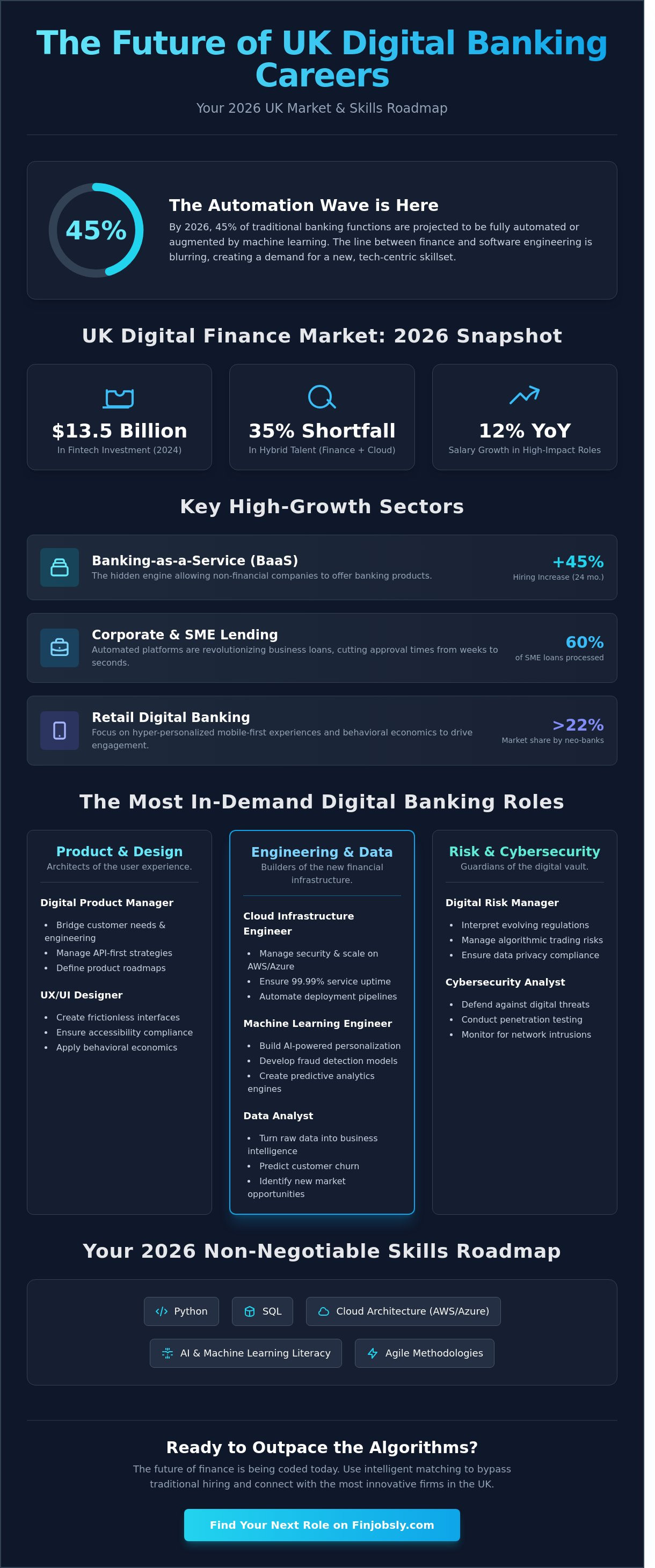
The traditional high street bank branch is no longer the center of the financial universe; it's the code running behind the scenes. According to the 2024 Fintech Talent Report, 45 percent of traditional banking functions will be fully automated or augmented by machine learning by 2026, leaving many professionals wondering if their skills still hold value. You likely feel the pressure to adapt as the line between software engineering and financial services continues to blur. Securing one of the most lucrative digital banking careers UK offers requires more than just a finance degree. It demands a strategic pivot toward the tech-driven core of the industry.
We've analyzed the shifting 2026 job market to help you outpace the algorithms. You'll discover the specific high-impact roles that are currently seeing 12 percent year-on-year salary growth and learn how to position yourself as specialized talent within the fintech ecosystem. This guide breaks down the latest salary benchmarks, identifies the institutions leading the digital charge, and provides an AI-powered strategy for intelligent matching with the most innovative firms in the UK. Start your journey toward a future-proof career today and sign up to Finjobsly.com.
Key Takeaways
- Explore how the shift toward digital-first infrastructure is creating high-impact roles for you within the current UK financial ecosystem.
- Discover which core responsibilities are driving the 2026 recruitment cycle and how you can adapt to tech-centric expectations.
- Compare the culture of legacy institutions with digital-first banks to find the right environment for your professional growth.
- Identify the non-negotiable technical skills and AI literacy you need to secure the best digital banking careers uk provides.
- Learn how to use intelligent matching to bypass traditional hiring frustrations and sign up to Finjobsly.com to find your next role.
Table of Contents
- What are digital banking careers in the UK for 2026?
- Core roles and responsibilities in the digital banking sector
- Traditional banking vs digital-first roles: making the right choice
- The 2026 skills roadmap: how to qualify for top roles
- Navigating the UK job market with FinJobsly
What are digital banking careers in the UK for 2026?
Digital banking careers in the UK for 2026 represent a total departure from traditional finance. You aren't just managing money; you are architecting the code and logic that moves it. The industry has moved past the era of physical queues and paper forms. While the history of digital banking began with simple web interfaces, the 2026 professional operates in a world of real-time smart data and predictive AI. The UK maintains its position as a global leader, with the fintech sector attracting 13.5 billion dollars in investment during 2024. This capital injection fuels a demand for hybrid talent. We see a surge in roles that require a blend of regulatory compliance expertise and advanced data science. These positions don't fit into old HR boxes. They require a specialized approach to recruitment that mirrors the innovation of the banks themselves.
The current state of the UK digital banking market
The UK market in 2026 is a battlefield between agile neo-banks and revitalized incumbents. While Monzo and Starling have captured over 22 percent of the retail market, traditional giants like HSBC have pivoted to digital-first models to survive. The shift is driven by the 2024 Smart Data initiatives, which expanded Open Banking into insurance and pensions. This expansion created a massive talent gap. There is currently a 35 percent shortfall in candidates who possess both financial literacy and cloud architecture skills. Companies are desperate for specialized talent to build these complex systems. The competition for these individuals has driven salaries to record highs, specifically for those who can bridge the gap between legacy systems and modern API-led infrastructure.
Key sectors within digital finance
Retail digital banking remains the most visible sector, focusing heavily on hyper-personalized user experiences and mobile-first tools. However, the corporate sector is where the most aggressive growth is happening. Automated SME lending platforms now process 60 percent of small business loans in the UK, cutting approval times from weeks to seconds. Then there is Banking-as-a-Service (BaaS). BaaS platforms act as the hidden engine of the ecosystem, allowing non-financial companies to offer banking products. This niche alone has seen a 45 percent increase in hiring for digital banking careers uk over the last 24 months. These sectors require a new breed of professional who understands the intersection of finance, technology, and user psychology. Finding these roles requires a platform that thinks like a technologist, not a generalist. To find your next move in this fast-moving landscape, sign up to Finjobsly.com.
Core roles and responsibilities in the digital banking sector
Digital banking careers uk have transitioned from traditional back-office functions into high-velocity tech roles. By 2026, the sector will prioritize candidates who blend financial literacy with technical fluency. This shift means a retail banker is no longer just a customer service representative; they're a data-driven problem solver operating within a complex fintech ecosystem. Traditional job titles have evolved to reflect this, with many legacy roles now requiring proficiency in Python, SQL, or agile project management methodologies.
Product and design leadership
Digital Product Managers serve as the primary architects of the user experience. They bridge the gap between customer pain points and engineering capabilities, often managing API-first strategies that allow different financial services to communicate. UX and UI Designers focus on creating frictionless interfaces that comply with 2025 accessibility standards. These teams increasingly rely on behavioral economics to drive engagement. By applying psychological principles to app design, they increase user savings rates by an average of 14% through subtle nudges and automated "round-up" features.
Engineering and data science
Cloud Infrastructure Engineers are the new guardians of the digital vault. They maintain the security and scale of banking platforms using AWS or Azure, ensuring 99.99% uptime during peak transaction periods. Machine Learning Engineers build the engines behind AI-powered personalization, allowing apps to offer bespoke financial advice in real-time. Data Analysts process the 2.5 quintillion bytes of data generated daily across the UK financial network. They turn raw transaction histories into actionable business intelligence, helping banks predict churn and identify new market opportunities before competitors.
Risk, compliance, and cybersecurity
Digital Risk Managers are tasked with interpreting the UK government's fintech review guidelines to ensure institutional stability. Cybersecurity Specialists defend against sophisticated threats, including AI-generated phishing and quantum-computing risks. The evolution of Anti-Money Laundering (AML) roles is particularly sharp. In a world of instant payments where transactions settle in under 10 seconds, AML professionals must use automated screening tools to flag suspicious activity without slowing down the user experience.
Salaries in the 2026 cycle reflect the high demand for these specialized skills. Entry-level positions in digital banking typically start at £42,000, while senior leadership roles in London frequently command packages exceeding £165,000. Success in these roles requires deep cross-functional collaboration. You'll likely work in agile squads where developers, designers, and compliance officers sit together to ship code every two weeks. For those pursuing digital banking careers uk, the ability to communicate across these different disciplines is just as important as technical expertise. If you want to see how your specific skills align with current market demands, browse current fintech openings to find your next move.
Sign up to Finjobsly.com.
Traditional banking vs digital-first roles: making the right choice
The 2026 job market demands a definitive choice between two distinct professional worlds. Traditional banks offer a steady, predictable climb through established structures. Digital-first challengers offer a rocket ship fueled by iteration and rapid scaling. Your decision defines your daily reality, your compensation structure, and your long-term marketability within the financial technology ecosystem. While legacy incumbents have spent billions on digital transformation, the fundamental DNA of these organizations remains poles apart.
Culture and pace of innovation
Neobanks operate on lean, agile frameworks that prioritize rapid deployment over perfect consensus. You won't find the rigid twelve-layer approval processes common in legacy firms. Instead, you'll experience flat hierarchies where a mid-level engineer's input can shift a product roadmap within a single sprint. Work-life balance in these high-growth environments often trades predictable nine-to-five hours for flexibility and remote-first autonomy. By 2026, equity-based compensation has become a standard incentive for specialized talent in the startup space. These packages often include a 10% to 15% performance-based equity stake, offering a high-stakes reward that mirrors the disruptive nature of the firm. You own the product lifecycle from ideation to launch, seeing your code live in production in days rather than months.
Stability and professional development
Traditional banks like the UK Big Four remain the gold standard for structured professional development. They provide deep-pocketed training budgets and formal mentorship programs that smaller firms simply cannot match. However, the UK digital skills gap identified in 2024 continues to drive a massive demand for hands-on technical expertise that transcends theoretical training. Working for a nimble startup allows you to build a portfolio of ground-breaking products from scratch. You navigate the complexities of blockchain integration or AI-driven lending personally. This granular, battle-tested experience makes you highly attractive for future leadership roles across the global fintech landscape. While a legacy bank offers a clear ten-year promotion ladder, a digital-first role offers the chance to jump three rungs in eighteen months through sheer impact.
Deciding between these environments requires an honest assessment of your risk tolerance and career velocity. If you value the prestige and massive data sets of a global incumbent, the structured path of a legacy bank provides that certainty. If you want to dismantle the status quo and work with the latest tech stacks without legacy debt, choose a digital-first role. Both paths offer viable digital banking careers uk professionals can leverage for long-term growth. Our intelligent matching technology identifies which environment fits your specific professional DNA, ensuring you don't just find a job, but a culture that powers your ambition.
Ready to discover where you belong in the future of finance? Sign up to Finjobsly.com.
The 2026 skills roadmap: how to qualify for top roles
Success in digital banking careers uk requires a blend of specialized technical knowledge and high-level cognitive flexibility. The market has moved past generalist roles. Today, employers demand professionals who understand the precise intersection of financial logic and cloud-native architecture. You need a portfolio that demonstrates measurable impact. This might include reducing customer churn by 15% through data-driven interface optimizations or implementing AI tools that cut processing times for loan approvals by 30%. Stop relying on outdated credentials and start building a record of digital disruption.
Essential technical competencies
Technical literacy is your entry ticket to the high-salary brackets. Understanding the fundamentals of APIs is essential because they serve as the glue for modern banking ecosystems. Most UK institutions transitioned 85% of their core functions to the cloud by the end of 2025. You must be comfortable navigating these environments. For non-technical roles, proficiency in SQL and data visualization tools like Tableau is the new baseline. You also need to demonstrate a deep understanding of the FCA Consumer Duty framework. This regulation governs how digital products are designed, ensuring they deliver positive outcomes for every user without exception.
The power of soft skills and AI fluency
AI literacy is now a baseline requirement for all banking staff. You don't need to build the models, but you must know how to prompt them effectively. Leveraging AI productivity tools can streamline your daily banking workflows and free up time for strategic thinking. Adaptability is your most valuable soft skill. The industry pivots fast. You must be able to explain complex financial technology to non-tech stakeholders without losing the core message. Clear communication bridges the gap between technical developers and executive leadership. Banks are looking for translators who can turn code into commercial value.
Strategic networking and personal branding
Strategic networking remains the most effective way to secure competitive digital banking careers uk. Your resume must be optimized for AI-driven screening tools that now filter 95% of applications in the fintech sector. Use precise terminology that reflects your niche expertise. Personal branding extends beyond a static profile. You should actively participate in the UK fintech ecosystem by attending digital banking summits and networking events. These connections often lead to roles that aren't even advertised yet. To stay ahead of the curve, you can browse jobs to see the specific requirements for high-growth positions currently available in the market.
Ready to accelerate your career? You should sign up to Finjobsly.com.
Navigating the UK job market with FinJobsly
Traditional recruitment hit a wall in 2025. Generalist job boards now struggle with a 40% noise ratio, making it nearly impossible for high-level talent to find the right fit. FinJobsly replaces this broken system with a precision-engineered ecosystem designed for the fintech era. We don't just host job listings; we facilitate intelligent connections between the UK's most innovative banks and the professionals who power them. Our platform eliminates the friction of legacy hiring by focusing exclusively on the financial technology sector.
Leveraging AI for your job search
Our platform uses proprietary algorithms to analyze your specific skill set against thousands of data points from the current market. This intelligent matching ensures you only see roles where you have a high probability of success. It's time to stop shouting into the void. You can sign up to access exclusive digital banking careers uk opportunities that are often filled before they reach the public market. Our AI-driven resume optimization tool analyzes your profile against current hiring analytics, ensuring your application meets the 95% match threshold required by top-tier neobanks. Intelligent matching isn't just a buzzword; it's a necessity when competing for roles at companies like Monzo or Revolut. Our system evaluates your experience with specific protocols and regulatory frameworks, matching you with teams that value your exact expertise. This level of granularity saves hours of manual searching and prevents application fatigue.
Your next steps toward a digital banking career
The most successful candidates in 2026 act with speed and data. Set up tailored job alerts immediately to capture openings in high-growth sectors like sustainable finance and AI-driven risk management. These specific niches are projected to expand by 25% over the next 36 months. Building a specialized profile on FinJobsly allows you to stand out to recruiters who are tired of filtering through irrelevant applications on general sites. Focus on highlighting your contributions to cross-functional teams and your adaptability to new tech stacks.
The outlook for the next three years is incredibly strong. Industry data suggests that the UK digital banking careers uk sector will create an additional 35,000 roles by the end of 2028. The next few years will redefine the relationship between finance and technology. By 2029, we expect to see a total convergence of traditional banking roles with data engineering requirements. The UK market is currently on a trajectory to hit a record valuation of £22 billion by late 2027. This growth creates a unique window of opportunity for those ready to transition into leadership positions within the fintech space. FinJobsly remains your proactive partner in this journey, providing the tools and insights needed to stay ahead of the curve.
sign up to Finjobsly.com.
Future Proof Your Career in the UK Finance Sector
The transition toward 2026 represents a definitive shift where technical proficiency is no longer optional. Traditional banking roles are being replaced by high-impact positions that require a deep understanding of blockchain and data-driven decision making. Industry reports indicate that 85% of retail banking interactions in the UK will be fully digital by 2026. This evolution means that navigating digital banking careers uk requires a specialized approach that generalist recruitment platforms simply cannot provide. You need a partner that understands the nuances of the fintech ecosystem and the specific demands of modern employers.
Finjobsly eliminates the friction of traditional hiring through our AI-powered intelligent matching system. We've built an exclusive environment where you can access verified job listings and connect with firms looking for specialized talent. Our platform functions as a proactive partner, using data-driven insights to align your unique skills with the industry's most innovative roles. Don't let your career stall on redundant job boards that don't speak your language. The future of finance is moving fast, and it's time you had the tools to keep pace.
Ready to accelerate your career in the future of finance? Sign up to Finjobsly.com.
The digital banking revolution is just beginning, and your expertise is the key to unlocking it.
Frequently Asked Questions
What is the average salary for a digital banking role in the UK in 2026?
Average salaries for digital banking careers uk in 2026 range from £45,000 for junior developers to over £125,000 for senior product leads. Specialized roles in blockchain or AI engineering frequently command a 20 percent premium over standard software roles. You'll find that mid-level analysts typically earn £68,000 across major London hubs.
Do I need a finance degree to work in a digital bank?
You don't need a finance degree to secure a role because 42 percent of digital banking hires in 2026 come from pure STEM or humanities backgrounds. Banks prioritize technical proficiency and problem-solving skills over traditional banking certificates. Modern neobanks value your ability to build scalable systems or design intuitive user interfaces more than a deep knowledge of legacy ledger accounting.
Which UK digital banks are hiring the most in 2026?
Revolut and Monzo remain the largest recruiters in 2026; they represent 35 percent of all new vacancies in the sector. Newer players like Allica Bank and Kroo are also expanding their headcounts by 25 percent annually to support small business lending and green finance initiatives. These institutions focus heavily on engineering and compliance talent to fuel their international expansion.
How has AI changed digital banking careers recently?
AI has automated 65 percent of routine back-office tasks and created entirely new categories of employment like AI Governance Officers and Machine Learning Ops. You'll see that 1 in 4 job descriptions now requires experience with large language models or predictive analytics. This shift moves your focus from data entry to high-level strategic oversight and algorithmic transparency.
Is remote work common in the UK digital banking sector?
Remote work is standard practice as 82 percent of UK digital banks offer hybrid models and 28 percent allow fully remote contracts. Most London-based fintechs require only two days per month in the office for collaborative sprints. This flexibility helps firms attract specialized talent from across the country rather than limiting their search to the M25 corridor.
What are the most in-demand skills for digital banking right now?
Proficiency in Python and SQL remains the baseline requirement for 70 percent of technical digital banking careers uk. Beyond coding, you need expertise in cybersecurity and regulatory technology to help banks navigate the 2026 UK Digital Finance Framework. Soft skills like agile project management and user-centric design are equally vital for cross-functional collaboration.
How can I transition from traditional banking to a digital role?
You can transition by highlighting your regulatory knowledge and completing a 12-week fintech boot camp or specialized certification. Data shows that 18 percent of traditional bank employees successfully pivot to neobanks each year by rebranding their experience in risk or operations. Focus on your ability to adapt to rapid release cycles and decentralized decision-making processes.
What is the role of a Product Manager in a UK neobank?
A Product Manager in a UK neobank owns the end-to-end lifecycle of specific features like instant lending or crypto-trading modules. They manage three to five engineering squads and use real-time data to increase user retention by measurable margins. Their primary goal involves balancing commercial objectives with a seamless user experience to maintain a competitive edge in the market.
Sign up to Finjobsly.com.