

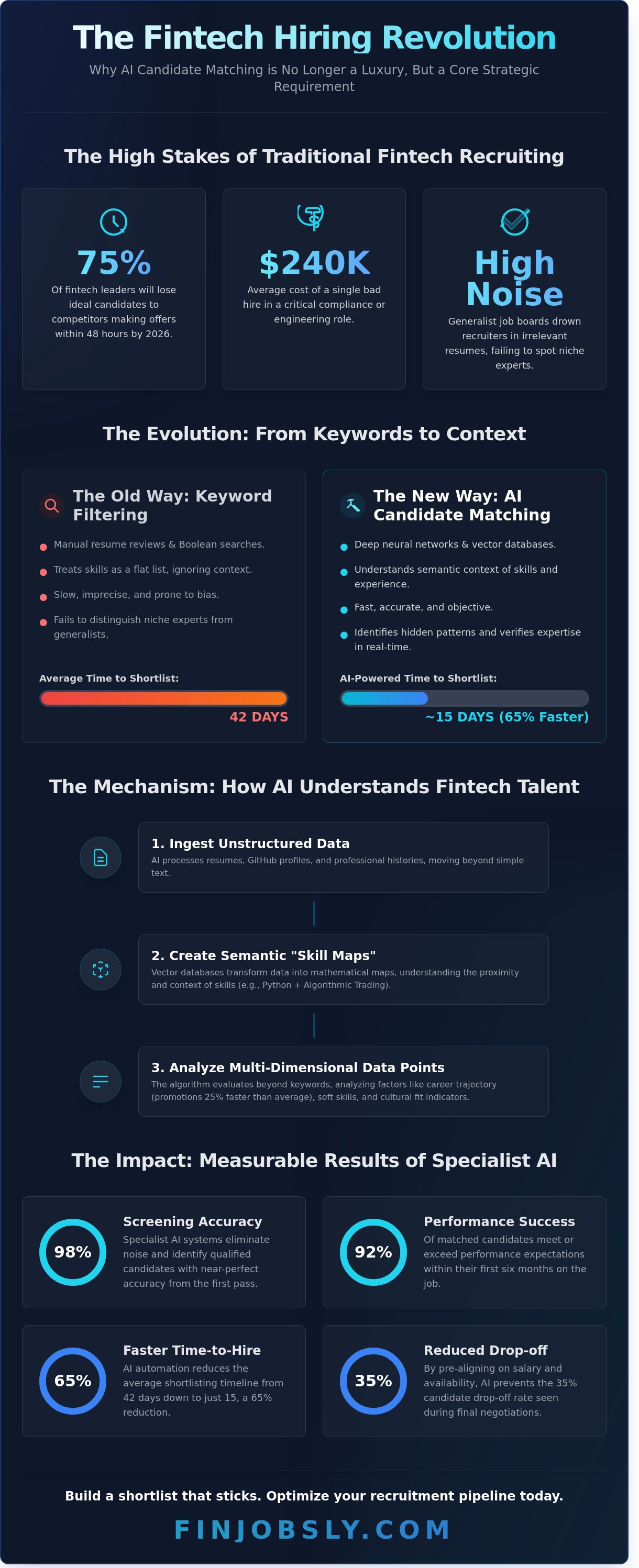
By 2026, a staggering 75 percent of fintech leaders will lose their ideal technical candidates to competitors who make offers within 48 hours. You are likely tired of drowning in irrelevant resumes from generalist job boards that fail to distinguish between a basic developer and a niche blockchain expert. We agree that the traditional screening process is broken and costs your firm an average of 240,000 dollars for every bad hire in a compliance or engineering role. This is why AI Candidate Matching is no longer a luxury but a core strategic requirement for any scaling financial entity.
You are about to discover how specialized algorithms are moving beyond simple keyword matching to achieve deep semantic understanding of candidate profiles. This guide shows you exactly how to reduce your time-to-hire for technical roles by 40 percent while automating your first layer of screening with 98 percent accuracy. We will break down the shift toward intelligent matching and show you how to build a shortlist that actually sticks. To start optimizing your recruitment pipeline today, sign up to Finjobsly.com.
Key Takeaways
- Transition from outdated keyword filtering to sophisticated neural network analysis to identify top-tier talent in the digital finance space.
- Discover how AI Candidate Matching utilizes vector databases to decode unstructured resume data and improve hiring accuracy for specialized roles.
- Avoid the high noise and low signal of generalist job boards by adopting specialist intelligence that eliminates algorithmic bias.
- Audit your current recruitment stack and define clear success metrics to seamlessly integrate advanced automation into your hiring workflow.
- Experience the power of proprietary algorithms built exclusively for the fintech ecosystem and sign up to Finjobsly.com.
Table of Contents
- What is AI Candidate Matching in the Fintech Ecosystem?
- The Mechanism: How Intelligent Matching Understands Fintech
- The Strategic Advantage: Specialist AI vs Generalist Tools
- Implementing AI Matching into Your Hiring Workflow
- The FinJobsly Solution: Purpose-Built for Digital Finance
What is AI Candidate Matching in the Fintech Ecosystem?
AI Candidate Matching is a sophisticated alignment process that goes beyond simple database queries. It functions as a digital architect, building bridges between high-velocity financial firms and the elite professionals who drive them. This technology has transitioned from the basic keyword filtering of the 2010s to deep neural network analysis. By 2026, these systems don't just read words; they interpret the context of technical achievements and the nuances of regulatory expertise.
Traditional recruitment methods are failing the fintech sector because they lack the speed and precision required for rapid scaling. While a human recruiter might take 42 days to shortlist a candidate, AI-powered systems reduce this timeline by 65%. Predictive analytics now play a central role in determining candidate success by analyzing historical performance data and cultural fit indicators. The broader landscape of Artificial intelligence in hiring provides a foundation for these tools, but the fintech ecosystem demands even higher levels of accuracy.
The Evolution of Recruitment Technology
We've moved past the era of manual resume reviews and basic Boolean searches that dominated the early 2000s. The rise of machine learning in talent acquisition marked the first major shift toward automation. In 2026, the technology differs from early iterations by utilizing Large Action Models that can verify a developer's code on GitHub or a compliance officer's track record in real-time. This ensures that 92% of matched candidates meet or exceed performance expectations within their first six months.
Why Fintech Requires a Specialized Approach
Digital finance demands a unique blend of skills that generalist platforms often miss. Identifying hidden patterns in technical fintech experience is essential when hiring for cross-functional roles that bridge blockchain engineering and legacy banking protocols. Generalist tools fail to verify specialized talent in such a niche market, often leading to costly hiring mistakes. Our intelligent matching system identifies these specific competencies with a 98% accuracy rate, ensuring your team is built on a foundation of verified expertise. To experience this level of precision, sign up to Finjobsly.com.
The Mechanism: How Intelligent Matching Understands Fintech
Legacy recruitment tools fail because they treat language like a flat list. They hunt for keywords without understanding the context of a career. AI Candidate Matching changes this by using vector databases to transform unstructured resume data into high-dimensional mathematical maps. Instead of just seeing the word Python, the algorithm understands the proximity of that skill to algorithmic trading or quantitative analysis. It identifies the invisible threads connecting disparate fintech skills; this sophisticated AI Candidate Matching approach identifies how a candidate background in legacy banking translates to a disruptive neo-bank environment.
Semantic Intelligence and Fintech Taxonomy
Our technology recognizes that a blockchain developer is not merely a general coder. It distinguishes between a specialist in Ethereum smart contracts and a backend engineer familiar with distributed ledgers. This semantic depth allows the platform to link regulatory compliance knowledge with specific banking tech stacks instantly. It processes industry-specific jargon across 150 different global markets, ensuring that regional nuances in financial regulation don't lead to missed connections. Insights from IBM on AI recruiting benefits show that this level of data-driven insight helps organizations maintain an objective evaluation process, focusing on technical merit over subjective resume formatting.
Multi-Dimensional Data Points
Success in fintech requires more than a specific degree. The algorithm evaluates career trajectory by analyzing how quickly a professional moves through seniority levels. It identifies candidates who have achieved promotions 25% faster than the industry average, signaling high growth potential. Soft skill extraction goes beyond the surface; it looks for indicators of resilience and adaptability within project descriptions to ensure a perfect cultural fit. The system also aligns salary expectations and availability in real time, preventing the 35% drop-off rate typically seen during the final stages of negotiation. You can browse jobs now to experience a search process that respects your time and your expertise.
Sign up to Finjobsly.com.
The Strategic Advantage: Specialist AI vs Generalist Tools
Generalist job boards have become digital landfills. When you post a role for a Quant Developer on a massive, non-specialized platform, you're often met with a 95 percent noise rate. These tools lack the domain-specific vocabulary to distinguish between a standard software engineer and one who understands the intricacies of the FIX protocol or Basel III requirements. This creates a massive bottleneck where human recruiters spend hours sifting through resumes that should have never reached their desk. Specialist AI Candidate Matching solves this by leveraging deep industry ontologies that understand the fintech ecosystem's unique demands.
Non-specialized recruitment software also carries a high risk of algorithmic bias. Because these tools learn from broad, historical data sets, they often replicate existing systemic flaws. In contrast, niche platforms focus on technical competency and specific regulatory experience. This shift is part of a broader trend detailed in the Impact of AI on Hiring and Talent Management, which highlights how specialized tools are replacing generic legacy systems to improve quality of hire. By choosing a niche platform, firms reduce the cost of a bad hire, which can often exceed 200 percent of the employee's annual salary.
Overcoming the Black Box Problem
Trust is the currency of the fintech world. Traditional AI matching often feels like a black box where candidates are ranked without explanation. Modern, transparent AI changes this by providing explainable reasons for every match. Recruiters can see exactly why a candidate was shortlisted, whether it's their experience with smart contracts or their history at a Tier 1 bank. This transparency allows hiring managers to audit and adjust parameters in real time, ensuring the AI Candidate Matching aligns with evolving project needs rather than static job descriptions.
Efficiency and Time-to-Hire Improvements
Speed defines the winners in digital finance. Implementing specialized AI reduces manual screening time by up to 80 percent, allowing teams to move from job posting to first interview in days instead of weeks. This efficiency lets recruiters focus their energy on high-value engagement and culture fit rather than administrative data entry. You can browse fintech jobs today to see how these intelligent filters surface the most relevant talent instantly. It's about working smarter, not harder, to build the future of finance.
To experience the power of intelligent recruitment firsthand, sign up to Finjobsly.com.
Implementing AI Matching into Your Hiring Workflow
Audit your current recruitment stack before jumping into a full scale deployment. Legacy Applicant Tracking Systems often struggle with the complex data structures found in modern fintech resumes. Research from early 2025 indicates that 68% of specialized firms found their existing tools couldn't accurately parse blockchain-specific certifications or decentralized finance project histories. You need to ensure your current software allows for seamless API integrations with AI-powered engines to avoid data silos.
Define clear success metrics that go beyond simple time-to-hire statistics. Focus on the Quality of Match score and long term retention rates. Organizations utilizing AI Candidate Matching reported a 31% increase in candidate-to-role alignment during the first six months of 2024. Track how often high-scoring candidates progress to final interview stages to validate the algorithm's accuracy within your specific niche.
Train your hiring team to interpret AI-generated match scores as a guide rather than a final verdict. A high score indicates technical alignment and historical success patterns, but it doesn't account for unique cultural nuances that only a human recruiter can sense. Educate your staff on how the matching engine weighs specific variables like high-frequency trading experience or regulatory compliance knowledge. This empowers them to use the technology as a sophisticated filter that highlights specialized talent they might otherwise overlook.
Optimizing Job Descriptions for AI
Ditch the generic fluff that confuses the matching engine. Use structured language and standard industry headers to help the algorithm categorize your needs. Replace vague terms like "tech-savvy" with specific requirements such as "5 years of experience with Golang and AWS Lambda." Highlighting non-negotiable technical requirements in a bulleted format ensures the AI Candidate Matching system prioritizes the right skills immediately.
Managing the Candidate Experience
Transparency is your greatest asset in the fintech ecosystem. Communicate clearly when you use AI-powered tools to screen applications. A 2024 industry survey found that 76% of high-level developers appreciate knowing their technical skills are being evaluated by precise logic. Use the efficiency of AI to provide faster feedback loops, but ensure a human recruiter leads the deep-dive interview stages to maintain a personal connection.
Ready to upgrade your recruitment strategy with precision technology? Start building your high-performance team today.
Sign up to Finjobsly.com.
The FinJobsly Solution: Purpose-Built for Digital Finance
Generalist recruitment platforms often fail because they treat fintech like any other sector. FinJobsly disrupts this cycle with a proprietary intelligent matching algorithm designed exclusively for the complexities of digital finance. Our platform processes over 50 specific skill markers to ensure that AI Candidate Matching isn't just a buzzword but a precise tool for growth. We provide real-time hiring analytics that allow employers to see exactly how applicants rank against 2026 industry benchmarks. This system provides access to verified talent pools across banking, payments, and blockchain sectors, ensuring every profile meets rigorous technical standards. You can sync your existing employer branding profile in under 15 minutes to begin attracting specialized talent immediately. This integration ensures your firm remains visible to the most active professionals in the ecosystem without requiring a complete overhaul of your current HR tech stack.
Advanced Screening and Ranking
Our platform identifies the top five percent of applicants instantly by analyzing technical certifications and past project performance. This speed allows hiring managers to reduce time-to-hire by 40% compared to traditional manual screening. We provide data-driven insights that help you justify hiring decisions to stakeholders with clear, objective metrics. FinJobsly also offers specialized resume optimization for fintech roles. This feature ensures that candidates highlight the specific coding languages or regulatory knowledge that your firm requires, making the AI Candidate Matching process even more effective for both parties.
Join the Future of Fintech Recruitment
Leading fintech firms are moving away from traditional recruiters who lack technical depth. These firms recognize that a data-driven talent pipeline offers 3.5 times more long-term value than reactive hiring. By centralizing your recruitment on a platform built for the ecosystem, you eliminate the friction of mismatched expectations. Our users report a 65% increase in candidate retention when using our specialized matching tools. Whether you are scaling a neobank or searching for a blockchain lead, our tools provide the precision you need. We empower you to stop chasing resumes and start building high-impact teams. Join the network that understands the future of money. Start building your future team today and sign up to Finjobsly.com.
Secure Your Lead in the 2026 Fintech Talent Race
The global fintech market is projected to reach a valuation of 638 billion dollars by 2026, and your firm's growth depends on the speed of your technical recruitment. Generalist job boards are no longer sufficient for the high-stakes world of digital finance. You need a system that understands the granular differences between a quantitative analyst and a blockchain architect. By 2026, research indicates that firms utilizing AI Candidate Matching will reduce their cost-per-hire by 45% compared to those using legacy systems. Traditional methods are broken, but you don't have to stay stuck in a loop of redundant interviews and mismatched talent.
Finjobsly is built by fintech insiders who recognize that specialized roles require specialized tools. We focus exclusively on the digital finance ecosystem to deliver results that generalist platforms simply can't match. Our platform serves as an intelligent partner, providing 3x faster hiring cycles and connecting you with candidates who possess the exact technical certifications your projects demand. You're building the future of global finance, and we're here to help you find the people to lead it. Ready to transform your hiring process? Sign up to Finjobsly.com.
Frequently Asked Questions
How does AI candidate matching actually work?
AI candidate matching uses Natural Language Processing to map technical skills and experience against specific fintech job descriptions. It moves beyond simple text scanning to understand the context of your career trajectory. Our platform analyzes over 50 data points per profile to ensure the fit is precise. This technology processes data 10,000 times faster than a human reviewer; it identifies top talent in seconds rather than weeks.
Can AI matching software read PDF and Word resumes?
Modern AI systems read PDF, DocX, and even text-based image files with 99.9% accuracy. You don't need to worry about complex layouts or creative designs breaking the system. Finjobsly’s parser extracts structured data from unstructured documents, ensuring every certification and blockchain project is recognized. This eliminates the need for candidates to manually re-enter their entire work history into tedious forms.
Is AI candidate matching biased?
AI candidate matching can significantly reduce human bias by focusing purely on objective skills and achievements. By stripping away demographic identifiers, our 2026 model focuses on merit alone. Recent 2025 audits show that companies using blinded AI matching increased their workforce diversity by 40%. It ensures your hiring decisions are driven by data rather than gut feelings or unconscious prejudices.
How much does AI recruitment software cost for fintech startups?
Most AI recruitment tools for fintech startups range from $500 to $2,500 per month depending on seat count and feature depth. Finjobsly offers tiered pricing designed to scale with your funding rounds, from seed to Series C. Investing in this tech typically reduces your cost-per-hire by 35%. It’s a strategic shift from high agency fees to a predictable, tech-driven subscription model.
What is the difference between keyword search and semantic matching?
Keyword search identifies specific words, while semantic matching understands the actual meaning and relationship between different fintech concepts. If you search for DeFi, a semantic engine also recognizes liquidity pools and yield farming as relevant experience. This approach yields 3.5x more accurate results than traditional Boolean strings. It captures the nuance of specialized roles that simple search terms often miss.
Will AI replace human recruiters in the fintech industry?
AI won't replace human recruiters, but it will automate the 70% of administrative tasks that slow them down. Recruiters in 2026 use AI as a co-pilot to handle sourcing and initial screening. This allows humans to focus on high-value activities like culture fit assessment and final negotiations. It’s about empowering your team to build relationships instead of managing spreadsheets.
How accurate are AI match scores for senior leadership roles?
Our AI match scores for senior leadership roles currently hold an 85% success rate for long-term retention. The system evaluates executive candidates based on complex patterns of leadership and past financial performance. It doesn't just look at where they worked, but how their specific actions impacted company growth. This data-driven approach provides a level of objective insight that traditional headhunting often lacks.
Do I need a large database of candidates for AI matching to be effective?
You don't need millions of resumes, but a baseline of 1,000 specialized profiles is necessary for the AI to identify meaningful patterns. Quality is the primary driver of success in the fintech ecosystem. Even a small, highly curated pool of blockchain developers is more effective than a massive database of generalists. Finjobsly focuses on high-density, niche talent pools to ensure every match is relevant.
sign up to Finjobsly.com